
Resources
Explore a wide range of valuable resources on GCED to deepen your understanding and enhance your research, advocacy, teaching, and learning.
2,668 Results found
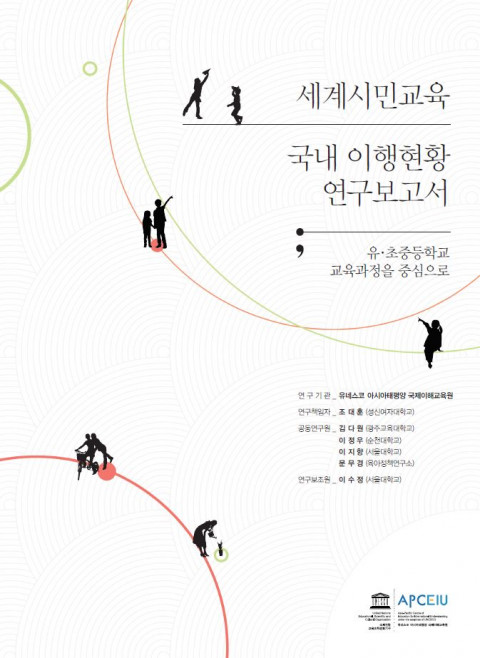 세계시민교육 국내 이행현황 연구보고서: 유·초중등학교 교육과정을 중심으로 Year of publication: 2018 Corporate author: 유네스코 아시아태평양 국제이해교육원 “세계시민교육 국내 이행현황 연구보고서 - 유·초중등학교 교육과정을 중심으로”가 발간되었다. 본 연구보고서는 세계시민교육의 실행과 성과에 대한 국가 수준의 모니터링 및 평가 연구가 희소하다는 문제의식에 기초하여 작성된 결과물이다. 특히, 국내 17개 시·도교육청 산하 유치원, 초·중·고등학교 교육과정 활동에서 세계시민의 개념이 어떻게 반영 및 실행되고 있는지를 살펴보기 위하여 탐색적 연구를 설계하고 관련 자료 조사를 실시하는데 주안점을 두었다. 또한 연구조사 결과를 토대로 동 보고서는 향후 세계시민교육이 교육현장에서 보다 명확하게 이행되고 확산될 수 있도록 하는 정책적 제언도 담고 있다.
 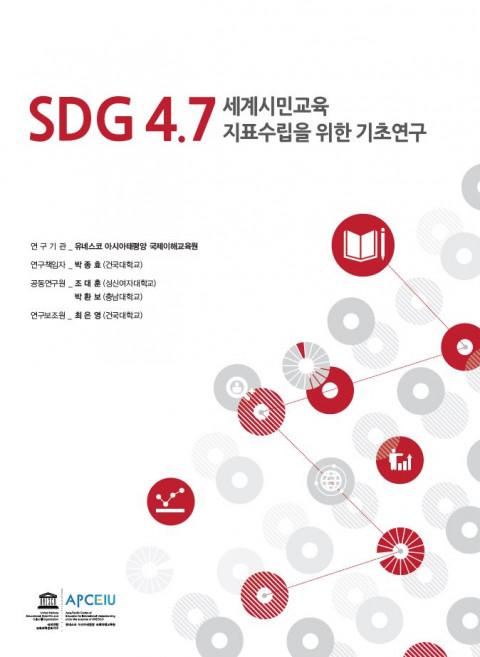 SDG 4.7: 세계시민교육 지표수립을 위한 기초연구 Year of publication: 2018 Corporate author: 유네스코 아시아태평양 국제이해교육원 “SDG 4.7 세계시민교육 지표수립을 위한 기초연구 보고서”가 발간되었다. 본 연구보고서는 국제적으로 합의된 글로벌 지표의 부재로 현재까지 정의가 완료되지 않은 지속가능발전목표 (SDG) 4.7 지표 개발을 위한 기초 연구이다. 즉, 동 보고서는 세계시민교육 및 SDG 4.7 지표에 관한 기존의 국내·외 연구결과를 종합적으로 검토하여 글로벌 지표에 관한 주요 논의를 정리하고, 국내 지표 개발을 위한 함의를 도출하는 데에 목적을 두고 있다. 이를 위하여 유네스코 통계원 (UIS)의 최신 SDG 4.7.1 메타데이터 연구와 국내·외 연구결과에 기초하여 국내에서 활용할 수 있는 정보와 데이터를 검토하고 있다.
 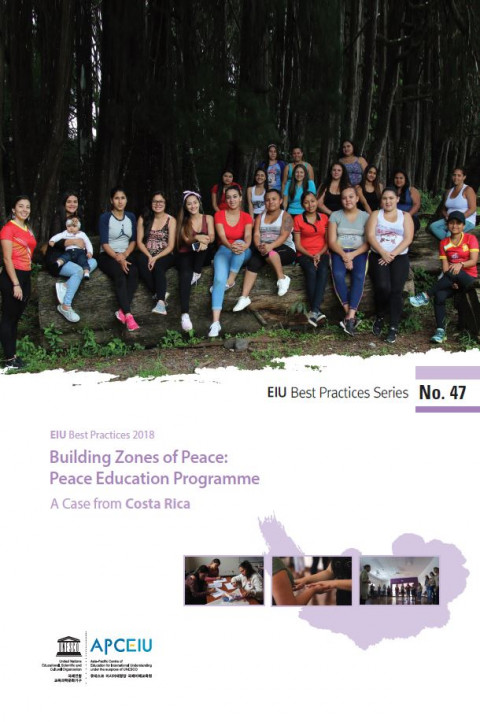 EIU Best Practices Series No. 47: Building Zones of Peace: Peace Education Programme; A Case from Costa Rica Year of publication: 2018 Corporate author: APCEIU Building Zones of Peace (BZP) is a non-formal peace and global citizen education programme created to promote peace and prevent violence in vulnerable urban communities in Costa Rica. The programme aims to encourage participants to develop a critical view of their contexts and explore different ways of taking action to transform the world we live in, and by recognizing how individual and collective efforts have a positive and direct impact in our personal, family and community spheres as well as nationally and globally.In 2017, BZP was conducted to a group of secondary education students ages 13 to 17. This year (2018), participants are young women, ages 18 to 22, all of the mothers who live in extreme poverty. These women have been selected by a governmental office whose aim is to reduce poverty by empowering them. Several resources and networks of support have been created in different areas such as health, employment, childcare and education to achieve this goal. In this sense, our programme was chosen to contribute significantly in this process.
 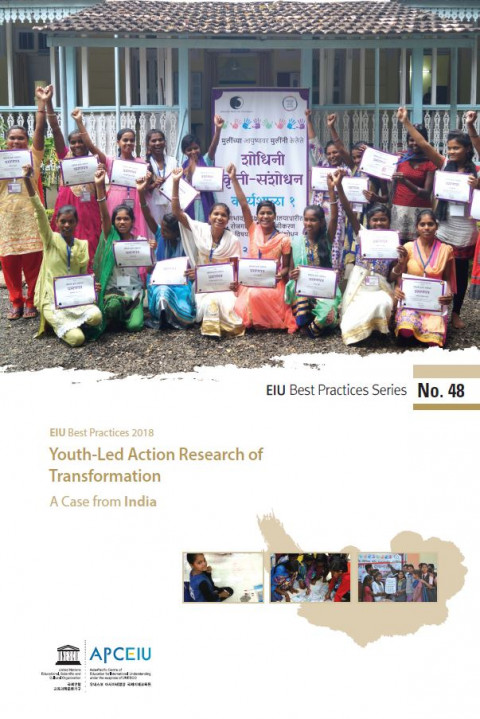 EIU Best Practices Series No. 48: Youth-Led Action Research of Transformation; A Case from India Year of publication: 2018 Corporate author: APCEIU This action research project is about the education for livelihood and life skills of marginalized young girls. This project was based from my experience in the Youth-Led Action Research Project organized by ASPBAE and UNESCO Institute of Lifelong Learning (UIL), which gradually led to the conception of the present action research project for the empowerment of the marginalized rural girls suppressed by patriarchal social systems. The Shodhinis are the subjects and objects of this action research. A hundred girls from ten villages conducted action research on the topics of gender, education, livelihood and life skills to young marginalized young girls aged between 14 to 25 years old in their respective communities. The Shodhinis discovered the joys of learning as they took positive steps in discovering and empowering themselves. The research enabled them to conduct various research methods like census and in-depth surveys of their fellow girls in their villages. As part of the research process, the girls also drew up a community map to understand their village. The relevance of this project to GCED values cannot be overemphasized especially in developing the cognitive, emotional and the behavioral dimensions of the girls themselves.This project not only focuses on analyzing the findings derived from the gathered data but also on generating action based on the data. It helped improve the way Shodhinis looked at themselves, their families, and their communities, inspiring them to become agents of change in their own lives as well as those of other girls in their villages. By amplifying their voices and opinions in the decision making processes at the family and community levels – for instance, by lobbying for the construction of libraries – the Shodhinis were able to demonstrate their leadership skills in shaping the development of their villages, thereby enhancing their dignity and self-worth.
 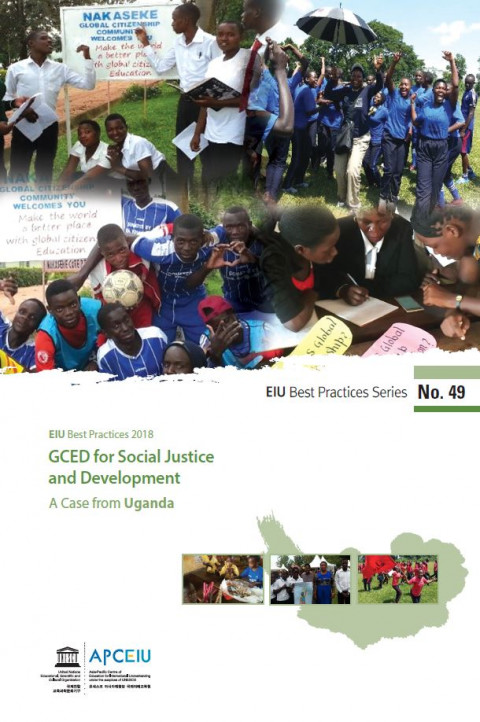 EIU Best Practices Series No. 49: GCED for Social Justice and Development; A Case from Uganda Year of publication: 2018 Corporate author: APCEIU Creating a peaceful, trusting and supportive learning environment is a strong driver for a nation’s sustainable development. Any society whose citizens have no cognitive, socio-emotional and behavioral values like respect for self and humanity, is doomed for chaos. The concepts of Education for International Understanding(EIU) and Global Citizenship Education(GCED) in this programme emerge from the need for harmonious living in the society. Sustainable human and economic development is built upon the successful dissemination and implementation of EIU/GCED practices. To understand this better, let’s use the analogy of a bird that gains its momentum to fly from its feet, lungs and wings.The contributor uses this analogy to illustrate that EIU/GCED is the foundation that exerts momentum for social development.The contributor saw it necessary that for any sustainable development to flourish in Ugandan society, pragmatic values have to be perfectly blended with public awareness for they serve as the foundation of all economic, social, cultural and political efforts. The national value system should be based on a strong foundation on which all national efforts are rooted. The social aspirations of the citizens should be the ones that propel development needs and national priorities.To effect sustainable development, we need to see schools as strategic intervention points. Recent times have, however, witnessed that the level of discipline and value inculcation gradually declined to near extinction. The distortion of the social setting that inculcated the ethical values in the young generation has called for a need to remedy the gap. The EIU/GCED is strategically tailored to inculcate Table of Contents moral principles and values in the children through the direct contact and support of the teachers of Early Childhood Development (ECD), both primary and postprimary levels.The Nakaseke Core Primary Teachers’ College (PTC) is mandated to mainstream and promote the social uprightness of the community being a primary stakeholder in the integration of EIU/GCED in the Ugandan Primary Schools (PS) and Primary Teachers Education (PTE) Curriculum. Consequently, the training programmes were designed to enhance the capacity of PTC’s administrators, tutors and support staff, pre-service student teachers, district education officers and primary school teachers to inculcate the EIU/GCED moral values and principles among the learners. Students are then expected to apply EIU/GCED principles to their families and communities, and uphold the values of integrity, honesty, justice, responsibility, respect for humanity, hard work, unity and creativity.
  A Study on the Status of Implementation of Global Citizenship Education in Lifelong Education in South Korea Year of publication: 2019 Corporate author: APCEIU The Asia-Pacific Centre of Education for International Understanding published a report titled "A Study on the Status of Implementation of Global Citizenship Education in Lifelong Education in South Korea". In the recognition of the need for an analysis on the status of implementation for the effective and systematic implementation of Global Citizenship Education (GCED) in the Republic of Korea, APCEIU conducted a study on the status of the implementation of GCED embedded in the curriculum of primary and secondary schools in 2018. As a follow-up study, this research paper examines the practice of civic education in the field of lifelong learning for adults and the formation, status and implementation process of GCED in which it appears and explores the potential for activation.
 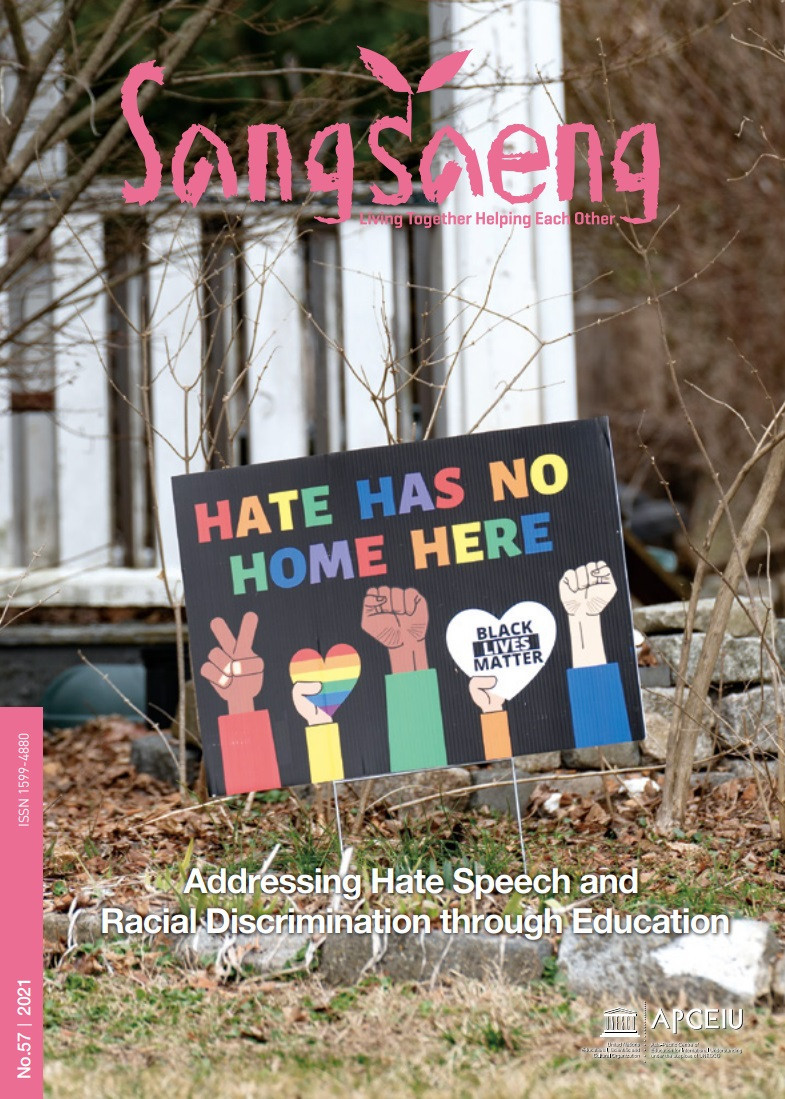 Addressing Hate Speech and Racial Discrimination through Education (SangSaeng no.57, 2021) Year of publication: 2023 Corporate author: APCEIU Today, humanity is faced with various multifaceted challenges such as climate change, increasing inequality, hate speech and racial discrimination. Moreover, the COVID-19 pandemic has crudely manifested those problems and further highlighted the acute need for concerted efforts to address them. In this context, SangSaeng No. 57 focuses on “Addressing Hate Speech and Racial Discrimination through Education” to provide readers with opportunities to reflect on these salient issues. Contents 03 Editor’s Note 04 Special ColumnFrom Hatred to Reconciliation - Learning from Rwanda / Freddy Mutanguha 08 FOCUS: Addressing Hate Speech and Racial Discrimination through Education08 Confronting Hate Speech - Thoughts, Challenges, Proposals from Educational Perspective / Gabriela Martini Armengol12 Missing Link in Global Citizenship Education – Taking into Account Identities, Alterities and Citizenships Hurt by Systemic and Chronic Racism / Gina Thesee16 Moving from Hate and Discrimination to Greater Humanity – Increasing Need for Empathy Education / Pat Dolan19 But What Can I Do? - Educational Responses to Hate Speech / Felisa Tibbitts 23 Best Practices23 Learning Democracy at Utoya - Young People’s Response to Hate and Extremism / Ingrid Aspelund26 Combatting Hate Speech – Experiences and Lessons from South Sudan / Marina Modi 29 Special Report29 Setting out Priorities for Addressing Hate Speech Through Educationt - Highlights of the Multi-Stakeholder Forum and Global Education Ministers Conference on Addressing Hate Speech through Education / UNESCO 32 Call for Global Action towards Transforming the World through Education - Highlights of the 5th UNESCO Forum on Transformative Education / APCEIU and UNESCO 35 Story TimeGrandfather’s Funeral / Sudipa Charkraverty 38 Peace in My MemoryPeace Turned into Pain / An anonymous contributor from Afghanistan 42 Understanding the Asia and the PacificMha Puja, Practicing Respect / Sharareh Bajracharya and Sanjeev Maharjan 45 Youth Network Youth Tackling Hate Speech and Racial Discrimination / GCED Youth Network Core Team 48 LetterReflections on Hate Speech and GCED / Sengpapah Holanouphab 50 APCEIU in Action
  21세기 대전환 시대 대학이 나아갈 길: 변혁 역량을 키워주는 세계시민교육 Year of publication: 2023 Author: 강경희 | 김윤철 | 김형숙 | 박순용 | 장준호 | 최윤정 | 한경희 Corporate author: 유네스코 아시아태평양 국제이해교육원 이 책은 대학에서 세계시민교육을 계획하거나 실행하고 있는 교수자가 참고할 만한 내용을 담고 있다. 전공 분야 별로 세계시민교육 수업을 어떻게 설계하고 진행할 수 있는지 등을 포함해 대학 세계시민교육의 방향과 내용에 관한 제안을 실천 사례를 바탕으로 제시하고 있다. 목차:펴내는 글1장. 대학 세계시민교육의 의의와 방향2장. 교양대학의 세계시민교육3장. 대학 사회과학분야의 세계시민교육4장. 대학 공학분야의 세계시민교육5장. 대학 미술분야의 세계시민교육6장. 초등 교사교육의 세계시민교육7장. 중등 교사교육의 세계시민교육: 사회과를 중심으로부록참고문헌 평생교육 내 세계시민교육 이행현황 연구 Year of publication: 2019 Corporate author: 유네스코 아시아태평양 국제이해교육원 유네스코 아태교육원은 “국내 평생교육 내 세계시민교육 이행현황 연구” 보고서를 발간하였다. 동 교육원은 국내 세계시민교육의 효과적이고 체계적인 이행을 위해서는 이행현황 분석연구가 필요함을 인식하여, 2018년에는 유ㆍ초중등학교 교육과정에 담긴 세계시민교육의 국내 이행현황을 연구하였다. 본 연구보고서는 이 작업에 대한 후속 연구로서 성인을 대상으로 하는 평생교육 영역에서의 시민교육 실천양상 및 그 안에서 나타나는 세계시민교육의 형성, 현황 및 이행과정을 검토하고 잠재적 활성화 가능성에 대해 탐색한다.
 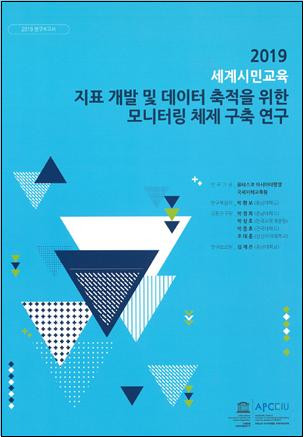 Establishing a Monitoring System for Global Citizenship Education in South Korea: A Preliminary Study with a Focus on Policy Area Year of publication: 2019 Corporate author: APCEIU The Asia-Pacific Centre of Education for International Understanding published a report titled "Establishing a Monitoring System for Global Citizenship Education in South Korea: A Preliminary Study with a Focus on Policy Area." The purpose of this research report is to provide implications for the development of indicators for Global Citizenship Education (GCED) which is the target 4.7 of the Sustainable Development Goals (SDGs) and the establishment of a Korean monitoring system for data accumulation. It is difficult for GCED to set up common indicators to monitor the implementation of each country, as it comprehensively deals with the direction and contents of education, whereas other targets of SDG4 are relatively clear targets and goals such as guaranteeing educational opportunities and improving educational conditions. For this reason, this study proposed Korean indicators based on domestic and international trends and analysis of issues concerning the development of SDG4.7.1 indicators and reviewed the domestic status in implementation based on them, thereby contributing to the development and consolidation of global indicators development and monitoring systems in the future.