
Resources
Explore a wide range of valuable resources on GCED to deepen your understanding and enhance your research, advocacy, teaching, and learning.
3,446 Results found
 Education, diversité et cohésion sociale en Méditerranée occidentale Year of publication: 2010 Author: Sobhi Tawil | Abdeljalil Akkari | Bouthaïna Azami Corporate author: Organisation des Nations Unies pour l'éducation, la science et la culture (UNESCO) La diversité culturelle constitue une caractéristique essentielle des différentes sociétés de la région de la Méditerranée occidentale où une multitude de traditions religieuses et culturelles se sont côtoyées et réciproquement influencées, créant ainsi une mosaïque sociale particulièrement intéressante. Or, la diversité, source de créativité et d'enrichissement culturel, peut aussi amener à renforcer les tensions sociales et creuser les divisions, menaçant ainsi la cohésion sociale à l'intérieur des sociétés comme entre les pays de la région. En effet, des événements récents ont attiré l'attention sur des tensions sociales et politiques liées à l'identité et à la cohésion sociale dans un contexte de mondialisation, d’accroissement des disparités des niveaux de développement économique entre les deux rives de la Méditerranée occidentale et de diversification grandissante des flux migratoires, contexte trop souvent marqué, par ailleurs, par une exacerbation du phénomène de l’exclusion sociale, de la montée de la xénophobie et de l’extrémisme religieux. Conscients de l’importance de la contribution essentielle de l’éducation pour promouvoir un dialogue interculturel axé sur les principes d’équité, de justice, et de respect de la dignité et de la diversité culturelle, la Chaire UNESCO Droits de l’homme et éthique de la coopération internationale de l’Université de Bergame, le Bureau multipays de l’UNESCO à Rabat, et l’ISESCO ont conjointement lancé, en 2007, le projet Education, diversité et cohésion sociale en Méditerranée occidentale. Le projet s’inscrit dans une dynamique de recherche, de dialogue et d’action, renforçant ainsi les efforts de chacun des trois partenaires visant à promouvoir la culture de la justice et de la paix. Cette recherche propose de nouveaux éclairages sur le rôle des systèmes éducatifs nationaux dans la promotion du respect de la diversité et le renforcement de la cohésion sociale, et esquisse des pistes d’action et de coopération. Nous formons le vœu que cet ouvrage commun, fruit des travaux de recherche se rapportant au projet, puisse contribuer à la promotion du respect de la diversité et de la cohésion sociale en Méditerranée occidentale. Educación en pro de la 'ciudadanía mundial': marco para el debate Year of publication: 2013 Author: Sobhi Tawil Corporate author: Organización de las Naciones Unidas para la Educación, la Ciencia y la Cultura (UNESCO) The notion of ‘global citizenship’ has recently gained prominence in international development discourse with the recently-adopted United Nations Secretary-General’s Global Education First Initiative (2012). Among the three priority areas outlined in this global initiative, the third aims to ‘foster global citizenship’. Education must fully assume its central role in helping people to forge more just, peaceful, tolerant and inclusive societies. It must give people the understanding, skills and values they need to cooperate in resolving the interconnected challenges of the 21st century. The notion of ‘global citizenship’, however, remains very broad, if not contested, and consequently difficult to operationalize in education. There are two possible reasons for this. Firstly, it is unclear whether the very notion of ‘global citizenship’ is a metaphor, a contradiction of terms, or an oxymoron (Davies, 2006). What does ‘global citizenship’ possibly imply both from a legal perspective, as well as from that of collective identity, sense of belonging, and civic engagement? Secondly, when applied to education, the notion of ‘global citizenship’ implies a certain degree of confusion. Is ‘global citizenship education’ (or ‘education for global citizenship’) merely an expression of a fundamental purpose of education systems? Does it also refer to a broad area of teaching and learning? If so, what are the contours of this domain? How does it relate to other often overlapping areas of learning associated with civic and political socialization?
  Education for 'global citizenship': a framework for discussion Year of publication: 2013 Author: Sobhi Tawil Corporate author: UNESCO The notion of ‘global citizenship’ has recently gained prominence in international development discourse with the recently-adopted United Nations Secretary-General’s Global Education First Initiative (2012). Among the three priority areas outlined in this global initiative, the third aims to ‘foster global citizenship’. Education must fully assume its central role in helping people to forge more just, peaceful, tolerant and inclusive societies. It must give people the understanding, skills and values they need to cooperate in resolving the interconnected challenges of the 21st century. The notion of ‘global citizenship’, however, remains very broad, if not contested, and consequently difficult to operationalize in education. There are two possible reasons for this. Firstly, it is unclear whether the very notion of ‘global citizenship’ is a metaphor, a contradiction of terms, or an oxymoron (Davies, 2006). What does ‘global citizenship’ possibly imply both from a legal perspective, as well as from that of collective identity, sense of belonging, and civic engagement? Secondly, when applied to education, the notion of ‘global citizenship’ implies a certain degree of confusion. Is ‘global citizenship education’ (or ‘education for global citizenship’) merely an expression of a fundamental purpose of education systems? Does it also refer to a broad area of teaching and learning? If so, what are the contours of this domain? How does it relate to other often overlapping areas of learning associated with civic and political socialization? Reflexiones sobre el progreso, el desarrollo sostenible y la ciudadanía mundial Year of publication: 2013 Author: Georges Haddad Corporate author: Organización de las Naciones Unidas para la Educación, la Ciencia y la Cultura (UNESCO) The arguments developed in this concise presentation demonstrate that sustainable development, progress and global citizenship, efficiently embedded in the context of the Knowledge Society, undeniably participate in the development of the New Humanism promoted by the Director-General of UNESCO, and which we all agree to consider essential for the wealth and prosperity of Humanity in an agreeable, peaceful and friendly common environment. Quelques réflexions sur le progrès, le développement durable et la citoyenneté globale Year of publication: 2013 Author: Georges Haddad Corporate author: Organisation des Nations Unies pour l'éducation, la science et la culture (UNESCO) The arguments developed in this concise presentation demonstrate that sustainable development, progress and global citizenship, efficiently embedded in the context of the Knowledge Society, undeniably participate in the development of the New Humanism promoted by the Director-General of UNESCO, and which we all agree to consider essential for the wealth and prosperity of Humanity in an agreeable, peaceful and friendly common environment.
 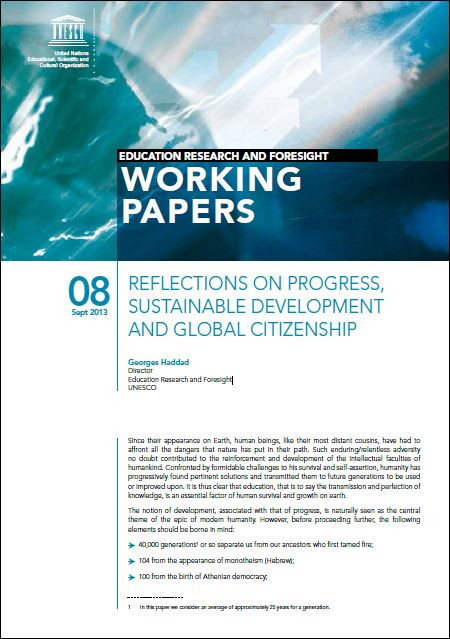 Reflections on Progress, Sustainable Development and Global Citizenship Year of publication: 2013 Author: Georges Haddad Corporate author: UNESCO The arguments developed in this concise presentation demonstrate that sustainable development, progress and global citizenship, efficiently embedded in the context of the Knowledge Society, undeniably participate in the development of the New Humanism promoted by the Director-General of UNESCO, and which we all agree to consider essential for the wealth and prosperity of Humanity in an agreeable, peaceful and friendly common environment. Buenas prácticas de educación para el desarrollo sostenible en la primera infancia Year of publication: 2012 Corporate author: Organización de las Naciones Unidas para la Educación, la Ciencia y la Cultura (UNESCO) To support the growing interest in early childhood issues and ESD, UNESCO is publishing this volume containing 12 examples of programmes addressing ESD in early childhood settings and practices. These good practices and shared experiences, which were provided by a range of different stakeholders, are concrete examples of successful implementation of ESD in different fields and sectors, from the political to the school level, and including formal, nonformal and informal learning situations. Éducation pour le développement durable: bonnes pratiques dans l'éducation de la petite enfance Year of publication: 2012 Corporate author: Organisation des Nations Unies pour l'éducation, la science et la culture (UNESCO) To support the growing interest in early childhood issues and ESD, UNESCO is publishing this volume containing 12 examples of programmes addressing ESD in early childhood settings and practices. These good practices and shared experiences, which were provided by a range of different stakeholders, are concrete examples of successful implementation of ESD in different fields and sectors, from the political to the school level, and including formal, nonformal and informal learning situations. Education for sustainable development good practices in early childhood Year of publication: 2012 Corporate author: UNESCO To support the growing interest in early childhood issues and ESD, UNESCO is publishing this volume containing 12 examples of programmes addressing ESD in early childhood settings and practices. These good practices and shared experiences, which were provided by a range of different stakeholders, are concrete examples of successful implementation of ESD in different fields and sectors, from the political to the school level, and including formal, nonformal and informal learning situations.
  Conceptualizing Intercultural Understanding within International Contexts: Challenges and Possibilities for Education Year of publication: 2017 Author: Fethi Mansouri, Ruth Arber Corporate author: UNESCO This chapter interrogates the ways in which intercultural conception has been defined in diverse contexts, providing the framing context for policy and curriculum measures to work with the manifestations of global population movement, diversity and change. It asks questions the ways in which conversations about intercultural understanding can be broadened to consider how entrenched systemic inequalities, the underlying notional and institutional frameworks that support them, and the mono-cultural and specific privileges and oppression, which are so often their enduring outcome, can be dismantled. To that end, it examines how policy and notional and practical work, in relation to intercultural understanding, can better encompass structural and cultural change regarding the ways in which cross cultural encounters and intercultural relations are shaped and take place.