
Resources
Explore a wide range of valuable resources on GCED to deepen your understanding and enhance your research, advocacy, teaching, and learning.
3,446 Results found
 A Decade of progress on education for sustainable development: reflections from the UNESCO Chairs Programme Year of publication: 2017 Author: Michelsen, Gerd | Wells, Peter J. Corporate author: Organisation des Nations Unies pour l'éducation, la science et la culture (UNESCO) The UNITWIN/UNESCO Chairs Programme, launched in 1992, today forms an extensive network of inter-university cooperation involving more than 700 higher education institutions in 128 countries worldwide. Through knowledge sharing and collaborative research in the priority areas of UNESCO’s work in education, the natural and social sciences, culture, communication and information, the Chairs provide a vital contribution to the Organization’s mission. The current volume focuses on the activities undertaken by UNESCO Chairs dedicated to the field of Education for Sustainable Development (ESD) within the context of the UN Decade of ESD which culminated in the UNESCO World Conference on ESD, held in AichiNagoya, Japan, 2014. The case studies included, showcase the good practices, applied research and curricula innovations pioneered by the individual UNESCO Chairs, as well as highlighting the challenges and lessons learned both for the new follow-up Global Action Programme (GAP) on ESD and the wider Education 2030 Agenda.
 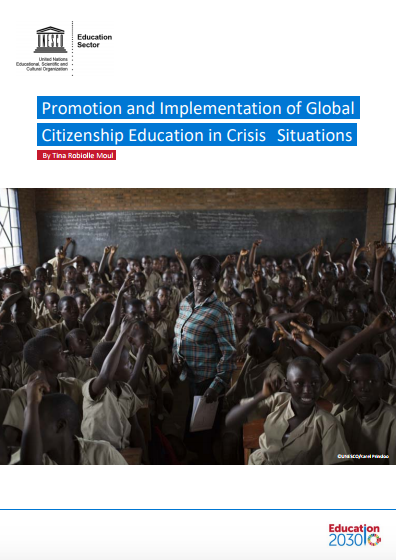 Promotion and implementation of global citizenship education in crisis situations Year of publication: 2017 Author: Robiolle Moul, Tina Corporate author: UNESCO Crisis situations affect the realization of human rights of many people and communities across all regions of the world. Within UNESCO’s relevant areas of work, GCED is a powerful approach to education that can empower people to recover from crises and transform their communities into peaceful and sustainable societies. UNESCO commissioned a desk study that aimed at reviewing existing research on the promotion and implementation of GCED and related programs in countries affected by crisis situations, with particular attention to initiatives benefiting the refugee population. This study unveils the key challenges these programs encounter in such contexts, as well as promising practices that can guide the design and implementation of future GCED in crisis situations.This report is a synthesis of this desk study and supports the evidence that, after analyzing the context and the available means, GCED and related programs can and should be systematically adapted and implemented in crisis situations, including in response to refugee crises. Promotion and implementation of global citizenship education in crisis situations Year of publication: 2017 Author: Robiolle Moul, Tina Corporate author: Organisation des Nations Unies pour l'éducation, la science et la culture (UNESCO) Crisis situations affect the realization of human rights of many people and communities across all regions of the world. Within UNESCO’s relevant areas of work, GCED is a powerful approach to education that can empower people to recover from crises and transform their communities into peaceful and sustainable societies. UNESCO commissioned a desk study that aimed at reviewing existing research on the promotion and implementation of GCED and related programs in countries affected by crisis situations, with particular attention to initiatives benefiting the refugee population. This study unveils the key challenges these programs encounter in such contexts, as well as promising practices that can guide the design and implementation of future GCED in crisis situations. This report is a synthesis of this desk study and supports the evidence that, after analyzing the context and the available means, GCED and related programs can and should be systematically adapted and implemented in crisis situations, including in response to refugee crises.
  Lifelong learning from a social justice perspective Year of publication: 2017 Author: Carlos Vargas Corporate author: UNESCO Over the past two decades, a set of globally converging discourses on lifelong learning (LLL) has emerged around the world. Driven mostly by inter-governmental organizations, these discourses have been largely embraced by national and local education systems seeking to reflect local traditions and priorities. This paper argues that these discourses tend to look remarkably alike, converging into a homogeneous rationale in which the economic dimension of education predominates over other dimensions of learning, and in which adaptation takes pre-eminence over social transformation as a goal of LLL. It also shows how these converging discourses are embedded in the logic of the knowledge economy, driven by concern for human capital formation as dictated by the changing demands of the global labour market, and can neglect the learning needs and interests of local communities. The paper concludes that the globally converging discourse of LLL tends to serve the interests of the market ahead of those of the community, and argues that an alternative characterization of LLL, anchored in social justice, is necessary in the light of the 2030 Agenda for Sustainable Development, and especially Sustainable Development Goal 4, which aims to ensure inclusive and equitable quality education and to promote lifelong learning opportunities for all.
 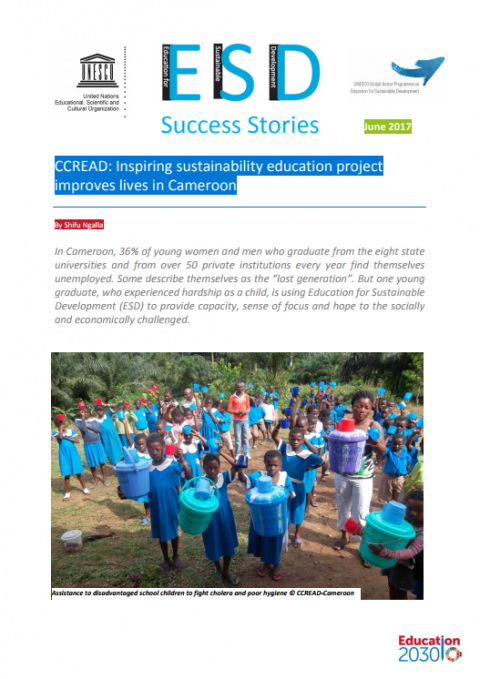 CCREAD: Inspiring sustainability education project improves lives in Cameroon (CAMEROON) Year of publication: 2017 Author: Shifu Ngalla Corporate author: UNESCO In Cameroon, 36% of young women and men who graduate from the eight state universities and from over 50 private institutions every year find themselves unemployed. Some describe themselves as the “lost generation”. But one young graduate, who experienced hardship as a child, is using Education for Sustainable Development (ESD) to provide capacity, sense of focus and hope to the socially and economically challenged. CCREAD: un projet d'éducation au développement durable améliore des vies au Cameroun Year of publication: 2017 Author: Shifu Ngalla Corporate author: Organisation des Nations Unies pour l'éducation, la science et la culture (UNESCO) In Cameroon, 36% of young women and men who graduate from the eight state universities and from over 50 private institutions every year find themselves unemployed. Some describe themselves as the “lost generation”. But one young graduate, who experienced hardship as a child, is using Education for Sustainable Development (ESD) to provide capacity, sense of focus and hope to the socially and economically challenged. CCREAD: un estimulante proyecto sobre educación para la sostenibilidad mejora la vida en el Camerún Year of publication: 2017 Author: Shifu Ngalla Corporate author: Organización de las Naciones Unidas para la Educación, la Ciencia y la Cultura (UNESCO) In Cameroon, 36% of young women and men who graduate from the eight state universities and from over 50 private institutions every year find themselves unemployed. Some describe themselves as the “lost generation”. But one young graduate, who experienced hardship as a child, is using Education for Sustainable Development (ESD) to provide capacity, sense of focus and hope to the socially and economically challenged.
 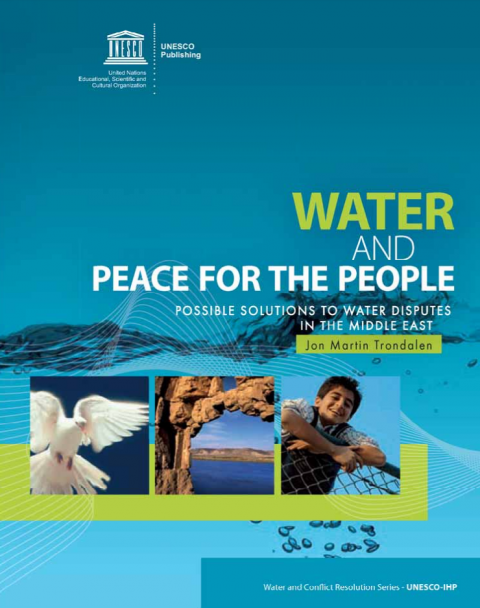 المياه والسلام من أجل الناس: حلول ممكنة للنزاعات المائية في الشرق الأوسط Year of publication: 2008 Corporate author: منظمة الأمم المتحدة للتربية والعلم والثقافة (UNESCO) This book proposes practical and objective solutions to the entrenched water conflicts in the Middle East. The author reveals and clarifies the complexity of the water conflicts, drawing on years of experience facilitating and chairing water negotiations in the region. The bottom line is: Unless the countries involved co-operate, the consequences will be devastating. The lack of plentiful and clean water for the people will not only result in severe human suffering, but could also have grave geopolitical consequences. Water and peace for the people: possible solutions to water disputes in the Middle East Year of publication: 2008 Corporate author: UNESCO This book proposes practical and objective solutions to the entrenched water conflicts in the Middle East. The author reveals and clarifies the complexity of the water conflicts, drawing on years of experience facilitating and chairing water negotiations in the region. The bottom line is: Unless the countries involved co-operate, the consequences will be devastating. The lack of plentiful and clean water for the people will not only result in severe human suffering, but could also have grave geopolitical consequences.
  Study on challenges in the development of local equality indicators: a human-rights-centred model; Commitment 2 of the Ten-Point Plan of Action Year of publication: 2010 Author: Klaus Starl | Jennifer Pinno Corporate author: UNESCO | European Training and Research Centre for Human Rights and Democracy (Austria) The study aims at: Providing a theoretical fundament of ECCAR Indicators to measure racism or (in)equality1 and to evaluate municipal anti-discrimination policies (framework concept), and Discussing related legal and practical issues such as legality and reliability of available ‘ethnic’ data (legal and practical preconditions) in the context of ECCAR’s endeavours to set up an ECCAR-wide applicable system of monitoring racism, discrimination, equality and respective municipal policies. The study is structured in three parts. In the first part, preliminary questions concerning legality and practical feasibility of ‘ethnic’ data collection as a prerequisite for the development of and work with adequate indicators will be discussed. The second part deals with the conceptualization of human rights law as the constructing principle of ECCAR Indicators. It includes the discussion of the proposed model of the ECCAR-ADIX. The third part of the study describes practical examples of indicator use in selected ECCAR member cities. The section shows various approaches and gives evidence on different attempts by municipalities to set up fact-based anti-racism policies but also highlights the variety of methods, data, measurement topics, goals, etc.