
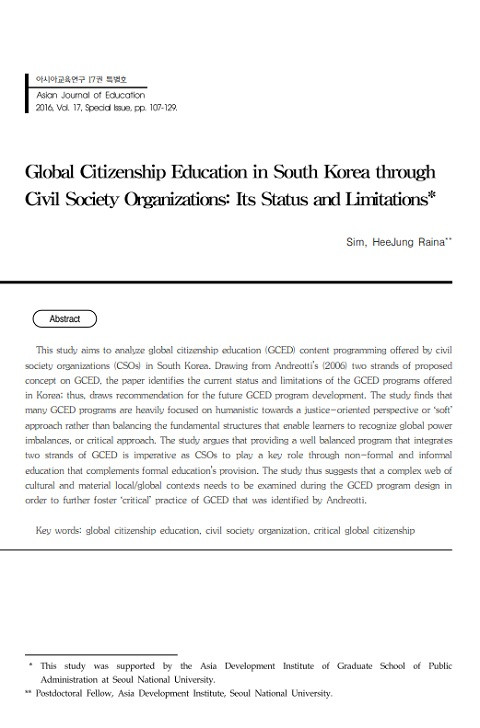
Global Citizenship Education in South Korea through Civil Society Organizations: Its Status and Limitation (Asian Journal of Education, Vol.17, Special Issue)
- Author
- HeeJung Raina Sim
- Corporate Author
- Asia Development Institute of Seoul National University
- ISBN
- ISSN 1229-9448
- Collation
- p. 107-129
- Resource Language
- English
- Year of publication
- 2016
- Resource Type
- Research papers / journal articles
- Level of education
- Primary educationSecondary educationHigher educationLifelong learningNon-formal education
- Region
- Asia and the Pacific
- Place of publication
- Seoul
This study aims to analyze global citizenship education (GCED) content programming offered by civil society organizations (CSOs) in South Korea. Drawing from Andreotti’s (2006) two strands of proposed concept on GCED, the paper identifies the current status and limitations of the GCED programs offered in Korea; thus, draws recommendation for the future GCED program development. The study finds that many GCED programs are heavily focused on humanistic towards a justice-oriented perspective or ‘soft’ approach rather than balancing the fundamental structures that enable learners to recognize global power imbalances, or critical approach. The study argues that providing a well balanced program that integrates two strands of GCED is imperative as CSOs to play a key role through non-formal and informal education that complements formal education’s provision. The study thus suggests that a complex web of cultural and material local/global contexts needs to be examined during the GCED program design in order to further foster ‘critical’ practice of GCED that was identified by Andreotti.
Related Resources
-
 Study on the Historical Impact of the 1974 Recommendation concerning Education for International Understanding, Cooperation and Peace and Education relating to Human Rights and Fundamental Freedoms
 -
 IIEP-UNESCO 12th Medium-Term Strategy: 2026–2029
 -
 More than Welcome: Intercultural Integration of Migrants in and Through Higher Education
 -
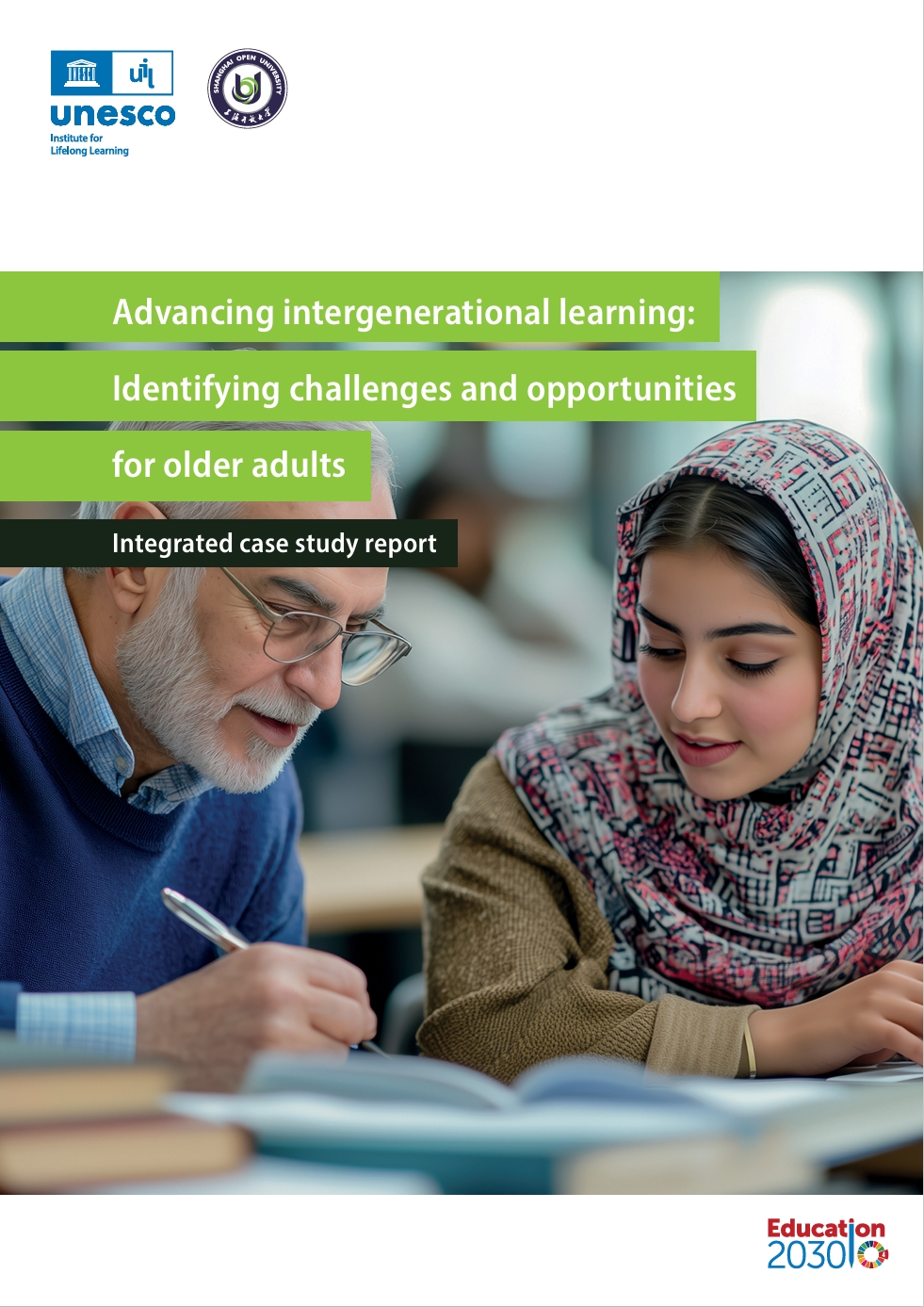 Advancing Intergenerational Learning: Identifying Challenges and Opportunities for Older Adults; Integrated Case Study Report