
Resources
Explore a wide range of valuable resources on GCED to deepen your understanding and enhance your research, advocacy, teaching, and learning.
3,446 Results found
 Rendir cuentas en el ámbito de la educación: cumplir nuestros compromisos; Informe de seguimiento de la educación en el mundo, versión para los jóvenes, 2017/8 Year of publication: 2017 Corporate author: Organización de las Naciones Unidas para la Educación, la Ciencia y la Cultura (UNESCO) Esta versión para los jóvenes del Informe GEM, que se basa en los resultados y conclusiones del Informe de Seguimiento de la Educación en el Mundo 2017-2018, se cuestiona acerca de la manera en que los jóvenes participan en el proceso de rendición de cuentas en la educación. En tanto que alumnos, ¿de qué somos responsables en nuestra educación, y cómo se nos responsabiliza? ¿Cómo podemos asegurarnos de que se responsabilice a otros interesados, como las escuelas, las universidades y los gobiernos, por lo que deben hacer? Estas son preguntas fundamentales, porque sabemos que quedan aún muchas cuestiones por resolver para que todos los jóvenes del mundo tengan acceso a una educación de calidad. El ausentismo de los docentes, el hacinamiento de las aulas, los diplomas ilícitos, las escuelas privadas no reglamentadas y el ausentismo de los alumnos son cuestiones que los sistemas educativos se esfuerzan por superar.Sería fácil afirmar que la resolución de esos problemas no está en nuestras manos, y que la responsabilidad es del gobierno o de una generación anterior. Pero esto simplemente no es cierto; la educación es una responsabilidad compartida, y los jóvenes desempeñan en ese sentido un papel importante. En este informe conocerá las historias de jóvenes de todo el mundo que han defendido el derecho a la educación en sus comunidades, y que han contribuido a motivar un cambio. También leerá sobre las maneras en que podrá participar en nuestra campaña para garantizar que se responsabilice a los gobiernos por la educación. Esto significa asegurarse de que los ciudadanos puedan llevar a sus gobiernos ante la justicia si no cumplen sus responsabilidades en materia de educación. Desde grabar vídeos hasta organizar actos de sensibilización, son muchas las maneras de hacerse escuchar. Su participación es indispensable para garantizar que el mundo transite por la vía correcta para alcanzar nuestros objetivos sobre la educación.
  [Summary] Investing in Cultural Diversity and Intercultural Dialogue: UNESCO World Report; Executive Summary Year of publication: 2009 Corporate author: UNESCO Cultural diversity has emerged as a key concern at the turn of a new century. Yet the meanings attached to this catch-all term are as varied as they are shifting. Some see cultural diversity as inherently positive, insofar as it points to a sharing of the wealth embodied in each of the world’s cultures and, accordingly, to the links uniting us all in processes of exchange and dialogue. For others, cultural differences are what cause us to lose sight of our common humanity and are therefore at the root of numerous conflicts.This second diagnosis is today all the more plausible since globalization has increased the points of interaction and friction between cultures, giving rise to identity-linked tensions, withdrawals and claims, particularly of a religious nature, which can become potential sources of dispute. The essential challenge, therefore, would be to propose a coherent vision of cultural diversity and thereby to clarify how, far from being a threat, it can become beneficial to the action of the international community. This is the essential purpose of the present report.
  Interculturalism at the Crossroads: Comparative Perspectives on Concepts, Policies and Practices Year of publication: 2017 Author: Fethi Mansouri Corporate author: UNESCO Today most societies across the world are witnessing rising levels of social and cultural diversity brought about by globalisation and in particular increased human mobility and significant advances in information and communications technologies. The dilemma, therefore, has been how best to manage the resultant diversity and what optimal social policy paradigms to adopt towards this end.Assimilation, multiculturalism and presently interculturalism have all been proposed as possible policy conduits for managing socio-cultural diversity.This book, in focusing on the latter concept, and in particular in its intercultural dialogue manifestation, offers at once theoretical examinations, policy discussion and practical explorations of its uptake across the world. The core argument connecting the book’s three distinct sections is that whilst assimilation in its racist manifestation is no longer a viable option in today’s world, intercultural dialogue within existing multicultural settings has much to offer.
  UNESCO and Gender Equality in Sub-Saharan Africa: Innovative Programmes, Visible Results Corporate author: UNESCO For over twenty years, UNESCO’s work in Africa has been undertaken in a specific framework with a range of institutional mechanisms designed to help translate into action its priorities: Africa and gender equality. During this period, UNESCO achieved important results in the areas covered by its mandate to promote gender equality.This publication highlights UNESCO’s contribution to the implementation of the African Union’s Agenda 2063 and the 2030 Agenda for Sustainable Development of the United Nations, in the field of gender equality in Africa, through examples of good practice, lessons learnt as well as suggestions and recommendations for the future. L'UNESCO et l'égalité des Genres en Afrique Subsaharienne: Des Programmes Novateurs, des Résultats Perceptibles Corporate author: Organisation des Nations Unies pour l'éducation, la science et la culture (UNESCO) Depuis plus d’une vingtaine d’années l’UNESCO a inscrit son action dans un cadre spécial assorti d’un ensemble de mécanismes institutionnels conçus pour appuyer l’opérationnalisation de ses Priorités: l’Afrique et l’égalité des genres. Au cours de cette période, l’UNESCO a été à l’origine d’importantes réalisations dans les domaines relevant de son mandat à travers la mise en oeuvre des programmes et activités novateurs.La présente publication met en exergue la contribution de l’UNESCO à la mise en oeuvre de l’Agenda 2063 de l’Union africaine et du Programme de développement durable à l’horizon 2030 dans le domaine de l’égalité des genres en Afrique, à travers des exemples de bonnes pratiques, de leçons apprises ainsi que des suggestions et recommandations pour le futur.
 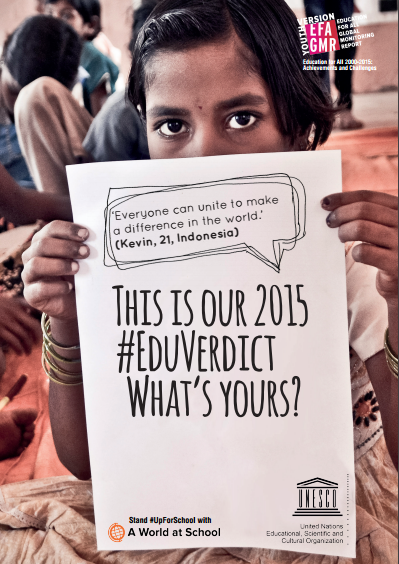 Education for All 2000-2015: Achievements and Challenges; Education for All Global Monitoring Report, 2015; Youth Version Year of publication: 2015 Corporate author: UNESCO This report highlights the progress and challenges of education that countries have faced over 15 years, brining together the voices of young people to show how Education for All (EFA) has affected their lives and hope for the future. L'Education pour tous 2000-2015: progrès et enjeux, rapport mondial de suivi sur l'EPT, 2015, youth version Year of publication: 2015 Corporate author: Organisation des Nations Unies pour l'éducation, la science et la culture (UNESCO) This report highlights the progress and challenges that countries have faced over 15 years, brining together the voices of young people to show how Education for All (EFA) has affected their lives. La Educación para Todos, 2000-2015: logros y desafíos, informe de seguimiento de la EPT en el mundo, 2015: youth version Year of publication: 2015 Corporate author: Organización de las Naciones Unidas para la Educación, la Ciencia y la Cultura (UNESCO) This report highlights the progress and challenges that countries have faced over 15 years, brining together the voices of young people to show how Education for All (EFA) has affected their lives.
  Historical efforts to implement the UNESCO 1974 Recommendation on Education in light of 3 SDGs Targets Year of publication: 2017 Corporate author: UNESCO This paper presents an analytical overview of historical efforts by Member States of the United Nations Educational, Scientific and Cultural Organization (UNESCO) to implement the 1974 Recommendation concerning education for international understanding, cooperation and peace education relating to human rights and fundamental freedoms. The author of the review was hired in April 2016 to undertake an analysis of Member States’ progress reports submitted for the fourth (2008) and fifth (2012) consultations on implementation of the 1974 Recommendation. The main purpose of the review was to provide a historical overview of efforts to achieve Sustainable Development Goal (SDG) Targets 4.7, 12.8 and 13.3 and their proposed measurement indicators, based on states’ historical reporting on the Recommendation. A total of 94 country reports were reviewed for the exercise: 37 from the 4th Consultation (2008); and 57 from the 5th Consultation (2012). The coding involved retrofitting the content of reportsto conceptsthat may have been developed at a later date for the Sustainable Development Agenda and coding for data that was not explicitly requested in the Consultations. Following the coding, a quantitative and qualitative analysis was undertaken and is presented in the following report.
 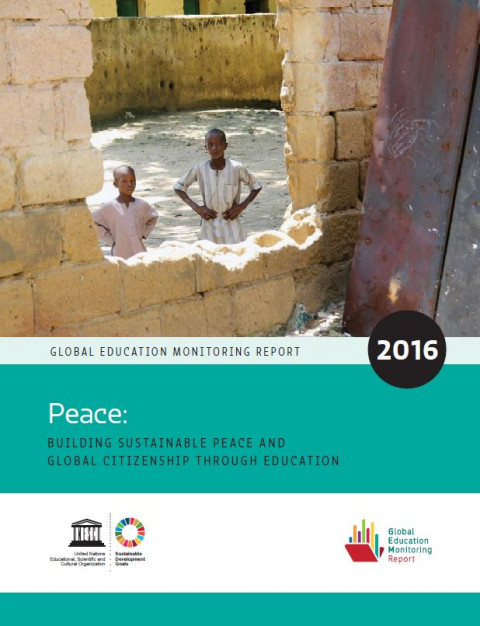 Peace: building sustainable peace and global citizenship through education;Global education monitoring report summary 2016 Year of publication: 2017 Corporate author: UNESCO The 2016 GEM Report, the first of a new 15-year series, shows that education will not deliver its full potential to catapult the world forward unless rates of improvement dramatically shift, and education systems consider sustainable development in the way services are delivered. This Peace: Building sustainable peace and global citizenship through education publication is a select extract from the full 2016 Global Education Monitoring (GEM) Report: Education for people and planet: Creating sustainable futures for all. It contains two chapters from that full Report – one on peace, political participation and access to justice and the other on education for global citizenship and sustainable development — , along with the associated policy recommendations and a short section of a recent GEM Report Policy Paper Textbooks pave the way to sustainable development.