
Resources
Explore a wide range of valuable resources on GCED to deepen your understanding and enhance your research, advocacy, teaching, and learning.
3,446 Results found
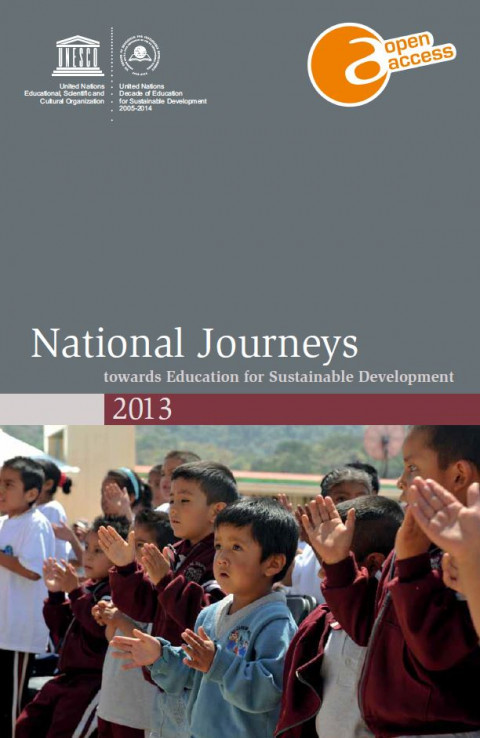 National journeys towards education for sustainable development, 2013: reviewing national ESD experiences from Costa Rica, Morocco, South Africa, Sweden, VietNam Year of publication: 2013 Corporate author: UNESCO This publication has sourced information from a series of national reviews commissioned by UNESCO in 2011/2012 and was written by experts in Costa Rica, Morocco, South Africa, Sweden and Viet Nam. The countries presented in this report are not necessarily the ‘best’ examples of the region, as many other countries are also progressing effectively towards implementing Education for Sustainable Development (ESD). Rather, the countries selected illustrate the wide diversity of ESD approaches and initiatives taking place in different parts of the world. The national studies were then edited and harmonized before common themes and lessons learnt were identified to support other national efforts in moving towards the end of the UN Decade of Education for Sustainable Development. Voyages nationaux vers l'éducation pour le développement durable, 2013: examen des expériences nationales EDD du Costa Rica, Maroc, Afrique du Sud, Suède, Vietnam Year of publication: 2013 Corporate author: Organisation des Nations Unies pour l'éducation, la science et la culture (UNESCO) Cette publication a source d'informations à partir d'une série d'examens nationaux mandatés par l'UNESCO en 2011/2012 et a été rédigé par des experts au Costa Rica, Maroc, Afrique du Sud, la Suède et le Viet Nam. Les pays présentés dans ce rapport ne sont pas nécessairement les exemples «meilleurs» de la région, comme beaucoup d'autres pays progressent également de manière efficace pour mettre en œuvre l'éducation pour le développement durable (EDD). Au contraire, les pays sélectionnés illustrent la grande diversité des approches et des initiatives qui se déroulent dans différentes parties du monde EDD. Les études nationales ont ensuite été modifiés et harmonisés avant les thèmes et les enseignements tirés ont été identifiés pour soutenir d'autres efforts nationaux dans le déplacement vers la fin de la Décennie des Nations Unies pour l'éducation au développement durable communs.
  Plan de mise en oeuvre international de la décennie des Nations Unies pour l'éducation au service du développement durable, 2005-2014 Year of publication: 2005 Corporate author: Organisation des Nations Unies pour l'éducation, la science et la culture (UNESCO) In December 2002, the UN General Assembly adopted a resolution to put in place a UN Decade of Education for Sustainable Development, lasting from 2005 to 2014. UNESCO was tasked with leading the Decade and developing an International Implementation Scheme (IIS). International implementation scheme for the UN decade of education for sustainable development, 2005-2014 Year of publication: 2005 Corporate author: UNESCO In December 2002, the UN General Assembly adopted a resolution to put in place a UN Decade of Education for Sustainable Development, lasting from 2005 to 2014. UNESCO was tasked with leading the Decade and developing an International Implementation Scheme (IIS).
  Reaching the Unreached: Indigenous Intercultural Bilingual Education in Latin America Year of publication: 2009 Author: Luis Enrique López Corporate author: UNESCO The paper focuses on the educational situation of the most marginalized children and adolescents in Latin America: those belonging to indigenous homes and communities. To illustrate indigenous marginalization and exclusion as well as the development of intercultural bilingual education (IBE) six countries have been chosen: Bolivia, Ecuador, Guatemala, Mexico, Paraguay and Peru. Atteindre les exclus: indigène éducation interculturelle bilingue en Amérique latine Year of publication: 2009 Author: Luis Enrique López Corporate author: Organisation des Nations Unies pour l'éducation, la science et la culture (UNESCO) Le document met l'aCECnt sur la situation de l'éducation des enfants les plus marginalisés et les adolescents en Amérique latine: ceux appartenant à des foyers et des communautés autochtones. Pour illustrer la marginalisation et l'exclusion des autochtones ainsi que le développement de l'éducation interculturelle bilingue (BIE) six pays ont été choisis: la Bolivie, l'Equateur, le Guatemala, le Mexique, le Paraguay et le Pérou.
 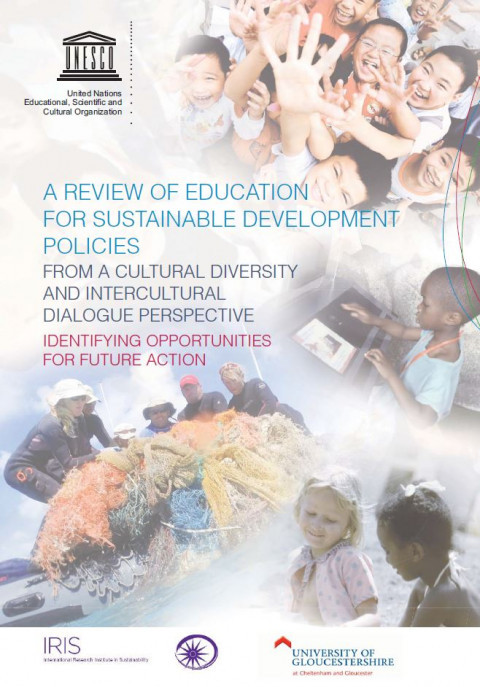 A Review of education for sustainable development policies from a cultural diversity and intercultural dialogue perspective: identifying opportunities for future action Year of publication: 2009 Author: Daniella Tilbury | I. Mulà Corporate author: UNESCO This review highlights the striking absence of culture in ESD, a gap also acknowledged by participants at the UNESCO World Conference on Education for Sustainable Development held in Bonn, Germany, from 31 March to 2 April 2009. The final declaration emphasizes that ESD is about 'creative and critical approaches, long-term thinking, innovation and empowerment for dealing with uncertainty', and for solving complex problems, highlighting in particular the interdependence of environment, economy, society, and cultural diversity from local to global levels. The review and its methodology provide an instructive example of ways to articulate the linkages between cultural diversity, intercultural dialogue and ESD, required for a sustainable future. Un examen de l'éducation pour les politiques de développement durable à partir d'une diversité culturelle et de la perspective d'un dialogue interculturel: l'identification des possibilités d'action future Year of publication: 2009 Author: Daniella Tilbury | I. Mulà Corporate author: Organisation des Nations Unies pour l'éducation, la science et la culture (UNESCO) Cet avis met en évidence l'absence frappante de la culture dans l'EDD, un écart aussi reconnu par les participants auconférencemondial de l'UNESCO sur l'éducation pour le développement durable tenu à Bonn, en Allemagne, du 31 Mars au 2 Avril 2009. La déclaration finale souligne que l'EDD est sur ' approches créatives et critiques, la pensée à long terme, l'innovation et l'autonomisation pour faire face à l'incertitude », et pour résoudre des problèmes complexes, en soulignant en particulier l'interdépendance de l'environnement, l'économie, la société et la diversité culturelle du niveau local au niveau mondial. L'examen et sa méthodologie fournissent un exemple instructif de façons d'articuler les liens entre la diversité culturelle, le dialogue interculturel et EDD, nécessaire pour un avenir durable.
 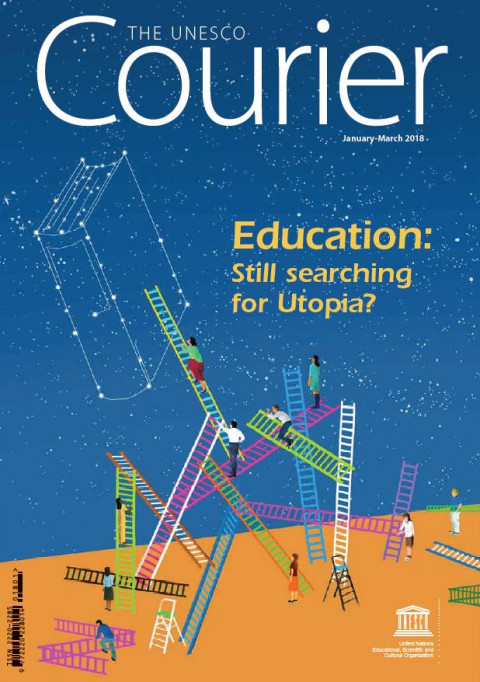 Education: Still Searching for Utopia? (The UNESCO Courier no. 1, January-March 2018) Year of publication: 2018 Corporate author: UNESCO At a time of heightened global tension, when human rights, freedom of speech, peace and the future of the planet itself may seem challenged as never before, the transformational power of education is of critical importance.In Learning: The Treasure Within, the landmark Report to UNESCO by the International Commission on Education for the Twenty-first Century in 1996, Jacques Delors, then Chairman of the Commission (1992 to 1996), spoke of education as “the necessary Utopia” and “an indispensable asset in its attempt to attain the ideals of peace, freedom and social justice.”Education was held up as neither miracle nor magic, but rather the best means to foster a climate where humanity would be improved −. and where the rich potential for learning, inherent in every individual, would be tapped. Our humanity is confronted with a very strange paradox: the world’s population has never been better educated, and yet, according to the UNESCO Institute for Statistics, 263 million children and young people are out of school, 617 million children and adolescents worldwide do not meet the minimum threshold for literacy and mathematics, at least 750 million adults are illiterate, and girls remain more likely than boys to never set foot in a classroom. Yet education is still called upon to address inequalities, poverty, terrorism and conflict. It is seen as one of the keys to global citizenship and sustainable development, two of UNESCO’s fields of action. The Organization is also mandated to lead the Education 2030 global agenda with a special focus on ensuring that no one is left behind. Under the title, “Education: Still searching for Utopia?”, the UNESCO Courier evaluates the state of global education and explores how it responds to some of the main challenges we face. Education: en quête d'une utopie nécessaire (Le Courrier de l’UNESCO no. 1, Janvier-Mars 2018) Year of publication: 2018 Corporate author: Organisation des Nations Unies pour l'éducation, la science et la culture (UNESCO) À une époque où la tension ne cesse de croître, où les droits de l'homme, la liberté d'expression, la paix et l'avenir de la planète semblent plus que jamais remis en question, le pouvoir de transformation véhiculé par l'éducation revêt une importance cruciale.L’éducation est une « utopie nécessaire », elle est « un atout indispensable pour permettre à l’humanité de progresser vers les idéaux de paix, de liberté et de justice sociale », lit‑on dans le rapport historique de l’UNESCO, L’éducation : un trésor est caché dedans, élaboré par la Commission internationale sur l'éducation pour le XXIe siècle, présidée en 1996 par Jacques Delors.L'éducation n'y est présentée ni comme miracle, ni comme baguette magique, mais comme le meilleur moyen de favoriser un climat permettant à l'humanité de s’améliorer.Notre humanité est confrontée à un paradoxe très étrange : la population mondiale n’a jamais été aussi instruite, alors que, selon l’Institut de statistiques de l’UNESCO, 263 millions d’enfants et de jeunes ne sont pas scolarisés, que 617 millions d’enfants et d’adolescents dans le monde n’atteignent pas le seuil minimal de compétence en lecture et en mathématiques, qu’au moins 750 millions d’adultes sont analphabètes, et que les filles demeurent plus susceptibles que les garçons de ne jamais mettre les pieds dans une classe. Cependant l’éducation est toujours appelée à remédier aux inégalités, à la pauvreté, au terrorisme et aux conflits. Elle est considérée comme une des clés essentielles de la citoyenneté mondiale et du développement durable, deux domaines d’action de l’UNESCO, qui a aussi pour mandat de diriger l’agenda mondial Éducation2030 en veillant tout particulièrement à ce que personne ne soit laissé pour compte.Sous le titre « Éducation : en quête d'une utopie nécessaire », Le Courrier de l'UNESCO porte un regard panoramique sur l'éducation dans le monde et explore comment elle peut répondre à certains grands défis.