
Resources
Explore a wide range of valuable resources on GCED to deepen your understanding and enhance your research, advocacy, teaching, and learning.
3,225 Results found
 5th UNESCO Forum on Transformative Education for Sustainable Development, Global Citizenship, Health and Well-being (Strand 2 & Special Session) Year of publication: 2021 Author: Miho Taguma | Leanne Riley | Valeria Damiani | Nandini Chatterjee | Valerie Shapiro | Pablo Pincheira | Nicolas Jonas | Denis Barrett | Doug McCall | Antoine Marivin | Cheoljin Yang | Sunkyung Lee Corporate author: UNESCO | APCEIU Strand 2 – What does progress in transformative education look like – a look at recent global and regional data Plenary session 2Building upon Strand 1, this session examined transformative education through the lens of regional and global comparative data in relation to SDG Target 4.7. The discussion identified the progress made, and remaining gaps in existing monitoring and assessment frameworks.Moderator: Mr Sobhi Tawil, Director, Future of Learning and Innovation, UNESCOMs Miho Taguma, Senior Policy Analyst on OECD Learning Compass 2030 and SDG 4.7Ms Leanne Riley, Unit Head, Surveillance, Monitoring and Reporting, Department of Noncommunicable Diseases (NCDs), World Health OrganizationMs Valeria Damiani, Associate Professor, La Libera Università Maria SS. Assunta (LUMSA) University, ItalyMr Carlos Henríquez Calderon, Coordinator of the Latin American Laboratory for Assessment of the Quality Education (LLECE), Regional Bureau for Education in Latin America and the Caribbean (OREALC), UNESCO Santiago Office Concurrent sessions 2The concurrent sessions engaged in an in-depth discussion on three selected major gaps in transformative education, identified opportunities and made suggestions on the way forward. Session 2.1 – How to address social and emotional dimensions of learning in assessment?The increasing integration of social and emotional learning (SEL) into curricula has raised questions regarding feedback and assessment. Drawing on research, policy and practice, this session examined possibilities and gaps in SEL.Moderator: Ms Cecilia Barbieri, Chief, Section of Education for Global Citizenship & Peace, UNESCOMs Nandini Chatterjee, Senior National Project Officer, UNESCO Mahatma Gandhi Institute of Education for Peace and Sustainable Development (MGIEP)Ms Valerie Shapiro, Associate Professor, University of California Berkeley, USAMr Pablo Pincheira, Training Director, Forja Chile, Chile Session 2.2 – Making adult learning and education visible within lifelong learning: strengthening non-formal education for individual, social and system level transformationThis session presented local initiatives that have embedded ESD and GCED into lifelong learning systems through policy/strategy development and project implementation, as well as progress made in building learning cities. Moderator: Mr Jose Roberto Guevara, President, International Council for Adult EducationSpeakers:Mr Nicolas Jonas, Programme Specialist, UNESCO Institute for Lifelong Learning (UIL)Ms Mo Winnie Wang, Programme Specialist, UNESCO Institute for Lifelong Learning (UIL)Mr Denis Barrett, Coordinator of Cork Learning City, Ireland Session 2.3 – What do we need to monitor/measure/assess in transformative education - gaps and opportunities?The session focused on promising practices and remaining gaps in capturing the transformation of individuals, societies and education. The key question addressed was how quality teaching and learning can be guided based on the evidence available.Moderator: Dr Marcia McKenzie, Director, MEECE Project and SEPN, and Professor, the University of Melbourne, AustraliaMr Doug McCall, Executive Director, International School Health NetworkMr Antoine Marivin, Project Manager, UNICEF-East Asia and Pacific Regional Office (EAPRO)Dr Julia Kim, Programme Director, the Gross National Happiness Centre, Bhutan Special Session by the Host Country (Plenary) – Experiences from the Republic of Korea and Beyond: Progress, Challenges and New VisionsThe Special Session discussed the Korean experience on SDG Target 4.7, at the domestic and international level. Good practices, emerging trends and lessons learnt were shared, suggesting key agendas, challenges, and visions towards 2030 and transformative education.Moderator: Mr Soon-yong Pak, Professor, Yonsei University, Republic of KoreaSpeakers:Mr Hwanbo Park, Professor, Chungnam University, Republic of KoreaMr Cheol-Jin Yang, Teacher at Songwoo Middle School & Co-Founder/Director of Neuroo, Republic of KoreaDiscussants:Ms Sun-Kyung Lee, Professor, Cheongju National University of Education, Republic of KoreaMr Aaron Benavot, Professor, University of Albany, USA Links to Strand 1 / Strand 3 / Strand 4
  ПЕРЕОСМЫСЛИМ НАШЕ БУДУЩЕЕ Year of publication: 2021 Corporate author: International Commission on the Futures of Education | UNESCO Наше человечество, наша планета находятся в опасности, пандемия лишь подтвердила нашу хрупкость и взаимозависимость, чтобы изменить ход вещей и переосмыслить наше будущее, необходимы неотложные совместные действия; в этом докладе Международной комиссии по перспективам образования подтверждается способность образования к осуществлению коренных изменений. Перед нами стоит двойная задача – выполнить невыполненное обещание обеспечить право на качественное образование для каждого ребёнка, молодого человека и взрослого и полностью реализовать преобразующий потенциал образования, способного проложить путь к устойчивому коллективному будущему. Для этого нам нужен новый общественный договор в области образования, который сможет устранять проявления несправедливости, преобразуя будущее.Этот новый общественный договор должен основываться на принципах прав человека, недопущения дискриминации, социальной справедливости, уважения жизни, человеческого достоинства и культурного разнообразия. Он должен включать в себя этику заботы о людях, взаимности и солидарности. Он должен укреплять позиции образования как общественного дела и общего блага.Этот доклад, который готовился два года на основе глобального процесса консультаций с участием миллиона человек, предлагает правительствам, учреждениям, организациям и гражданам всего мира разработать новый общественный договор в области образования, который поможет нам построить мирное, справедливое и устойчивое будущее, отвечающее всеобщим интересам.Представленные здесь концепции, принципы и предложения являются лишь отправной точкой. Их воплощение в практику в конкретных условиях – это коллективная работа. Уже есть много положительных моментов, и в настоящем докладе предпринята попытка их отразить и развить. Это не инструкция и не план, а начало жизненно важного разговора.
 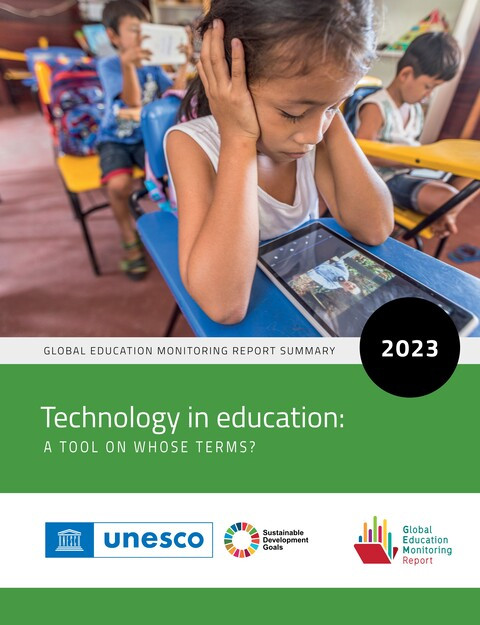 [Résumé] Résumé du rapport mondial de suivi sur l’éducation 2023 : les technologies dans l’éducation; qui est aux commandes? Year of publication: 2023 Corporate author: UNESCO | Global Education Monitoring Report Team Le rôle de la technologie dans l’éducation suscite depuis longtemps un débat intense. Est-ce qu’elle démocratise le savoir ou menace la démocratie en permettant à quelques-uns de contrôler l’information? Offre-t-elle des opportunités sans limite ou mène-t-elle vers un avenir dépendant de la technologie sans retour en arrière possible ? Est-ce qu’elle égalise les chances ou aggrave les inégalités? Devrait-elle être utilisée pour enseigner aux jeunes enfants ou présente-t-elle des risques pour leur développement? Ce débat a été alimenté par les fermetures d’écoles dues à la COVID-19 et l’émergence de l’intelligence artificielle générative. Mais comme les développeurs sont souvent en avance sur les décideurs, la recherche sur la technologie éducative est complexe. Les preuves solides et impartiales sont rares. Les sociétés posent-elles même les bonnes questions sur l’éducation avant de se tourner vers la technologie comme solution? Reconnaissent-elles ses risques tout en cherchant ses avantages? Les technologies de l’information et de la communication ont le potentiel de favoriser l’équité et l’inclusion en permettant d’atteindre les apprenants défavorisés et de diffuser plus de connaissances dans des formats attrayants et abordables. Dans certains contextes et pour certains types d’apprentissage, elles peuvent améliorer la qualité de l’enseignement et l’apprentissage des compétences de base. De toute évidence, les compétences numériques font désormais partie des compétences de base. La technologie numérique peut également soutenir la gestion et accroître l’efficacité en aidant à traiter de plus grands volumes de données éducatives. Mais la technologie peut également exclure, être inappropriée et pesante, voire carrément nuisible. Les gouvernements doivent veiller à créer les bonnes conditions pour assurer un accès équitable à l’éducation pour tous, réguler l’utilisation de la technologie afin de protéger les apprenants de ses influences négatives, et former les enseignants. Ce rapport recommande que la technologie soit introduite dans l’éducation sur la base de preuves montrant qu’elle serait appropriée, équitable, évolutive et durable. En d’autres termes, son utilisation devrait être dans l’intérêt des apprenants et compléter l’interaction en face-à-face avec les enseignants. Elle devrait être considérée comme un outil à utiliser dans ces conditions. À mi-parcours de l’échéance, le Rapport mondial de suivi sur l'éducation 2023 évalue la distance qu’il reste à parcourir pour atteindre les objectifs éducatifs de 2030. L’éducation est la clé pour débloquer la réalisation d’autres objectifs de développement, notamment le progrès technologique.
  نحو عقد اجتماعي جديد للتربية والتعليم: الأخذ بترابط العلاقات نموذجاً فكرياً Year of publication: 2023 Author: Elena Toukan Corporate author: UNESCO إىل إبرام »عقد اجتماعي جديد للرتبية والتعليم« وذلك بمنظار تتناول هذه املقالة الدعوات الصادرة مؤخرا العالقات الوجودية بني البرش والكوكب الحي، وتفحص من خالل التحليل النقدي لنظرية العقد االجتماعي ً إىل إحداث تحول أعمق عىل مستوى النموذج الفكري عند تناول كيف يمكن أن توفر تلك الدعوات مدخال مسألة العدالة والتنظيم االجتماعي والتعليم بحد ذاته. وتقرتح املقالة التحول من نموذج املعامالت القائمة عىل قواعد محددة إىل نموذج قائم عىل العالقات يرتكز عىل إدراك عالقات الرتابط والتداخل وتقديرها حق ً للبرشية والكوكب، ال بد للعقد االجتماعي الجديد للرتبية ً واستدامة ً إىل بناء مستقبل أكثر عدال قدرها. وسعيا والتعليم من تجاوز الديناميات االجتماعية الفردية الذرية والقائمة عىل املعامالت والصدام، بل أن ينتظم حول ترابط العالقات املتشابكة. A New Social Contract for Education: Advancing a Paradigm of Relational Interconnectedness Year of publication: 2023 Author: Elena Toukan Corporate author: UNESCO This paper looks at recent calls for “a new social contract for education” through the lens of a relational ontology for humanity and a living planet. Through a critical view of social contract theory, the paper looks at how this call can be an entry point to a deeper paradigmatic shift in framing questions of justice, social organization, and education itself. It proposes a shift from a rules-based transactional model to a relationship-based model grounded in understanding and appreciation of interdependence and interconnectedness. In order to shape more just and sustainable futures for humanity and the planet, a new social contract for education will need to transcend atomistic, transactional, and adversarial social dynamics and instead be organized around relational interconnectedness. Un nuevo contrato social para la educación: promover un paradigma de interconexión relacional y los conocimientos Year of publication: 2023 Author: Elena Toukan Corporate author: UNESCO En el presente artículo se examinan los recientes llamamientos a “un nuevo contrato social para la educación” a través de la lente de una ontología relacional para la humanidad y un planeta vivo. Mediante una visión crítica de la teoría del contrato social, el artículo examina cómo este llamamiento puede ser un punto de partida hacia un cambio paradigmático más profundo a la hora de enmarcar cuestiones de justicia, organización social y la propia educación. Propone pasar de un modelo transaccional basado en normas a un modelo basado en relaciones y fundamentado en la comprensión y la apreciación de la interdependencia y la interconexión. Con miras a forjar futuros más justos y sostenibles para la humanidad y el planeta, el nuevo contrato social para la educación deberá trascender las dinámicas sociales atomistas, transaccionales y de confrontación y organizarse en torno a la interconexión relacional. Un nouveau contrat social pour l’éducation : promouvoir un paradigme d’interconnexion relationnelle Year of publication: 2023 Author: Elena Toukan Corporate author: UNESCO Le présent article examine les récents appels en faveur d’un « nouveau contrat social pour l’éducation » à travers le prisme d’une ontologie relationnelle au service de l’humanité et d’une planète vivante. Il se penche, en portant un regard critique sur la théorie du contrat social, sur la façon dont ces appels peuvent amorcer un changement de paradigme plus profond en ce qui concerne la façon d’aborder les questions de justice, d’organisation sociale et d’éducation. Il propose de passer d’un modèle transactionnel fondé sur les règles à un modèle relationnel qui repose sur la compréhension et la valorisation de l’interdépendance et de l’interconnexion. Afin de façonner des futurs plus justes et plus durables pour l’humanité et la planète, le nouveau contrat social pour l’éducation devra dépasser les dynamiques sociales atomistes, transactionnelles et antagonistes et se structurer autour de l’interconnexion relationnelle.
 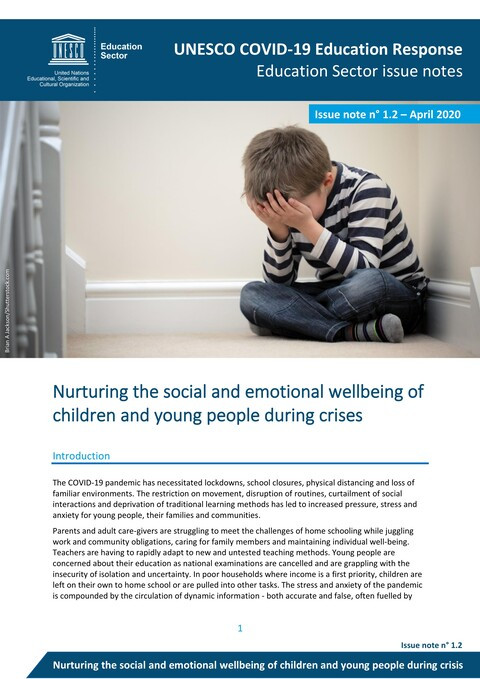 Nurturing the Social and Emotional Wellbeing of Children and Young People During Crises (UNESCO COVID-19 Education Response: Education Sector issue notes; No.1.2, 2020) Year of publication: 2020 Corporate author: UNESCO The COVID-19 pandemic has necessitated lockdowns, school closures, physical distancing and loss of familiar environments. The restriction on movement, disruption of routines, curtailment of social interactions and deprivation of traditional learning methods has led to increased pressure, stress and anxiety for young people, their families and communities. Parents and adult care-givers are struggling to meet the challenges of home schooling while juggling work and community obligations, caring for family members and maintaining individual well-being. Teachers are having to rapidly adapt to new and untested teaching methods. Young people are concerned about their education as national examinations are cancelled and are grappling with the insecurity of isolation and uncertainty. In poor households where income is a first priority, children are left on their own to home school or are pulled into other tasks. The stress and anxiety of the pandemic is compounded by the circulation of dynamic information - both accurate and false, often fuelled by sensationalist media reporting. This not only increases insecurity but also acts as fertile ground for the spread of intolerance, racism, xenophobia and hate crimes. To address and counter the social anxiety, emotional upheaval and fearful insecurity unleashed by COVID-19, it is urgent and necessary that families and communities build vital coping skills and emotional resilience. Social and emotional skills are well established, evidence-based practices, that can be adapted to help equip children, young people, parents and teachers with the knowledge, skills, attitudes and behaviours they need to stay healthy and positive, navigate emotions, practice mindful engagement, exhibit pro-social behaviour and cope with daily challenges. Promoción del bienestar socioemocional de los niños y los jóvenes durante las crisis (Respuesta del ámbito educativo de la UNESCO al COVID-19 Notas temáticas del Sector de Educación; No.1.2, 2020) Year of publication: 2020 Corporate author: UNESCO La pandemia del COVID-19 ha requerido cuarentenas, cierre de escuelas, distanciamiento físico y pérdida de entornos familiares. La restricción de movimiento, la interrupción de las rutinas, la reducción de las interacciones sociales y la privación de los métodos de aprendizaje tradicionales han dado como resultado una mayor presión, estrés y ansiedad en las personas jóvenes, sus familias y sus comunidades. Actualmente las madres, los padres y los cuidadores se esfuerzan por cumplir los desafíos del aprendizaje en el hogar y a la vez tener que hacer malabares con el trabajo y sus obligaciones comunitarias, el cuidado de sus familiares y su propio bienestar individual. Las y los docentes han tenido que adaptarse rápidamente a métodos de enseñanza nuevos y que todavía no han sido probados. La gente joven está preocupada por su propia educación al ver cancelarse los exámenes nacionales y luchan contra la inseguridad producida por el aislamiento y la incertidumbre. En los hogares más pobres, donde los ingresos son la primera prioridad, se deja a los niños y las niñas a cargo de su propio aprendizaje o se les asignan otras tareas. El estrés y la ansiedad de la pandemia se ven agravados por la circulación de información dinámica, tanto verdadera como falsa, que por lo general es fomentada por el trabajo de la prensa sensacionalista. Esto no solo aumenta la inseguridad, sino que también actúa como un campo fértil para la propagación de la intolerancia, el racismo, la xenofobia y los crímenes de odio. Para abordar y contrarrestar la ansiedad social, la convulsión emocional y la atemorizante inseguridad que ha desatado el COVID-19, es urgente que las familias y las comunidades desarrollen habilidades vitales de adaptación y resiliencia emocional. Las habilidades sociomocionales son prácticas bien establecidas y con base empírica que se pueden adaptar con el fin de entregar a niños, niñas, jóvenes, padres, madres y docentes las herramientas, habilidades, actitudes y conductas necesarias para mantenerse sanos y positivos, explorar en sus emociones, practicar un compromiso consciente, exhibir una conducta prosocial y lidiar con los desafíos diarios. Favoriser le bien-être social et émotionnel des enfants et des jeunes en période de crise(Réponse éducative de l’UNESCO face au Covid-19: Notes du Secteur de l’éducation; No.1.2, 2020) Year of publication: 2020 Corporate author: UNESCO La pandémie de COVID-19 a nécessité le confinement, la fermeture des écoles, la distanciation physique et la perte d’environnements familiers. Les restrictions de déplacement, le bouleversement des routines, la diminution des interactions sociales et la privation des méthodes d’apprentissage traditionnelles ont eu pour effet d’augmenter la pression, le stress et l’anxiété chez les jeunes, leurs familles et leurs communautés Les parents et les adultes aidants déploient des efforts considérables pour gérer l’école à la maison, tout en jonglant avec leurs obligations professionnelles et communautaires, s’occupant des membres de la famille et préservant le bien-être de chacun. Les enseignants doivent s’adapter rapidement à de nouvelles méthodes d’enseignement non éprouvées. Les jeunes s’inquiètent pour leurs études à cause de l’annulation des examens et sont aux prises avec un sentiment d’insécurité dû à l’isolement et à l’incertitude. Dans les foyers pauvres, où le revenu est la priorité absolue, les enfants sont livrés à euxmêmes pour leur travail scolaire ou en sont détournés pour effectuer d’autres tâches. Le stress et ’anxiété suscités par la pandémie sont aggravés par la circulation d’informations, exactes ou fausses, souvent exacerbées par les articles à sensation des médias. Non seulement le sentiment d’insécurité en est accru, mais cela crée un terrain propice à la propagation de l’intolérance, du racisme, de la xénophobie et des crimes de haine. Pour combattre et contrer l’anxiété sociale, les troubles émotionnels ainsi que le sentiment d’insécurité et de peur générés par le COVID-19, il est urgent et nécessaire que les familles et les communautés acquièrent des capacités d’adaptation et une résilience émotionnelle vitales. Les compétences sociales et émotionnelles sont des pratiques bien établies, fondées sur des données, qui peuvent être adaptées pour équiper les enfants, les jeunes, les parents et les enseignants des connaissances, compétences, attitudes et comportements nécessaires pour rester en bonne santé et positifs, gérer ses émotions, s’engager en toute conscience, adopter un comportement social positif et faire face aux difficultés quotidiennes.