
Resources
Explore a wide range of valuable resources on GCED to deepen your understanding and enhance your research, advocacy, teaching, and learning.
3,782 Results found
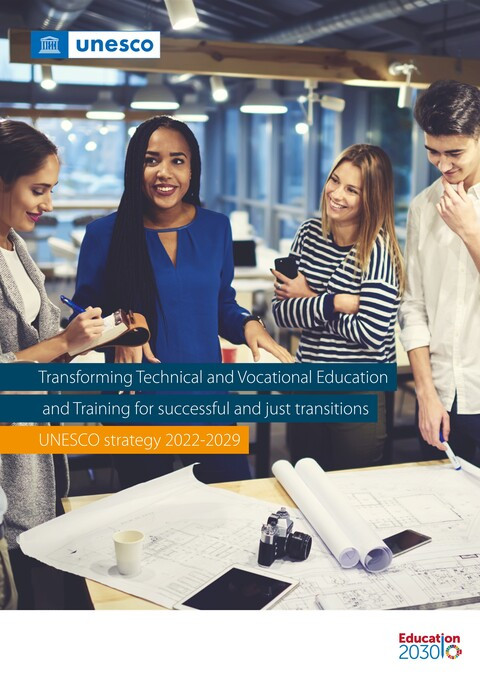 Transformar la educación y formación técnica y profesional (EFTP) para transiciones exitosas y justas: Estrategia de la UNESCO 2022-2029 Year of publication: 2022 Corporate author: UNESCO Esta estrategia que abarca del 2022 al 2029, guía a la UNESCO para promover el desarrollo de competencias para el empoderamiento, empleo productivo y trabajo decente, y facilitar la transición hacia economías y sociedades más digitales, verdes e inclusivas. En línea con los Objetivos de Desarrollo Sostenible, la Agenda Educación 2030, y las recomendaciones de la Cumbre sobre la Transformación de la Educación, la UNESCO apoyará la transformación de la educación y formación técnica y profesional en todos los Estados Miembros y trabajara con socios bilaterales y multilaterales, instituciones, gobiernos, el sector privado y educadores de todo el mundo para posicionar a la EFTP como máxima prioridad en la agenda educativa. Es evidente que deben realizarse esfuerzos colectivos para preparar a los jóvenes y adultos en la adquisición de nuevas habilidades, ayudándolos a desarrollar su potencial para afrontar de manera exitosa los cambios sociales, económicos y medioambientales que el mundo está atravesando.
 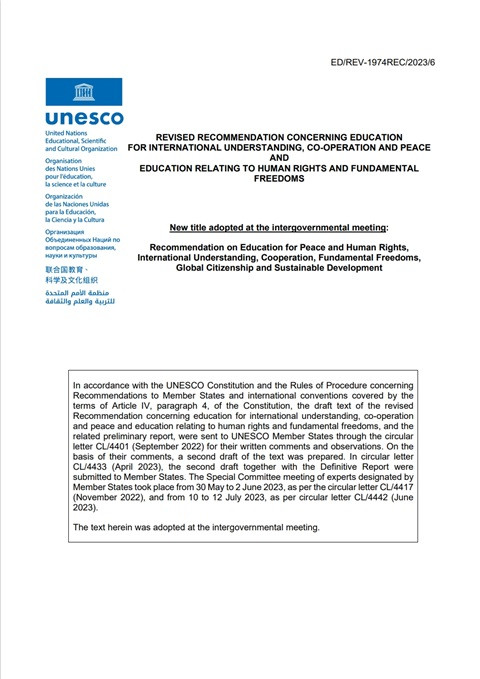 Recommendation on Education for Peace and Human Rights, International Understanding, Cooperation, Fundamental Freedoms, Global Citizenship and Sustainable Development Year of publication: 2023 Corporate author: UNESCO Building more peaceful, just, and sustainable societies starts with education. It influences all aspects of our daily lives and our overall prospects while being impacted by our health and environment. In the global landscape of worsening climate change, democratic backsliding, persistent inequalities, rising discrimination, hate speech, violence and conflict, it can be a tool to address and prevent these problems in the future. And it can also be a long-term investment with increasing returns if shaped and deployed effectively. The new UNESCO Recommendation on Education for Peace and Human Rights, International Understanding, Cooperation, Fundamental Freedoms, Global Citizenship and Sustainable Development, which is commonly referred to as the Recommendation on Education for Peace, Human Rights and Sustainable Development is a landmark guidance document that defines what needs to evolve in and through education to accomplish these goals. 평화, 인권, 국제이해, 협력, 기본적 자유, 세계시민성, 지속가능발전을 위한 교육 권고 Year of publication: 2023 Corporate author: 유네스코 이 권고는 ‘국제이해, 협력, 평화를 위한 교육과 인권, 기본적 자유에 관한 교육 권고(1974)’를 개정하여 2023년 제42차 유네스코 총회가 채택한 것이다.
  Kit de herramientas global sobre IA y el estado de derecho para el poder judicial Year of publication: 2023 Author: Miriam Stankovich | Ivana Feldfeber | Yasmín Quiroga | Marianela Ciolfi Felice | Vukosi Marivate Corporate author: UNESCO ¿Qué es la Inteligencia artificial (IA)? ¿Cómo funciona? Y lo que es más importante, ¿cómo se abre camino en el contexto judicial? Tecnologías como la IA han existido durante décadas, pero solo recientemente han comenzado a usarse en una variedad de entornos de justicia y aplicación de la ley. Si bien la IA tiene un inmenso potencial para el sistema de justicia, ya que ayuda a los jueces a tomar mejores decisiones, mejora la eficiencia, aumenta el acceso y ayuda a detectar y prevenir el delito, también existen algunas cuestiones importantes que las partes interesadas en la justicia deben tener en cuenta mientras se preparan para un futuro en el que la IA se utiliza cada vez más en los sistemas de justicia. En 2022, la UNESCO lanzó dos evaluaciones de necesidades. En primer lugar, a través de la Encuesta de evaluación de necesidades de inteligencia artificial de la UNESCO en África, el 90 % de los 32 países encuestados solicitaron apoyo para el desarrollo de capacidades para el poder judicial en materia de IA. Al mismo tiempo, una segunda encuesta mundialde actores judiciales en 100 países subrayó la necesidad de comprender mejor el uso de la IA en la administración de justicia y sus repercusiones jurídicas más amplias en las sociedades. El “Kit de herramientas mundial sobre la IA y el Estado de derecho” para el Poder Judicial responde a estas necesidades y proporciona a los actores judiciales (jueces, fiscales, fiscales estatales, abogados públicos, universidades de derecho e instituciones de formación judicial) el conocimiento y las herramientas necesarias para comprender los beneficios y riesgos de la IA en su trabajo. El kit de herramientas ayudará a los actores judiciales a mitigar los posibles riesgos de la IA para los derechos humanos al brindar orientación sobre las leyes, principios, normas y jurisprudencia internacional de derechos humanos relevantes que sustentan el uso ético de la IA.
 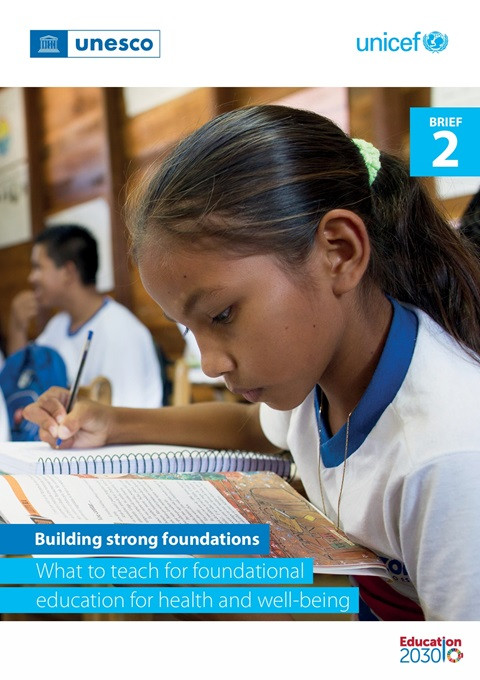 Building Strong Foundations: What to Teach for Foundational Education for Health and Well-being (Building Strong Foundations Brief; 2) Year of publication: 2024 Corporate author: UNESCO | United Nations Children's Fund (UNICEF) In a rapidly changing world, establishing strong foundations for children is vital for their well-being and resilience. Quality education is central to this endeavour and is the key to lifelong health and success. Recognizing that children thrive in the classroom when they are in good health, it is crucial to learn about health and well-being early on in primary schools. The Building strong foundations briefs, developed jointly by UNESCO and UNICEF, provide evidence-based guidance to support primary school-aged children to thrive through foundational education for health and well-being. Drawing from extensive research and consultations with leading experts from various fields and across the world, these briefs serve as a roadmap for education stakeholders to equip learners with the requisite knowledge and skills to navigate their current and future health and well-being needs. The present document is the second of four briefs. It is a go-to resource to better understand what makes a primary school curriculum effective in supporting health, well-being and learning. The brief provides practical tips and insights on integrating core thematic concepts for health and well-being into the curriculum, including concrete examples of learning objectives for lower primary and upper primary curricula. Whether a seasoned curriculum designer, a passionate educator or an individual involved in primary school curriculum processes, this brief equips readers with the tools to design impactful curricula for transformative learning, health and well-being.
  Countering Online Hate Speech Year of publication: 2015 Author: Iginio Gagliardone | Danit Gal | Thiago Alves | Gabriela Martinez Corporate author: UNESCO The present report provides a global overview of the dynamics characterizing hate speech online and some of the measures that have been adopted to counteract and mitigate it, highlighting good practices that have emerged at the local and global levels. While the study offers a comprehensive analysis of the international, regional and national normative frameworks developed to address hate speech online, and their repercussions for freedom of expression, it places particular emphasis on social and non-regulatory mechanisms that can help to counter the production, dissemination and impact of hateful messages online. Combattre les discours de haine sur internet Year of publication: 2015 Author: Iginio Gagliardone | Danit Gal | Thiago Alves | Gabriela Martinez Corporate author: UNESCO Le présent rapport offre un panorama mondial des dynamiques caractéristiques des discours de haine en ligne et des mesures prises pour les combattre et les contenir, en mettant en évidence les bonnes pratiques qui ont émergé au niveau local comme au niveau international. Si l’étude fournit une analyse exhaustive des cadres normatifs internationaux, régionaux et nationaux mis en place pour lutter contre les discours de haine en ligne et de leurs répercussions sur la liberté d’expression, elle met particulièrement l’accent sur les mécanismes sociaux et non réglementaires qui peuvent contribuer à lutter contre la production, la diffusion et l’impact des messages de haine en ligne.
  Youth and Violent Extremism on Social Media: Mapping the Research Year of publication: 2017 Author: Séraphin Alava | Divina Frau-Meigs | Ghayda Hassan Corporate author: UNESCO | Information for All Programme (IFAP) Does social media lead vulnerable individuals to resort to violence? Many people believe it does. And they respond with online censorship, surveillance and counter-speech. But what do we really know about the Internet as a cause, and what do we know about the impact of these reactions? All over the world, governments and Internet companies are making decisions on the basis of assumptions about the causes and remedies to violent attacks.The challenge is to have analysis and responses firmly grounded. The need is for a policy that is constructed on the basis of facts and evidence, and not founded on hunches – or driven by panic and fearmongering.It is in this context that UNESCO has commissioned the study titled Youth and Violent Extremism on Social Media – Mapping the Research. This work provides a global mapping of research (mainly during 2012-16) about the assumed roles played by social media in violent radicalization processes, especially when they affect youth and women. The research responds to the belief that the Internet at large is an active vector for violent radicalization that facilitates the proliferation of violent extremist ideologies.Indeed, much research shows that protagonists are indeed heavily spread throughout the Internet. There is a growing body of knowledge about how terrorists use cyberspace. Less clear, however, is the impact of this use, and even more opaque is the extent to which counter measures are helping to promote peaceful alternatives. While Internet may play a facilitating role, it is not established that there is a causative link between it and radicalization towards extremism, violent radicalization, or the commission of actual acts of extremist violence. Молодежь и насильственный экстремизм в социальных медиа: Сопоставление исследований Year of publication: 2017 Author: Séraphin Alava | Divina Frau-Meigs | Ghayda Hassan Corporate author: UNESCO | Information for All Programme (IFAP) Оказывают ли влияние социальные сети на уязвимые группы молодежи, в последствие которого они прибегают к насилию? Многие считают, что да. И они отвечают онлайн-цензурой, наблюдением и контрречью. Но что действительно мы знаем об Интернете в качестве причины развития насилия, и что мы знаем о влиянии реакций людей? Во всем мире правительства и интернет-компании принимают решения на основе предположений о причинах и средствах защиты от насильственных нападений.Задача состоит в том, чтобы анализ и ответы были прочно обоснованы. Существует необходимость в политике, которая построена на основе фактов и доказательств, а не основана на суждениях или на панике и страхе.Именно в этом контексте ЮНЕСКО поручила провести исследование под названием «Молодежь и насильственный экстремизм в социальных медиа - сопоставление исследований". Эта работа обеспечивает глобальное сопоставление (в основном в течение 2012-16 гг.) о предполагаемых ролях, которые играют социальные медиа в процессе радикализации, особенно когда они затрагивают молодежь и женщин. Исследование реагирует на убеждение, что Интернет в целом является активным вектором насильственной радикализации, что способствует распространению насильственных экстремистских идеологий.Действительно, много исследований показывает, что протагонисты достаточно широко распространены по всему Интернету. Eсть растущий объем знаний о том, как террористы используют киберпространство. Менее ясное, однако,влияние этого использования и еще более непрозрачное - это степень, в которой встречные меры помогают продвигать мирные альтернативы.
  Enseigner et apprendre avec Twitter Year of publication: 2019 Corporate author: Twitter | Organisation des Nations Unies pour l'éducation, la science et la culture (UNESCO) Ce document est destiné aux enseignants qui souhaitent créer des cours axés sur l'éducation aux médias et à l'information, et leur lien avec le fait d'être un « citoyen du monde » et un « citoyen numérique ». Que vos cours soient orientés sur l'éducation aux médias et à l'information (MIL), sur les bonnes habitudes à adopter sur Internet ou toute autre compétence liée à l'utilisation du Web, ce document contient des informations qui pourront vous être utiles.