
Resources
Explore a wide range of valuable resources on GCED to deepen your understanding and enhance your research, advocacy, teaching, and learning.
1,448 Results found
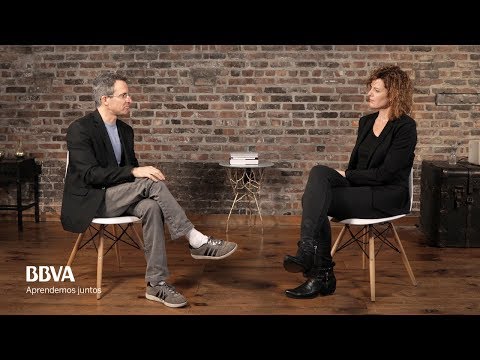 La ciencia de la felicidad Year of publication: 2018 Corporate author: BBVA Aprendemos Juntos Tal Ben-Shahar es el científico de la felicidad del siglo XXI. En este vídeo nos habla sobre la necesidad de enseñar con emociones positivas para aumentar la felicidad y la creatividad de los estudiantes. Doctor en psicología y filosofía, El curso de Psicología Positiva de Tal Ben-Shahar en Harvard posee el récord de la asignatura con mayor número de alumnos de la historia (1400 por semestre) de la Universidad de Harvard ganándose el sobrenombre de “profesor de la felicidad”. Ben-Shahar es autor de libros como "Elige la vida que quieres” o "Practicar la felicidad”, entre otros, en los que nos habla sobre las emociones que mejoran el aprendizaje, la creatividad, la capacidad de innovación, y en definitiva, la vida diaria de las personas.
 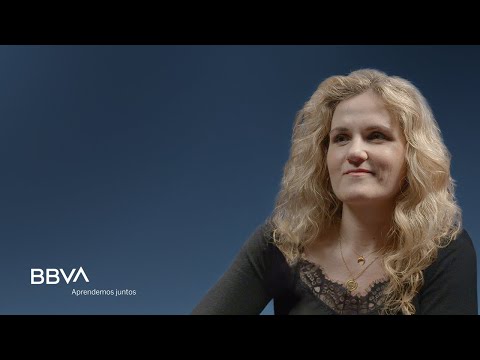 What Does It Mean to Have Good Self-Esteem? Year of publication: 2020 Corporate author: BBVA Aprendemos Juntos The psychologist Silvia Congost exposes in this video the steps to develop a healthy self-esteem, based on the teachings of Nathaniel Branden, author of 'The six pillars of self-esteem': live consciously, accept oneself, take responsibility for our actions , develop assertiveness, live with a purpose and be a person of integrity. ¿Qué significa tener buena autoestima? Year of publication: 2020 Corporate author: BBVA Aprendemos Juntos La psicóloga Silvia Congost expone en este vídeo los pasos para desarrollar una sana autoestima, a partir de las enseñanzas de Nathaniel Branden, autor de 'Los seis pilares de la autoestima': vivir de forma consciente, aceptarse a uno mismo, responsabilizarnos de nuestros actos, desarrollar la asertividad, vivir con un propósito y ser personas íntegras.
 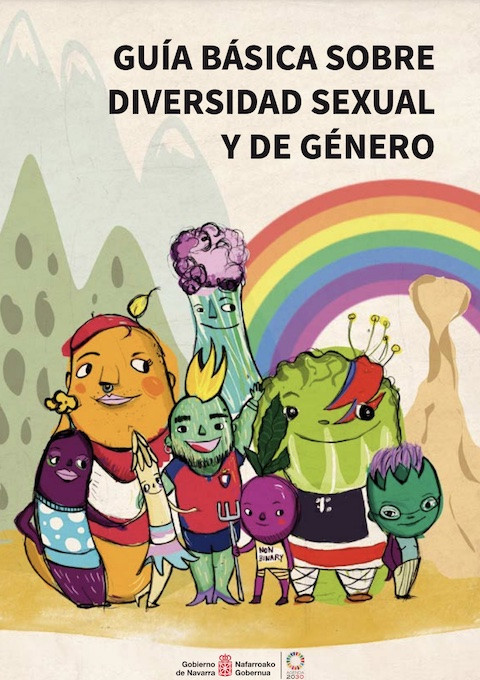 Basic Guide on Sexual and Gender Diversity Year of publication: 2020 Author: Miriam Solá García Corporate author: Navarra Institute for Equality This guide is a tool to learn about affective, sexual and gender diversity and reflect on why all of us have a key role in social change to achieve equality and recognition of LGTBI+ people. Respect for affective, sexual and gender diversity is an element of value and social wealth in whose promotion and experience all citizens are involved. Guía básica sobre diversidad sexual y de género Year of publication: 2020 Author: Miriam Solá García Corporate author: Navarra Institute for Equality Esta guía es una herramienta para conocer la diversidad afectiva, sexual y de género y reflexionar sobre por qué todas las personas tenemos un papel clave en el cambio social para lograr la igualdad y reconocimiento de las personas LGTBI+. El respeto por la diversidad afectiva, sexual y de género es un elemento de valor y de riqueza social en cuya promoción y vivencia está implicada toda la ciudadanía
 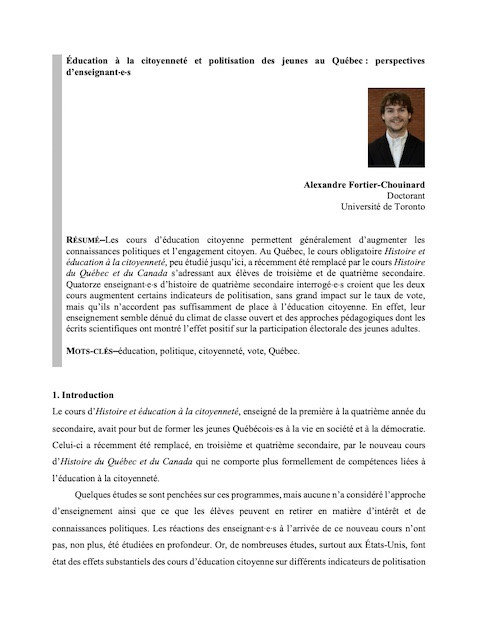 Citizenship Education and Youth Politicization in Quebec: Teacher Perspectives (vol. 46, no. 3) Year of publication: 2020 Author: Alexandre Fortier-Chouinard Corporate author: Université de Montréal. Faculté des sciences de l’éducation Civic education classes generally have a positive impact on political knowledge and citizen involvement. In Quebec, the mandatory History and citizenship education class, almost unstudied thus far, was recently replaced by a History of Quebec and Canada class in secondary 3 and 4. 14 interviewed History and citizenship education teachers in secondary 4 believe that these courses improve some indicators of students’ politicization but not necessarily future turnout, and that civic education takes too little space in the curriculum. An open classroom climate, which literature has found to have a positive impact on voting, seems to be absent from their teaching. Éducation à la citoyenneté et politisation des jeunes au Québec: Perspectives d’enseignant⋅e⋅s (vol. 46, no. 3) Year of publication: 2020 Author: Alexandre Fortier-Chouinard Corporate author: Université de Montréal. Faculté des sciences de l’éducation Les cours d’éducation citoyenne permettent généralement d’augmenter les connaissances politiques et l’engagement citoyen. Au Québec, le cours obligatoire Histoire et éducation à la citoyenneté, peu étudié jusqu’ici, a récemment été remplacé par le cours Histoire du Québec et du Canada s’adressant aux élèves de troisième et de quatrième secondaire. Quatorze enseignant⋅e⋅s d’histoire de quatrième secondaire interrogé⋅e⋅s croient que les deux cours augmentent certains indicateurs de politisation, sans grand impact sur le taux de vote, mais qu’ils n’accordent pas suffisamment de place à l’éducation citoyenne. En effet, leur enseignement semble dénué du climat de classe ouvert et des approches pédagogiques dont les écrits scientifiques ont montré l’effet positif sur la participation électorale des jeunes adultes.
 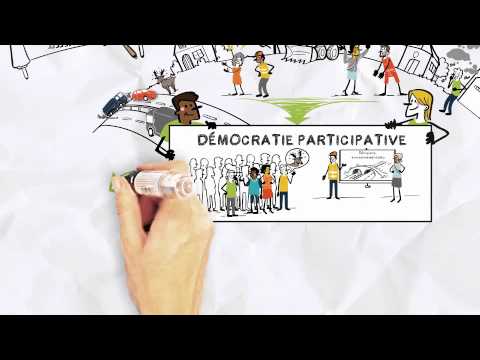 Why and How to Move Towards Participatory Democracy Year of publication: 2015 Corporate author: Fondation pour la Nature et l'Homme Co-constructing tomorrow's solutions is the major challenge of participatory democracy. However, the participation of citizens in decisions is not always obvious and today many projects are contested in the territory. Solutions exist to involve citizens more directly in environmental decisions, discover these issues and solutions in 3 minutes! Pourquoi et comment aller vers une démocratie participative Year of publication: 2015 Corporate author: Fondation pour la Nature et l'Homme Co-construire les solutions de demain, tel est l’enjeu majeur de la démocratie participative. Cependant, la participation des citoyens aux décisions n’est pas toujours évidente et aujourd’hui de nombreux projets sont contestés sur le territoire. Des solutions existent pour impliquer plus directement les citoyens dans les décisions environnementales, découvrez en 3 minutes ces enjeux et solutions !
 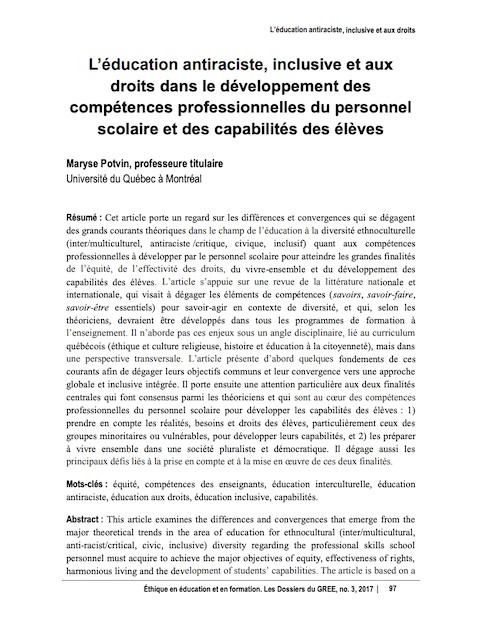 Anti-racist, Inclusive and Rights Education in the Development of Professional Competencies for School Staff and Student Abilities (Éthique en éducation et en formation; no. 3) Year of publication: 2017 Author: Maryse Potvin Corporate author: Université du Québec à Montréal (UQAM) This article examines the differences and convergences that emerge from the major theoretical trends in the area of education for ethnocultural (inter/multicultural, anti-racist/critical, civic, inclusive) diversity regarding the professional skills school personnel must acquire to achieve the major objectives of equity, effectiveness of rights, harmonious living and the development of students’ capabilities. The article is based on a review of the national and international literature, which aimed to identify the skills (knowledge, expertise, soft skills) that are essential for knowing how to act in the context of diversity and that, according to theoreticians, should be developed in all teacher training programs. These issues are discussed from a crosscutting perspective rather than from a disciplinary angle related to the Quebec curriculum (ethics and religious culture, history and education for citizenship). The article begins by providing some background on these trends in order to identify their common objectives and convergence toward an integrated and inclusive global approach. It then examines two objectives supported by all theoreticians in terms of the core professional skills needed by school personnel for developing students’ capabilities: 1) taking into account the realities, needs and rights of students, particularly those in minority or vulnerable groups, and 2) preparing students to live together in a pluralistic and democratic society. As well, it identifies the key challenges involved in the consideration and implementation of these two goals.