
Resources
Explore a wide range of valuable resources on GCED to deepen your understanding and enhance your research, advocacy, teaching, and learning.
1,180 Results found
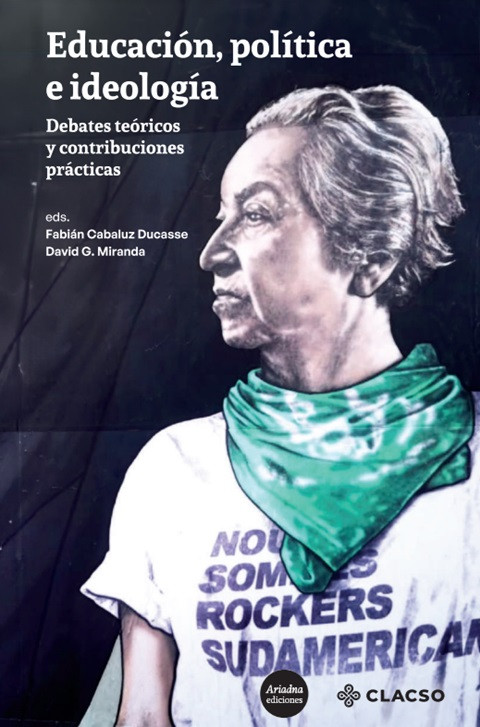 Education, Politics and Ideology: Theoretical Debates and Practical Contributions Year of publication: 2024 Author: David G. Miranda | Jorge Fabián Cabaluz Ducasse Corporate author: Latin American Council of Social Sciences (CLACSO) This book, "Education, Politics and Ideology: Theoretical Debates and Practical Contributions", is a work by the Latin American Pedagogies Research Group at the University of Playa Ancha, which is positioned from a critical perspective in the educational and pedagogical field. This currently implies, among other things, the relevance of discussing, polemizing and confronting those perspectives that have technified and instrumentalized pedagogy, reducing it to a merely practical, technical field, unrelated to epistemological, ethical, philosophical and/or political issues. In this direction, the essays that make up the book distance themselves substantially from those perspectives that conceive our field as a terrain that must advocate for neutrality, impartiality, and asepsis; and they propose clear and explicit positions with respect to social justice, democracy, equality, and dignity. Educación, política e ideología: Debates teóricos y contribuciones prácticas Year of publication: 2024 Author: David G. Miranda | Jorge Fabián Cabaluz Ducasse Corporate author: Latin American Council of Social Sciences (CLACSO) Este libro "Educación, política e ideología: debates teóricos y contribuciones prácticas", surge desde el Grupo de Investigación de Pedagogías Latinoamericanas de la Universidad de Playa Ancha, el cual se encuentra posicionado desde las perspectivas críticas del campo educativo y pedagógico, lo que implica en la actualidad, entre otras cosas, la relevancia de discutir, polemizar y confrontar aquellas perspectivas que han tecnificado e instrumentalizado la pedagogía, reduciéndola a un campo meramente práctico, técnico, ajeno a cuestiones epistemológicas, éticas, filosóficas y/o políticas. En esta dirección, los ensayos que componen el libro se distancian sustancialmente de aquellas perspectivas que conciben nuestro campo como un terreno que debe abogar por la neutralidad, la imparcialidad, la asepsia; y proponen posicionamientos claros y explícitos con respecto a la justicia social, la democracia, la igualdad, la dignidad.
  Education Reform in Pakistan Year of publication: 2014 Corporate author: International Crisis Group In April 2010, the eighteenth constitutional amendment committed Pakistan to free and compulsory education for all children between the ages of five and sixteen. Yet millions are still out of school, and the education system remains alarmingly impoverished. The madrasa (religious school) sector flourishes, with no meaningful efforts made to regulate the seminaries, many of which propagate religious and sectarian hatred. Militant violence and natural disasters have exacerbated the dismal state of education. The public education system needs to foster a tolerant citizenry, capable of competing in the labour market and supportive of democratic norms within the country and peace with the outside world. Education Reform in Pakistan Year of publication: 2014 Corporate author: International Crisis Group En Avril 2010, le Pakistan s’est engagé, l'amendement constitutionnel XVIII, à mettre en place une éducation gratuite et obligatoire pour tous les enfants âgés de cinq à seize ans. Pourtant, des millions d’enfants ne sont encore à l'école et le système éducatif s’appauvrit d’une façon alarmante. Le secteur de la madrasa (école religieuse) fleurit, sans que des efforts significatifs soient déployés pour réglementer les séminaires, qui propagent souvent la haine religieuse et le sectarisme. La violence militante et les catastrophes naturelles ont aggravé l'état lamentable de l'éducation. Le système public de l'éducation doit favoriser une citoyenneté tolérante, compétitive sur le marché du travail et apportant son soutien aux normes démocratiques dans le pays et à la paix avec le monde extérieur.
 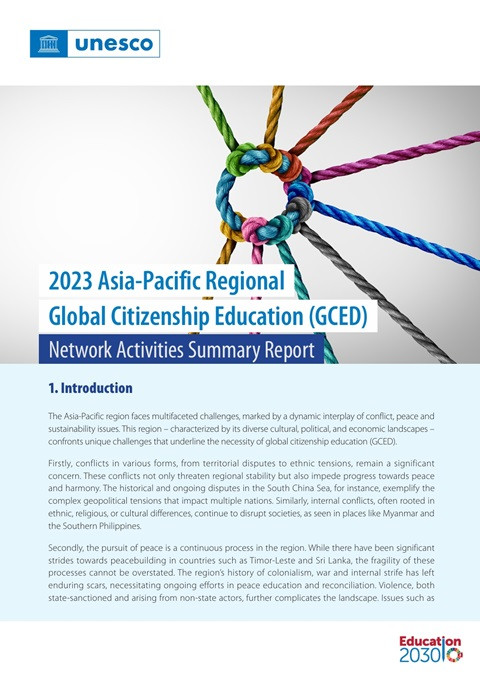 2023 Asia-Pacific Regional Global Citizenship Education (GCED): Network Activities Summary Report Year of publication: 2023 Author: Seek Ling Tan Corporate author: UNESCO Bangkok This is a summary report from the Global Citizenship Education (GCED) network activities in Asia-Pacific in 2023. The Asia-Pacific Regional Global Citizenship Education Network, spearheaded by UNESCO Bangkok and the Asia-Pacific Centre of Education for International Understanding (APCEIU), has illuminated the path to empower learners to become global citizens since its inception in 2018. In 2023, their journey was punctuated by significant milestones and a revitalized commitment to propel GCED across the region. This commitment is particularly evident in the key priority areas of advocacy, capacity building, learning/teaching materials, policy and research and the synergizing of regional collaboration towards Education 2030.
 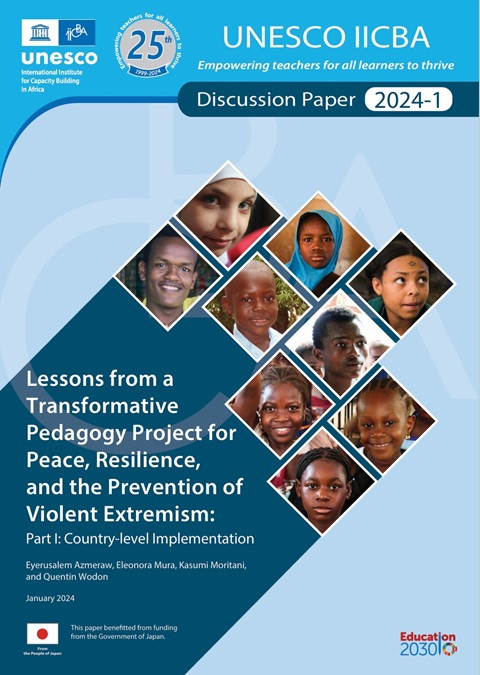 Lessons from a Transformative Pedagogy Project for Peace, Resilience, and the Prevention of Violent Extremism: Part I; Country-Level Implementation Year of publication: 2024 Author: Eyerusalem Azmeraw | Quentin Wodon | Eleonora Mura | Kasumi Moritani Corporate author: UNESCO International Institute for Capacity-Building in Africa (IICBA) From 2017 to 2022, UNESCO’s International Institute for Capacity Building in Africa (IICBA) led a series of projects for peacebuilding and the prevention of violent extremism through education with support from the Government of Japan. This two-part paper draws lessons from the projects. The first part of the paper briefly explains the transformative pedagogy approach that guided project implementation and provides examples of changes that were implemented at the country level under the projects. The analysis is qualitative, with the aim being to outline, through country examples, what can be achieved through such projects. Lessons on factors contributing to impact are also outlined.
 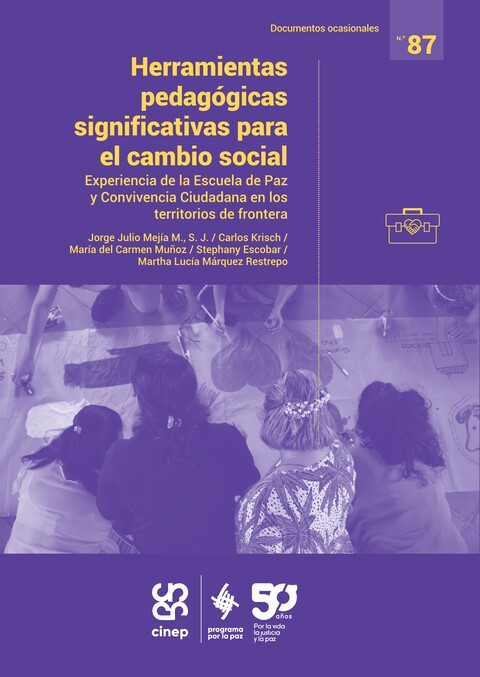 Significant Pedagogical Tools for Social Change Year of publication: 2023 Author: Jorge Julio Mejía | Carlos Krisch | Sthepany Escobar | Martha Lucía | Márquez Restrepo | María Del Carmen Muñoz Corporate author: Center for Research and Popular Education / Program for Peace (CINEP/PPP) This document includes significant pedagogical tools to promote processes of social change through training experiences for twelve years in territories on the Colombian-Venezuelan border. Through workshops and activities, participants have experienced transformations in attitudes and practices that have been useful for understanding the border as a shared space. Herramientas pedagógicas significativas para el cambio social Year of publication: 2023 Author: Jorge Julio Mejía | Carlos Krisch | Sthepany Escobar | Martha Lucía | Márquez Restrepo | María Del Carmen Muñoz Corporate author: Center for Research and Popular Education / Program for Peace (CINEP/PPP) En este documento se recogen las herramientas pedagógicas significativas para promover procesos de cambio social a través de experiencias formativas durante doce años en territorios de la frontera colombo-venezolana. Mediante talleres y actividades, los participantes han experimentado transformaciones en actitudes y prácticas que les han resultado útiles para comprender la frontera como un espacio compartido.
  MGIEP Annual Report 2015-2016 Year of publication: 2017 Corporate author: Mahatma Gandhi Institute of Education for Peace and Sustainable Development (MGIEP) The Mahatma Gandhi Institute of Education for Peace and Sustainable Development (MGIEP) is UNESCO’s first Category I institute in the Asia-Pacific region, established with the generous support of the Government of India.UNESCO MGIEP focuses on transforming current education policies and practices by developing innovative teaching and learning methods. Their objective is to build generations of young people equipped to create peaceful and sustainable societies.This annual report describes MGIEP’s main works and various educational programmes for peace and sustainable development.
 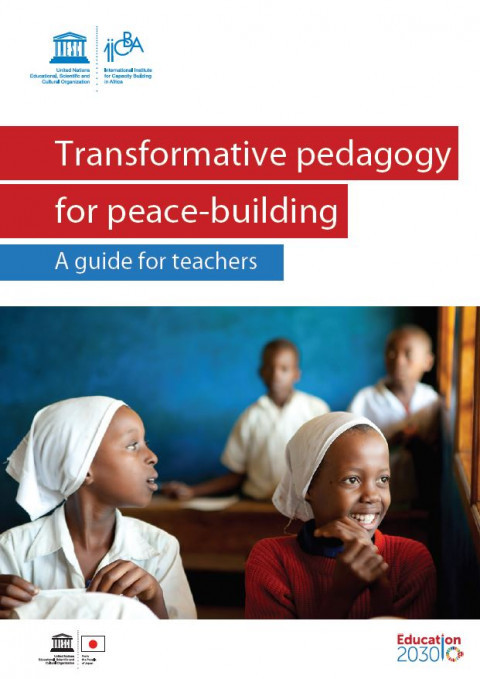 Transformative Pedagogy for Peace-building: A Guide for Teachers Year of publication: 2017 Corporate author: UNESCO International Institute for Capacity-Building in Africa (IICBA) This publication is a guide for teachers and teacher trainers on transformative pedagogy so that they are able to empower youth with peace-building knowledge, skills and competencies necessary to develop into advocates and actors of peace.The guide particularly aims to introduce teachers to the foundation of conflict analysis and peace-building and to equip them with a learner-centered approach to peace education and community engagement.This guide is a resource for educators to engage and support youth in their journey to becoming active peace-builders and fostering transformation in the Horn of Africa and Surrounding Countries.