
Resources
Explore a wide range of valuable resources on GCED to deepen your understanding and enhance your research, advocacy, teaching, and learning.
3,438 Results found
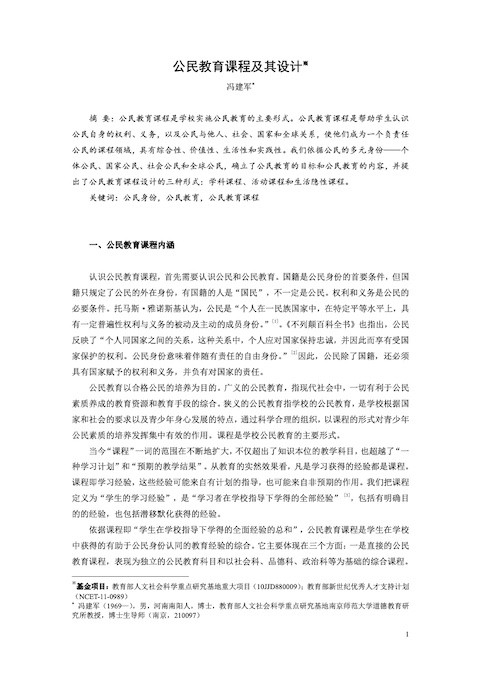 公民教育课程及其设计 Year of publication: 2015 Author: Feng Jianjun Corporate author: Northeast Normal University 本文讨论了关于公民教育课程的相关内容,包括公民教育课程的内涵、内容以及课程结构等。
 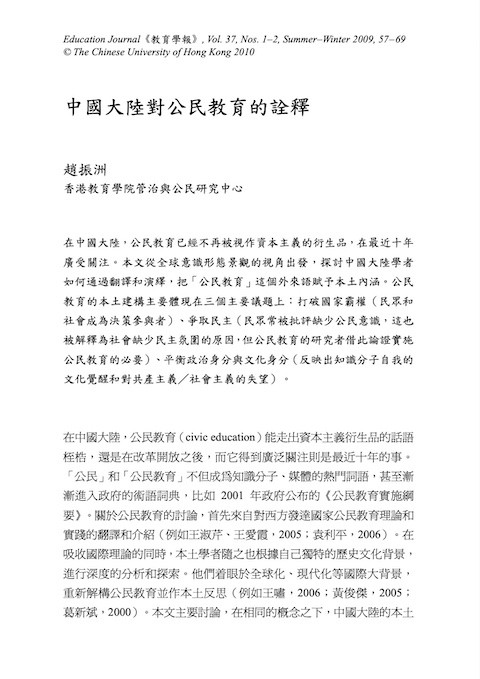 Conceptualization of Citizenship Education in the Chinese Mainland (Education Journal 《教育學報》; Vol. 37) Year of publication: 2010 Author: Zhao Zhengzhou Corporate author: Chinese University of Hong Kong This paper discusses how Chinese academics conceptualised Citizenship Education. It provides a local perspective on this issue, including breaking state hegemony, struggling for democracy and balancing political identity and cultural identity. 中国大陆对公民教育的诠释 (教育學報; Vol. 37) Year of publication: 2010 Author: Zhao Zhengzhou Corporate author: Chinese University of Hong Kong 该文讨论了中国大陆的研究者如何探讨公民教育议题,并赋予公民教育以本土意义,包含,打破国家霸权,争取民主,平衡政治身份与文化身份等。
  Why Is Transformative Education a Vital Response to the Multiple Challenges of the Future? Year of publication: 2021 Author: Tereza Čajková Corporate author: Bridge 47 This report explores the role of transformative education as described in SDG Target 4.7 in responding to the global challenges, risks and trends of the future, and is split into three sections: Part 1 sets the context based on several foresight reports, suggesting that the physical effects of climate change are likely to intensify during the next two decades as humanity looks unlikely to meet the goal of limiting global warming to under 2°C. The burden of climate disruption and environmental decline is already felt by everyone, but disproportionately by the most vulnerable populations. Social challenges described in foresight reports reflect increasing levels of uncertainty, precarity, fragility and complexity. The future world will likely be more connected, yet more fragmented, characterised by multiple changes taking place at an unprecedented pace.Part 2 reflects on the role of education in times of social and ecological transformation. There is currently increasing momentum for questioning established education approaches in terms of whether they are able to equip future generations to cope with the multiple crises the foresight reports warn us of. Transformative education can contribute to this process given that preparing learners to address future challenges is one of its core commitments. Part 3 provides an insight into the types of learning which may be more suited to coping with these numerous challenges. Transformative learning develops the cognitive abilities to learn from the social and historical shortcomings of the dominant world-view and to address the driving forces responsible for degradation of life on the planet. It can support development of dispositions enabling learners to relate to each other and the world in a radically different way, understanding that we cannot separate humanity from the planet and all other living beings and that humanity may need to learn how to live in, and with the world, without occupying its centre.
  Imagining Transformation Otherwise: Case Studies of Learning Practices Year of publication: 2021 Author: Rene Suša Corporate author: Bridge 47 This publication is written by Rene Suša, on behalf the Bridge 47 project. It features ten case studies of organizations and initiatives from around the world that are committed to bringing about positive changes in society and strive to do that in different ways. Working in diverse social, cultural and political contexts, the organizations and initiatives presented in this publication seek to address the systemic inequalities, injustices and harm they perceive as important. They strive to do that in ways that correspond to their analysis of the problems, their respective theories of change and their available means and resources. Although highly diverse in the ways they approach social change, these organizations and initiatives emphasize the importance of learning and unlearning in their work. This applies in equal measure to those initiatives with an explicitly education-oriented mission and to those that work on other approaches to social change, such as different practices of (internal) organizational transformation.
 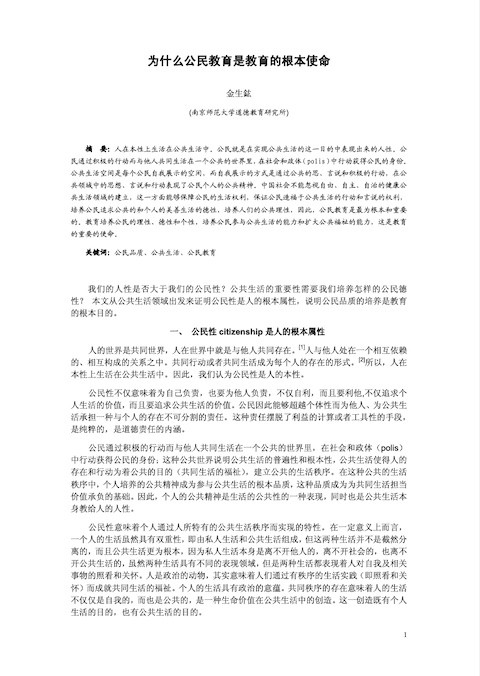 Why the Fundamental Vision of Education Is Civil Education Year of publication: 2007 Author: Jin Shenghong Corporate author: NanJing Normal University This paper discusses the importance of citizenship in modern world. It also stresses the unique role of education in cultivating citizens. 为什么公民教育是教育的根本使命 Year of publication: 2007 Author: Jin Shenghong Corporate author: NanJing Normal University 本文讨论了公民身份对于现代生活的重要意义,并强调了公民教育在培养公民上的重要使命。
 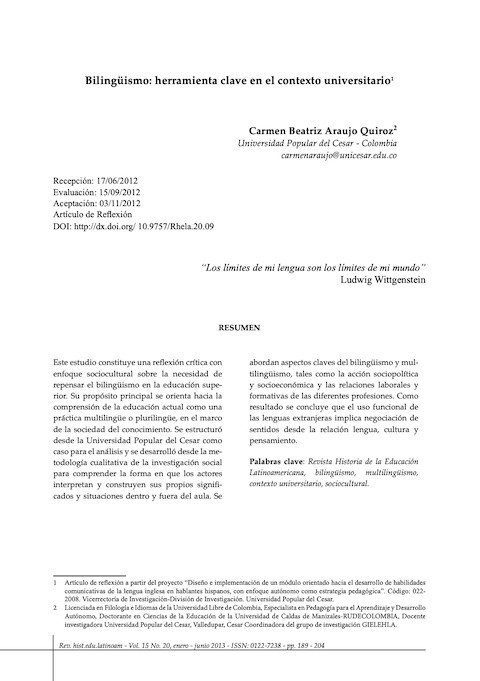 Bilingualism: A Key Tool in the University Context Year of publication: 2013 Author: Carmen Beatriz Araujo Quiroz Corporate author: Rev. hist.edu.latinoam This study constitutes a critical reflection from a sociocultural approach on the need to rethink the bilingualism in higher education. Its main purpose is focus on the understanding of the current education as a multilingual practice in the context of the knowledge society Bilingüismo: Herramienta clave en el contexto universitario Year of publication: 2013 Author: Carmen Beatriz Araujo Quiroz Corporate author: Rev. hist.edu.latinoam Este estudio constituye una reflexión crítica con enfoque sociocultural sobre la necesidad de repensar el bilingüismo en la educación superior. Su propósito principal se orienta hacía la comprensión de la educación actual como una práctica multilingüe o plurilingüe, en el marco de la sociedad del conocimiento.
 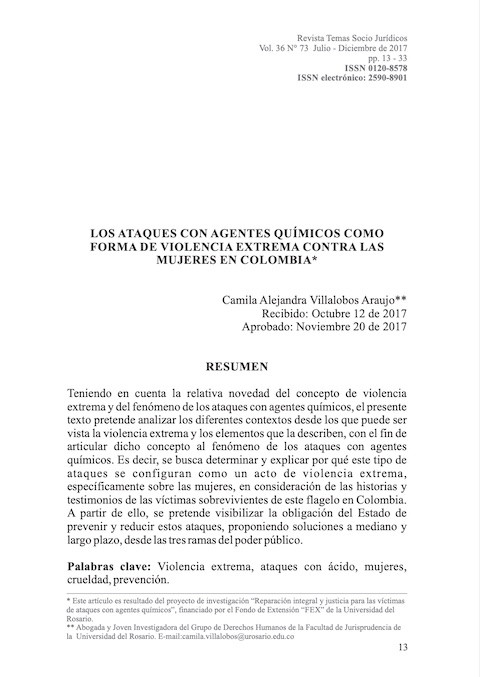 Attacks With Chemical Agents as a Form of Extreme Violence Against Women in Colombia (Revista Temas Socio Jurídicos; Vol. 36 No. 73) Year of publication: 2017 Author: Camila Alejandra Villalobos Araujo Corporate author: Universidad Autónoma de Bucaramanga (UNAB) This text aims to analyse different contexts from which the extreme violence can be seen and the elements that describe it, in order to articulate this concept to the phenomenon of acid attacks. In other words, the text seeks to determine and explain why such attacks are configured as an act of extreme violence, specifically to women, taking into account the stories and testimonies of surviving victims in Colombia. From it, the text seeks to make visible the obligation of the State to prevent and reduce these attacks, proposing solutions in the medium and long term, from the legislative, judicial and executive power.