
Resources
Explore a wide range of valuable resources on GCED to deepen your understanding and enhance your research, advocacy, teaching, and learning.
884 Results found
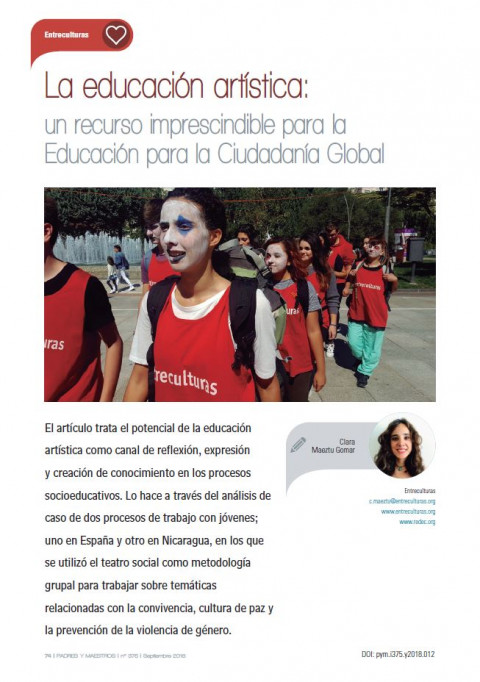 La educación artística: un recurso imprescindible para la Educación para la Ciudadanía Global Year of publication: 2018 Author: Clara Maeztu Gomar El artículo trata el potencial de la educación artística como canal de reflexión, expresión y creación de conocimiento en los procesos socioeducativos. Lo hace a través del análisis de caso de dos procesos de trabajo con jóvenes; uno en España y otro en Nicaragua, en los que se utilizó el teatro social como metodología grupal para trabajar sobre temáticas relacionadas con la convivencia, cultura de paz y la prevención de la violencia de género.
  Address by Irina Bokova, Director-General of UNESCO, on the Role of UNESCO in Countering Anti-Semitism and Preserving the Legacy of the Holocaust on the occasion of the launch of UNESCO's guide on Holocaust Education and Genocide Prevention, 15th Plenary Assembly of the World Jewish Congress, New York, 24 April 2017 Year of publication: 2017 Corporate author: UNESCO. Director-General, 2009-2017 (Bokova, I.G.) This address was given by Irina Bokova, Director-General of UNESCO, on the role of UNESCO in countering anti-semitism and preserving the legacy of the holocaust on the occasion of the launch of UNESCO's guide on Holocaust Education and Genocide Prevention, 15th Plenary Assembly of the World Jewish Congress.
  Well-Being and Safety of Women: OSCE-Led Survey on Violence Against Women Year of publication: 2019 Corporate author: Organization for Security and Co-operation in Europe (OSCE) This report presents the cross-regional, comparable findings of the OSCE-led Survey on the Well-being and Safety of Women, which was implemented in 2018 in Albania, Bosnia and Herzegovina, Montenegro, North Macedonia and Serbia, Moldova3 and Ukraine. The research was also conducted in Kosovo.The OSCE-led survey included a quantitative and qualitative component and was undertaken with the goal of providing comparable data on different forms of violence women experience in their childhood and throughout the course of their lives. The research examined violence that women experience in conflict and non-conflict settings, as well as the impact violence has on women, including its lasting consequences. Questions on norms and attitudes connected to violence against women were asked to better understand the underlying causes of violence.The area covered by this research is diverse and has different historical, social and economic contexts. Rather than focusing on the findings from particular locations, the report aims to provide an overview of women’s experiences and to highlight the issues – often similar – that persist and continue to hamper the well-being and safety of women throughout the area covered by the research.
  Uzbekistan Expresses Concerns about School Bullying Year of publication: 2018 Author: Дарина Солод Corporate author: Central Asian Bureau for Analytical Reporting (CABAR) Psychologists will appear in secondary schools in Uzbekistan. The author asks if they will be able to influence the solution of this complex social problem among children. В Узбекистане озаботились проблемой травли в школах Year of publication: 2018 Author: Дарина Солод Corporate author: Central Asian Bureau for Analytical Reporting (CABAR) В средних школах в Узбекистане появятся психологи. Автор задается вопросом, смогут ли они повлиять на решение этой сложной социальной проблемы среди детей.
 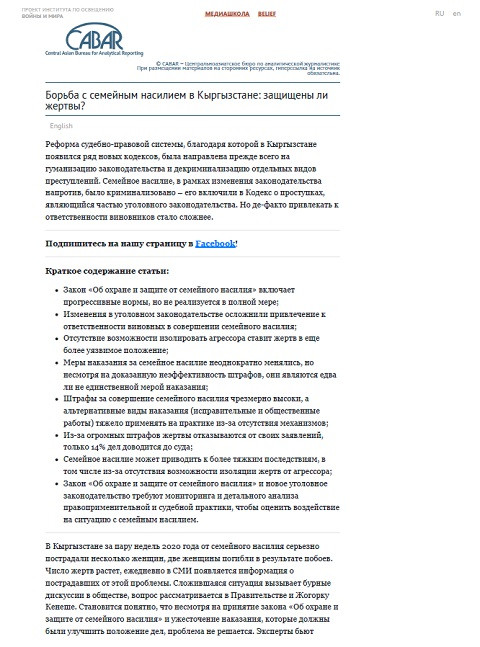 Combating Domestic Violence in Kyrgyzstan: Are Victims Protected? Year of publication: 2020 Author: Анна Зубенко Corporate author: Central Asian Bureau for Analytical Reporting (CABAR) The reform of the judicial system, thanks to which a number of new codes appeared in Kyrgyzstan, was aimed primarily at the humanization of legislation and the decriminalization of certain types of crimes. Domestic violence, in the framework of changing the legislation, on the contrary, was criminalized - it was included in the Code of Misconduct, which is part of the criminal law. But the de facto prosecution of perpetrators has become more difficult.
 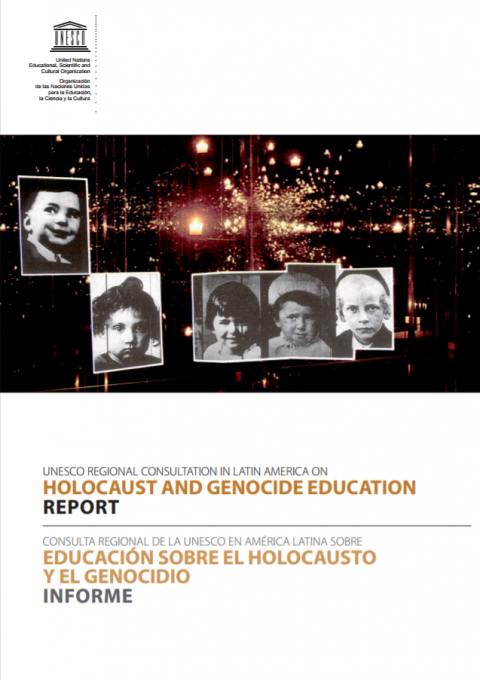 UNESCO regional consultation in Latin America on Holocaust and genocide education: report Year of publication: 2014 Corporate author: UNESCO Santiago This consultation with Latin American Member States sought to raise awareness amongst policymakers and education specialists of the region about the history of the Holocaust, as it can contribute to the prevention of genocide, following United Nations General Assembly resolution 60/7 on Holocaust remembrance. The meeting also aimed at fostering concrete cooperation between UNESCO and Member States on education about the history of genocide and mass atrocities, notably the Holocaust, with a view of introducing the subject in the curriculum and of developing relevant educational programmes in the region. The overall objectives of the project were as follows:▶ Strengthen educational leaders’ awareness and support for Holocaust remembrance and education about the history of genocide and mass atrocities, in line with regional efforts to foster education for peace and human rights.▶ Increase the implementation of education programmes about the history of the Holocaust and other genocides, and support interested Ministries of Education to introduce these subjects in the curriculum.▶ Foster regional exchanges about this topic and facilitate access to good practices regarding Holocaust and genocide related issues and peace education.
 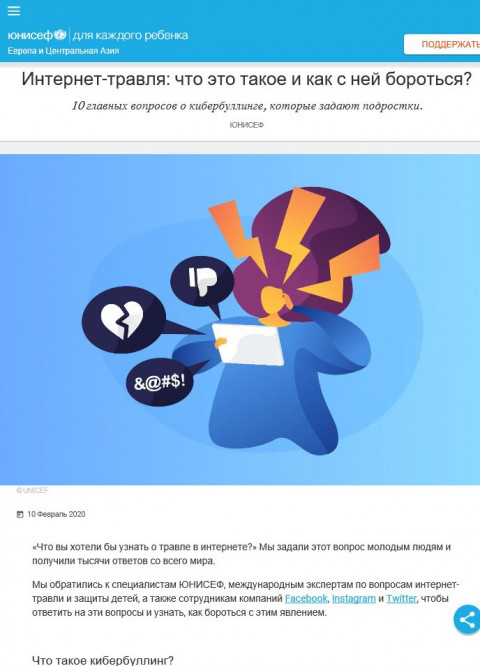 Internet Bullying: What is It and How to Deal with It? ; Top 10 Cyberbullying Questions Asked by Teens Year of publication: 2020 Corporate author: UNICEF Europe and Central Asia In the article, UNICEF experts, international experts on Internet bullying and child protection, as well as employees of Facebook, Instagram and Twitter, answer questions about how to deal with Internet bullying. Top 10 Cyberbullying Questions: How to understand that I am being harassed on the Internet? How to distinguish a joke from bullying? How does Internet bullying affect a person? Who should I talk to if someone is chasing me on the Internet? Why is it important to report bullying? I am being harassed by the Internet, but I’m afraid to talk to my parents about it. How do I turn to them for help? How can I help my friends report online bullying, especially if they don’t want to do this? The Internet gives me access to a lot of information, but it also means that I can become a victim of online violence. How can you protect yourself from cyberbullying without refusing to use the Internet? How to avoid using my personal information to manipulate or humiliate me on social networks? Is there any punishment for Internet harassment? Internet companies are not trying to solve the problem of cyberbullying. Are they responsible for this? Are there any online tools to combat bullying of children or youth? Интернет-травля: что это такое и как с ней бороться? ; 10 главных вопросов о кибербуллинге, которые задают подростки Year of publication: 2020 Corporate author: UNICEF Europe and Central Asia В статье специалисты ЮНИСЕФ, международные эксперты по вопросам интернет-травли и защиты детей, а также сотрудники компаний Facebook, Instagram и Twitter отвечают на вопросы о том, как бороться с интернет травлей. 10 главных вопросов о травле в интернете: Как понять, что меня преследуют в интернете? Как отличить шутку от травли? Как интернет-травля влияет на человека? С кем мне поговорить, если кто-то преследует меня в интернете? Почему важно сообщать о случаях травли? Я подвергаюсь интернет-травле, но боюсь поговорить с родителями об этом. Как мне обратиться к ним за помощью? Как мне помочь друзьям сообщить об интернет-травле, особенно, если они не хотят этого делать? Интернет дает мне доступ к большому количеству информации, но это также означает, что я могу стать жертвой насилия в сети. Как можно оградить себя от кибербуллинга, не отказываясь от использования интернета? Как избежать использования моей личной информации для манипуляции или унижения меня в соцсетях? Существует ли какое-то наказание за интернет-травлю? Интернет-компании не пытаются решить проблему кибербуллинга. Несут ли они за это ответственность? Существуют ли какие-нибудь онлайн-инструменты для борьбы с травлей детей или молодёжи?
  Report on the Social Monitoring of the Legislation and Law Enforcement Practices of the Local Police Service in the Area of Preventing Domestic Violence in the Republic of Kazakhstan Year of publication: 2017 Author: S.V. Korneytchuk | N.S. Gladyr Corporate author: OSCE. Programme Office in Astana This monitoring focuses on evaluating and forecasting the legislation by means of identifying contradictions in the legislation, obsolete, corruption-generating and ineffectively implemented statutes, as well as the drafting of proposals on improving the legislation and mechanisms of its implementation by units of the local police service. This edition was published with the financial support of the OSCE Programme Office in Nur-Sultan as part of the project entitled “Social Monitoring of the Legislation and Law Enforcement Practices of the Local Police Service in the Area of Preventing Domestic Violence in the Republic of Kazakhstan”.