
Resources
Explore a wide range of valuable resources on GCED to deepen your understanding and enhance your research, advocacy, teaching, and learning.
1,477 Results found
 Promouvoir la culture du dialogue entre les cultures dans le monde Arabe Year of publication: 2013 Author: Selim El Sayegh Corporate author: UNESCO Beirut Le défi majeur des soulèvements arabes réside dans le lecteur de la jeunesse. Comptabilisation de 60 pour cent de la population arabe, de la jeunesse ont été réclame des réformes politiques et économiques. Pendant les révoltes, ces créances sont devenues plus radicales à la recherche d'un changement fondamental. Cette évolution progressive, d'un changement relativement partielle à l'une complète plus absolue, ouvre la voie à une nouvelle ère avec une construction intellectuelle différente. Avec l'éviction des dictatures, toutes les forces de la société civile se déchaînent avec d'énormes ressources réelles et potentielles mobilisées pour contribuer à l'édification du nouvel ordre. Des groupes de solidarité, les communautés, les partis, les associations et organisations de toute nature parmi beaucoup d'autres mettent en avant de nouvelles idées et plans d'action adéquats. Liberté ainsi acclamé devient le cri de la dignité, l'honneur et la fierté. Jamais auparavant dans le monde arabe a l'individu avait une telle place centrale comme il le fait aujourd'hui. Un individu de saisir pleinement les possibilités de la liberté restaurée et reconnue la dignité donne naissance à un nouveau citoyen agissant dans un nouveau paradigme; un nouveau citoyen qui cherche une transcendance de l'ego de relier l'individu au bien commun. Ce nouveau paradigme permet l'individu en tant que citoyen au nom de l'égalité, tout en reconnaissant en même temps le droit à la différence de chaque citoyen en ce qui concerne l'appartenance à une culture ou sous-culture. Le droit d'être différent implique plus que le droit à la différence et à contester et par le fait même, l'obligation de règlement pacifique. Le droit à la différence, par l'appartenance à une culture ou d'une sous-culture signifie une nouvelle ère de liberté et de dignité, l'obligation de procéder à une transformation des modèles de génération de différends et les conflits entre les cultures. Dès lors, la question de la promotion de la culture du dialogue interculturel dans la foulée des révoltes arabes représente les principales caractéristiques qui seront reflétées ci-après.
  Que valent les apprentissages en histoire, géographie et éducation à la citoyenneté ? : Colloque international des didactiques de l'histoire, de la géographie et de l'éducation à la citoyenneté Year of publication: 2014 Author: Caroline Leininger | Angelina Ogier | Sylvain Genevois Corporate author: Institut national de recherche pédagogique L’histoire et la géographie scolaires, de même que l’éducation à la citoyenneté, sont des domaines sensibles, liés au politique et au contexte social et sociétal dans lequel ils s’inscrivent. Si les recherches en didactique ont constaté dans les années 1990 une grande stabilité de l’histoire et la géographie scolaires, elles interrogent aujourd’hui plus spécifiquement les changements curriculaires et les recompositions qu’ils entraînent (thèmes des deux dernières éditions du colloque (Nantes, 2008, Lausanne 2009). Ces changements découlent de choix politiques et de savoirs universitaires, et redéfinissent le projet de ces disciplines et ses finalités. L'élève devient ainsi à l'issue de sa scolarité : un acteur de la société, un citoyen, un acteur économique, membre de communautés culturelles et politiques, un individu épanoui etc.Ce choix de finalités est aussi un choix de valeurs, explicites ou non dans les prescriptions, assumées ou non par les enseignants, par les élèves, les parents. Ce constat amène à questionner les articulations entre les apprentissages disciplinaires d’une part, et les apprentissages sociaux et politiques d’autre part. Les définitions de ces apprentissages, leur légitimité et leurs évaluations posent également question. Enseignants, décideurs, formateurs, didacticiens peuvent ainsi se demander ce que valent les apprentissages en histoire, en géographie et en éducation à la citoyenneté, tant du point de vue de leur reconnaissance disciplinaire et sociale que du point de vue des valeurs qui leur sont associées. Cet ouvrage cherche à questionner les articulations entre les apprentissages disciplinaires et les apprentissages sociaux et politiques.
  The SDGs and Cities INTERNATIONAL HUMAN MOBILITY Year of publication: 2018 Corporate author: International Centre for the Promotion of Human Rights | (ICPHR) The Handbook is to address new situations – and responses to these situations – generated by the global phenomenon of human mobility in urban spaces. Democracies are being threatened by the sustained growth of social gaps and the exclusion of vast sectors of the population from political systems and benefits of development, placing structural limits on the exercise of human rights. In this context, where new tensions and problems have arisen such as massive displacements of the population, the appearance of diverse types of extremism, of wars and conflicts and climate change in turn place these social sectors under conditions of structural inequality, exclusion and discrimination, as the main victims of human rights violations. This Handbook was prepared and published with the support and assistance of the UNESCO Sector for Social and Human Sciences through its Regional Science Bureau in Montevideo and the Latin American and Caribbean Coalition of Cities against Racism, Discrimination and Xenophobia.
 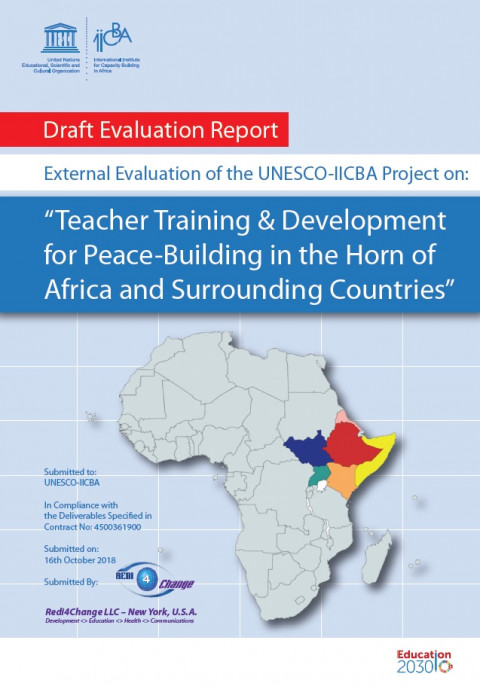 [Draft Evaluation Report] External Evaluation of the UNESCO-IICBA Project on: “Teacher Training & Development for Peace-Building in the Horn of Africa and Surrounding Countries” Year of publication: 2018 Corporate author: UNESCO International Institute for Capacity-Building in Africa (IICBA) The project on “Teacher Training and Development for Peace-Building in the Horn of Africa and Surrounding Countries” was designed by UNESCO-IICBA and financed by the Government of Japan. The project benefitted six conflict-affected countries; Ethiopia, Eritrea, Somalia, Kenya, Uganda, and South Sudan by building on the mandate and niche expertise of UNESCO-IICBA in teacher education, as well as benefiting from the empathetic insights and financing of the Government of Japan.This evaluation report analyses the design, implementation, and consolidation of the project to assess the likelihood that it can facilitate peace education as an effective and integral part of the national education systems. The project’s short timeframe and modest financing mean that the evaluation could not credibly deal with its outcomes and impact; but efforts are made to gauge the uptake and sustainability of this project as a vehicle for promoting peace education and so help to prevent violent conflict and cultivate a culture of peace in the countries concerned.
  The SDGs AND CITIES INTERNATIONAL HUMAN MOBILITY Year of publication: 2018 Corporate author: International Centre for the Promotion of Human Rights | (ICPHR) The Handbook is to address new situations – and responses to these situations – generated by the global phenomenon of human mobility in urban spaces. Democracies are being threatened by the sustained growth of social gaps and the exclusion of vast sectors of the population from political systems and benefits of development, placing structural limits on the exercise of human rights. In this context, where new tensions and problems have arisen such as massive displacements of the population, the appearance of diverse types of extremism, of wars and conflicts and climate change in turn place these social sectors under conditions of structural inequality, exclusion and discrimination, as the main victims of human rights violations. This Handbook was prepared and published with the support and assistance of the UNESCO Sector for Social and Human Sciences through its Regional Science Bureau in Montevideo and the Latin American and Caribbean Coalition of Cities against Racism, Discrimination and Xenophobia.
 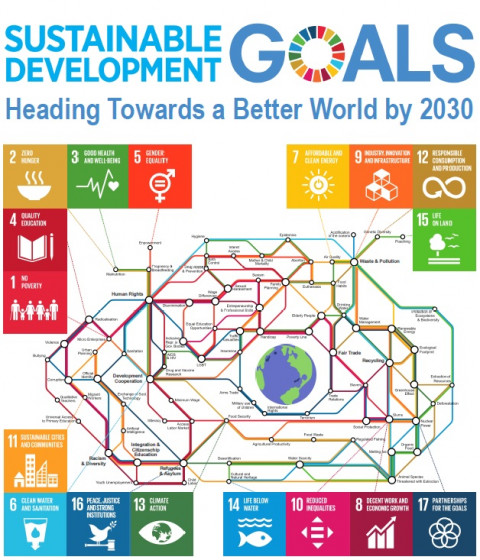 A metro map illustrated in the 17 sustainable development goals Year of publication: 2018 Author: Rembert Jonckheere Corporate author: ASPnet Flanders (Belgium) “Tackling one SDG… is tackling all of them!”This metro map is a complex illustration of the 17 sustainable development goals. With different kinds of topics as service stations and the SDG’s connecting them, it shows how the goals can relate to each other, and thus it emphasises their holistic nature. I do not pretend to be completely exhaustive or correct. Probably one can add more links and topics, but this map could be helpful in education or in other institutions as a source of inspiration to start up projects within the framework of the sustainable development goals.
 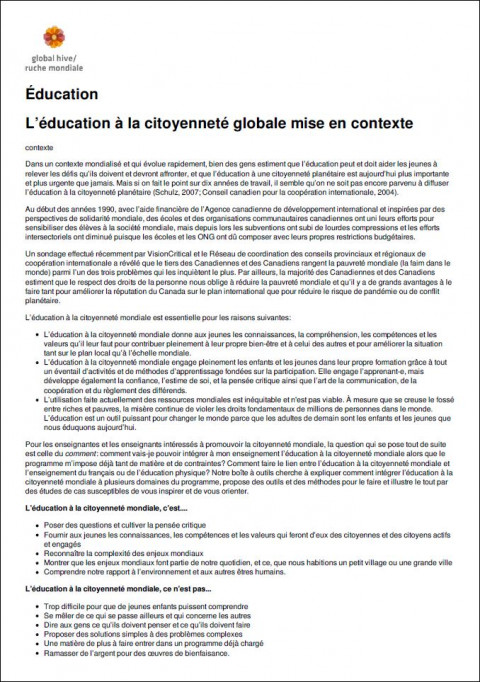 L'éducation à la citoyenneté globale mise en contexte Corporate author: Global Hive L’éducation à la citoyenneté mondiale est essentielle pour les raisons suivantes:L’éducation à la citoyenneté mondiale donne aux jeunes les connaissances, la compréhension, les compétences et les valeurs qu’il leur faut pour contribuer pleinement à leur propre bien-être et à celui des autres et pour améliorer la situation tant sur le plan local qu’à l’échelle mondiale.L’éducation à la citoyenneté mondiale engage pleinement les enfants et les jeunes dans leur propre formation grâce à tout un éventail d’activités et de méthodes d’apprentissage fondées sur la participation. Elle engage l’apprenant-e, mais développe également la confiance, l’estime de soi, et la pensée critique ainsi que l’art de la communication, de la coopération et du règlement des différends.L’utilisation faite actuellement des ressources mondiales est inéquitable et n'est pas viable. À mesure que se creuse le fossé entre riches et pauvres, la misère continue de violer les droits fondamentaux de millions de personnes dans le monde.L’éducation est un outil puissant pour changer le monde parce que les adultes de demain sont les enfants et les jeunes que nous éduquons aujourd’hui.Pour les enseignantes et les enseignants intéressés à promouvoir la citoyenneté mondiale, la question qui se pose tout de suite est celle du comment: comment vais-je pouvoir intégrer à mon enseignement l’éducation à la citoyenneté mondiale alors que le programme m’impose déjà tant de matière et de contraintes? Comment faire le lien entre l’éducation à la citoyenneté mondiale et l’enseignement du français ou de l’éducation physique? Notre boîte à outils cherche à expliquer comment intégrer l’éducation à la citoyenneté mondiale à plusieurs domaines du programme, propose des outils et des méthodes pour le faire et illustre le tout par des études de cas susceptibles de vous inspirer et de vous orienter.
  Disinformation and Peacebuilding in Sub-Saharan Africa : Security Implications of AI-Altered Information Environments : Research Report Year of publication: 2024 Author: Eduardo Albrecht | Eleonore Fournier-Tombs | Rebecca Brubake Corporate author: United Nations University This report aims to further explore the way in which AI technologies as they currently stand impact peace and conflict, and what methods might be used to mitigate their adverse effects - through the development of better tools and the inclusion of peace and conflict considerations in AI governance frameworks. The report proposes the following recommendations: 1. More funding and support should be provided to civil society organization efforts to expand media literacy and fact-checking initiatives using AI tools to enhance capabilities. 2. Governments need to work with civil society to develop and implement comprehensive, transparent legal frameworks combating disinformation. These legislative measures need to support digital and media literacy campaigns and fact-checking organizations. 3. Social media companies need to expand investment and research into understanding local information environments, so they can better identify and respond to instances of disinformation in all contexts in which they operate and enhance transparency. 4. Peacebuilding organizations need to carefully consider local media ecosystems and information environments when conducting conflict analyses, and factor these dynamics into their projects' frameworks.
  Capacity Building Workshop on the Prevention of Violent Extremism through Education in West Africa and the Sahel: Final Report Year of publication: 2017 Corporate author: UNESCO Dakar | Institut de la Francophonie pour l'éducation et la formation (IFEF) The capacity building workshop for the countries of West Africa and the Sahel, was organized in close collaboration with IICBA and APCEIU from 9 to 11 May 2017 in Dakar. The following countries participated in the meeting: Côte d’Ivoire, Cameroon, Guinea‐Bissau, Liberia, Mali, Mauritania, Niger, Senegal, Sierra Leone and The Gambia.This workshop was organized on the basis of a long‐standing partnership between UNESCO and the International Organization of La Francophonie (OIF), which strengthens its action on PVE. The regional workshop on capacity building for the prevention of violent extremism through education mainly used UNESCO materials and those for youth promoted by OIF. This workshop is a follow‐up to a similar initiative for education stakeholders of East and Southern Africa, organized in Addis Ababa in February 2017 by UNESCO through its International Institute for Capacity Building in Africa (IICBA).The overall objective of the workshop was to guide the countries of West Africa and the Sahel towards the Prevention of Violent Extremism (PVE). This includes familiarization with key issues, challenges, and opportunities identified to implement and further stimulate the implementation of the PVE strategy at the country level.
  UNESCO Survey on Intercultural Dialogue, 2017: Analysis of Findings Year of publication: 2018 Corporate author: UNESCO Institute for Statistics (UIS) The present report sets out the key findings of the first UNESCO survey on intercultural dialogue conducted among its Member States. The survey takes stock of the current understanding and operational mechanisms and strategies of intercultural dialogue at national level. It assesses the main issues and opportunities, current policies and legislation, available data and resources, and main stakeholders in this field. The resulting information permits an initial inventory of countryspecific intercultural dialogue policies that will function as a point of analysis for future monitoring and inform future policy-making.The questionnaire for the survey was distributed to 199 National Commissions for UNESCO in six official United Nations languages with a submission deadline of Spring 2017. There was a response rate of 21.622%. The respondents represent all geographic regions, including countries with large, middle and small populations, and over half are from developing economies.