
Resources
Explore a wide range of valuable resources on GCED to deepen your understanding and enhance your research, advocacy, teaching, and learning.
132 Results found
 中国的家庭政策 Year of publication: 2023 Corporate author: UNICEF China 为更好地支持父母养育子女,我们建议• 倡导全面而系统性的家庭政策概念,支持父母和家庭以更加健康、更循证的方式养育下一代,减少 养育成本和压力,并明确家庭政策的最终目标是提高整体人口的综合素质和生活质量。• 探索多样化的家庭政策,因为其他国家的经验教训表明并不存在单一、简单而普遍有效的家庭政策 工具。• 探索全面可持续的家庭政策,从子女出生前到整个未成年时期为家庭提供支持,并兼顾年长的父母 和照料者。• 创造更加宽容和宽松的育儿环境, 更好地支持有生育意愿的父母, 调整家庭政策范畴以外的政 策和制度(例如养老金政策、教育制度、性别平等、婚姻制度和其他相关社会制度),从而减轻年 轻父母目前面临的 “ 三重压力”。• 支持工作场所及家庭内部的性别平等原则,并解决基于性别的各种形式的歧视。 Family Policies in China Year of publication: 2023 Corporate author: UNICEF China To further support parents in their child-rearing responsibilities there is a need to:• Establish a comprehensive and systematic concept of family policy in China to support parents and families to raise the next generation in a healthier and more evidence-informed way, and to reduce the cost and pressures of parenting, with the ultimate aim to improve the overall quality of life of the population.• Explore diverse family policy options by looking at lessons learned from other countries, because there is no single, simple, and universal solution for workplace policies, inclusive parent and child benefit policies, childcare service policies, and institutional fiscal policies.• Identify comprehensive and sustainable family policies that support families from pre-birth and throughout childhood, while also helping elderly parents and caregivers.• Address the ‘triple pressure’ that young parents are facing by creating a more tolerant and lenient parenting environment that supports people who wish to have children and by adjusting policies and institutions beyond family policy, for example, pensions, the education system, gender equality, marriage, and other social institutions.• Support gender equality in the workplace and in households and address all forms of gender-based discrimination.
  中国少数民族基础教育政策研究报告 Year of publication: 2010 Corporate author: UNESCO Beijing 本报告是在“提高少数民族群体的受教育程度及文化上敏感的教育”的框架下是实地调查少数民族基础教育政策研究实施情况。2010年,根据对中国政府制定、实施的少数民族基础教育政策文本分析报告,确定实地调研的目标和任务,对三个项目省十二个个案点调研报告。通过田野调查和问卷调查,六个调研组完成十二个个案点调研报告。基于十二个个案调研报告内容形成本报告,并在此基础上提出改进建议和下一步的行动计划。
  Cultivating "Global Citizens": Relevant Photographs of Current Curriculum Construction: Rational Thinking and Practical Exploration of International Understanding Education Year of publication: 2018 Author: Pan Guowei The international understanding of education has quietly emerged. Its purpose is to enable students to grow into “global citizens” and promote human harmony. Based on this aim, schools should make a difference in the experience of students experiencing foreign languages, so that students can gradually form the necessary qualities of “global citizenship” in expanding international knowledge, enhancing the common prosperity of the world, and improving the ability of foreign activities.
  The Theory and Practice of Global Citizenship Education in Korean International School in Beijing Year of publication: 2014 Author: LIU Mei-xian | WANG Lu The purpose of this research is to explore the theory and practice of the global citizenship education of The Korean International School in Beijing. First,I outlined the concept and the theory of the global citizenship education. Second,I inquired the situation of global citizenship education of Korea. Third,I analyzed the curriculum of the elementary course of the Korean International School in Beijing in the viewpoint of global citizenship education. This research comes to the conclusion that the global citizenship education of this school is composed of three dimensions: Beijing citizenship,Korean citizenship and global citizenship in balance. 全球公民教育的理论与实践 —— 以北京韩国国际学校为例 Year of publication: 2014 Author: LIU Mei-xian | WANG Lu 本文阐述了全球公民的概念与全球公民教育的进程,探讨了韩国全球公民教育的实施现状,以“北京韩国国际学校”小学部全球公民教育的实践为主要个案进行分析,探讨该学校的全球公民教育是如何与北京社会公民意识、韩国国家公民意识以及全球公民意识三个层面的教育相融合的。 Research Report on Basic Education Policies for Ethnic Minorities in China Year of publication: 2010 Corporate author: UNESCO Beijing This report is a survey of the implementation of basic education policy research towards ethnic minority in the framework of "Improving the educational level and culturally sensitive education of ethnic minority groups". In 2010, based on the text analysis report of the basic education policy which has been formulated and implemented for ethnic minorities by the Chinese government, the objectives and tasks of the field research were determined. The field research was conducted on the twelve project sites of three provinces. Through field investigations and questonnaire surveys, six research groups completed twelve case study reports. Based on the contents of the 12-case research report, this report is formed and then proposes suggestions for improving and the next action plan.
 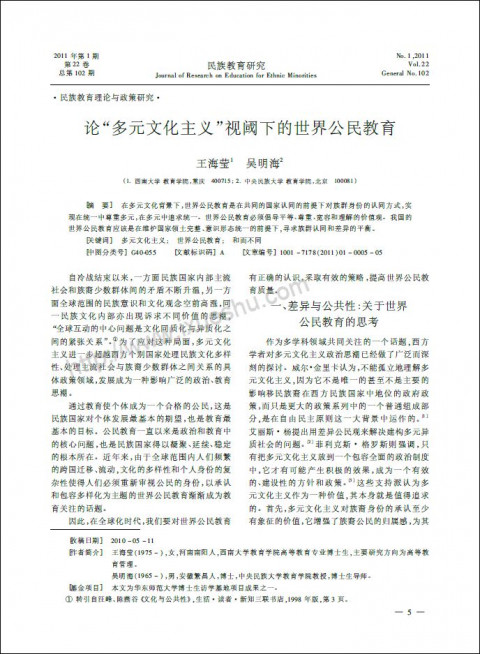 On Global Citizenship Education in Perspective of “Multiculturalism” Year of publication: 2011 Author: Wang Haiying | WU Minghai Under multicultural circumstances,global citizenship education is identity recognition of ethnic groups by mutual acknowledgment of the states. It is respect for multiculturalism in unity and pursuit of unity under multiculturalism. In global citizenship education, the value of equality,respect,tolerance and understanding should be advocated. The prerequisite to identity of ethnic groups and balance in diversity in China is to preserve national territory integrity and ideological unity. 论 “多元文化主义” 视阈下的世界公民教育 Year of publication: 2011 Author: Wang Haiying | WU Minghai 在多元文化背景下,世界公民教育是在共同的国家认同的前提下对族群身份的认同方式,实现在统一中尊重多元,在多元中追求统一。世界公民教育必须倡导平等、尊重、宽容和理解的价值观。我国的世界公民教育应该是在维护国家领土完整、意识形态统一的前提下,寻求族群认同和差异的平衡.
 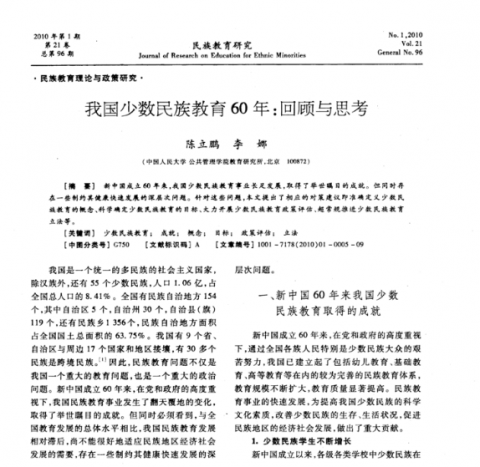 Sixty Years of Education of Ethnic Minorities in China: Retrospect and Reflection Year of publication: 2010 Author: Chen Lipeng, Li Na In the sixty years after the founding of China, great development has been made in eductaion of ethnic minorities in China with outstanding achievements. But at the same time, there still exists some problems restricting its healthy and rapid development. In this paper some suggestions have been put forward to help solve these problems. They are to make an accurate definition of education of ethnic minorities, set up its goal in a scientific way, carry out its policy assessment, and promote its legislation in a hyper normal way.