
Resources
Explore a wide range of valuable resources on GCED to deepen your understanding and enhance your research, advocacy, teaching, and learning.
1,447 Results found
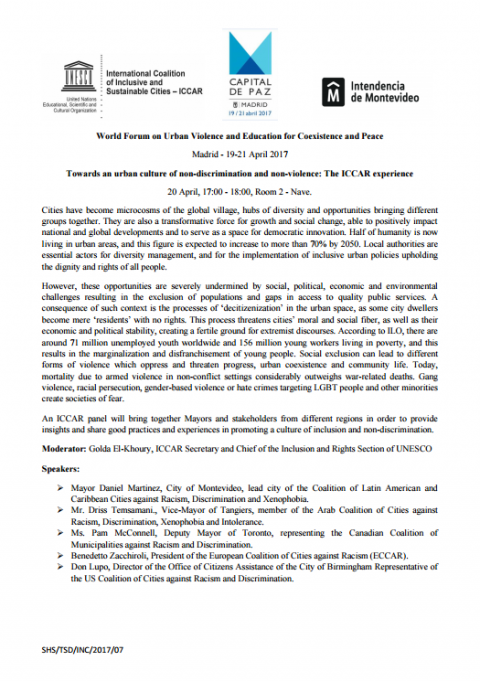 Towards an urban culture of non-discrimination and non-violence: The ICCAR experience Year of publication: 2017 Corporate author: International Coalition of Inclusive and Sustainable Cities This is a conference report for the World Forum on Urban Violence and Education for Coexistence and Peace.
  Ministerial Forum: Global Dialogue on ICT and Education Innovation – Towards Sustainable Development Goal for Education (SDG 4); Proceedings Year of publication: 2019 Corporate author: UNESCO Institute for Information Technologies in Education (IITE) The present publication contains articles based on the outcomes of the Ministerial Forum “Global Dialogue on ICT and Education Innovation – Towards Sustainable Development Goal for Education (SDG 4)”, organized by UNESCO IITE in cooperation with the Ministry of Education and Science of the Russian Federation in Moscow (Russia) on 18-19 March, within the Moscow International Education Fair 2018 (MIEF 2018).The publication covers the flagship topics such as ICT potential for future teachers and future schools, digital pedagogy and OER, collaboration between public and private sectors in the use of ICT in education, digital technologies for quality and equity in education.
 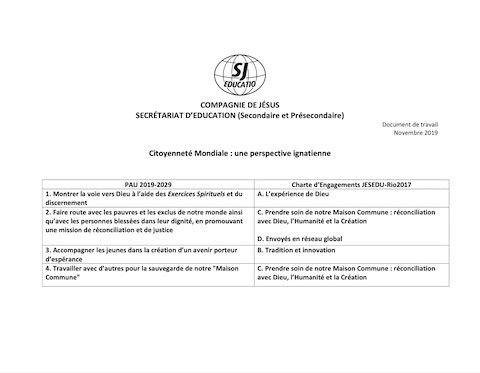 Citoyenneté mondiale: Une perspective ignatienne Year of publication: 2019 Corporate author: Educate Magis Ce tableau suit est un modèle qui présente des suggestions d’activités pour chaque région, province, établissement ou département éducatif, qui peuvent être utilisées comme exemples ou comme guides et qui peuvent être mises en œuvre et développées d’une manière adaptée à chaque situation ou besoin spécifique.
 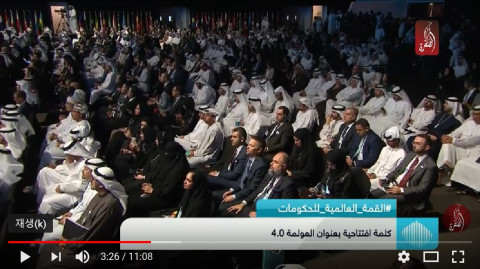 Speech by Professor Klaus Schwab Entitled Globalization 4.0 at the Opening Session of the #World Summit of Governments 2019 Year of publication: 2019 Corporate author: Al Dhafra TV Professor Klaus Schwab, Founder and CEO of the World Economic Forum: We must move to globalization in line with the modern world and the Fourth Industrial Revolution. كلمة البروفيسور كلاوس شواب بعنوان العولمة 4.0 في الجلسة الافتتاحية لـ#القمة_العالمية_للحكومات 2019 Year of publication: 2019 Corporate author: Al Dhafra TV البروفيسور كلاوس شواب المؤسس والرئيس التنفيذي للمنتدى الاقتصادي العالمي: يجب أن ننتقل إلى العولمة التي تتماشي مع العالم الحديث والثورة الصناعية الرابعة.
  Let's Build a Fairer and More United World, with Young People from Here and Elsewhere Year of publication: 2021 Corporate author: Quebec Association of International Cooperation Organizations (AQOCI) Discussion panel organized as part of the Quebec Days of International Solidarity (JQSI) by the Regional Committee for Education for International Development of Lanaudière (CRÉDIL) and the Table de concertation jeunesse en solidarité Internationale (TCJSI) of AQOCI. The event took place on November 25, 2021, and presented the engagement projects of young people from here and elsewhere to highlight the importance of youth involvement for the construction of a fairer and more united world. Construisons un monde plus juste et solidaire, avec les jeunes d’ici et d’ailleurs Year of publication: 2021 Corporate author: Association québécoise des organismes de coopération internationale (AQOCI) Panel de discussion organisé dans le cadre des Journées québécoises de la solidarité internationale (JQSI) par le Comité régional d’éducation pour le développement international de Lanaudière (CRÉDIL) et la Table de concertation jeunesse en solidarité internationale (TCJSI) de l’AQOCI. L'événement avait lieu le 25 novembre 2021 et présentait les projets d’engagement de jeunes d'ici et d'ailleurs afin de mettre en valeur l’importance de l’implication jeunesse pour la construction d’un monde plus juste et solidaire.
 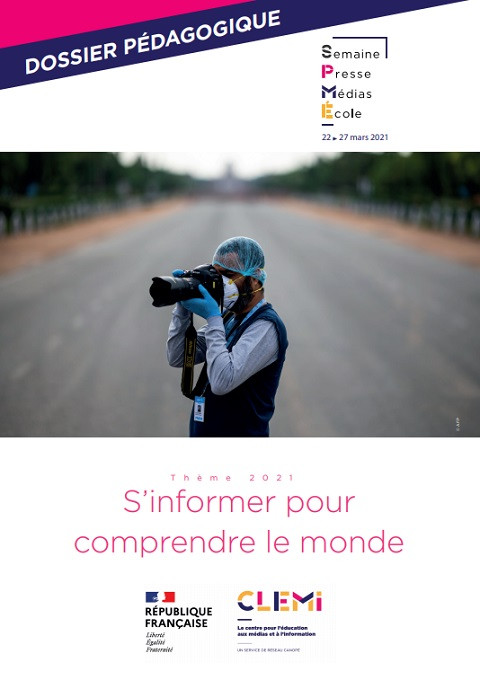 Dossier pédagogique 2021: S’informer pour comprendre le monde Year of publication: 2020 Corporate author: Centre pour l’éducation aux médias et à l’information (CLEMI) | Réseau Canopé Le dossier pédagogique 2021 a pour thème : «S'informer pour comprendre le monde». Pour comprendre le monde qui les entoure, les élèves doivent plus que jamais apprendre à s’informer en exerçant leur esprit critique. Ce nouveau thème de la SPME permet ainsi de revenir aux fondamentaux de l’éducation aux médias et à l’information.
  Quality TVET for the Successful Training to Employment Transition of Africa’s Youth Year of publication: 2020 Corporate author: UNESCO International Institute for Educational Planning (IIEP) | Agence luxembourgeoise pour la coopération au développement (LuxDev) | Institut de la Francophonie pour l'éducation et la formation (IFEF) This report constitutes the analytical synthesis of the 2nd Regional Workshop for Exchange between Vocational Training Actors in Africa and their Mutual Strengthening, held in Nairobi from 18-20 June 2019, on the theme of “Quality TVET for the successful training to employment transition of Africa’s youth”. Des systèmes d’EFTP de qualité pour une transition formation-emploi réussiedes jeunes en Afrique Year of publication: 2020 Corporate author: UNESCO International Institute for Educational Planning (IIEP) | Agence luxembourgeoise pour la coopération au développement (LuxDev) | Institut de la Francophonie pour l'éducation et la formation (IFEF) Ce rapport constitue la synthèse analytique du 2e atelier régional de partage et de renforcement mutuel des acteurs de la formation professionnelle en Afrique, tenu à Nairobi du 18 au 20 juin 2019 sur le thème : « Améliorer la gestion de la qualité des systèmes d’EFTP pour une transition formation-emploi des jeunes d’Afrique réussie ».