
Resources
Explore a wide range of valuable resources on GCED to deepen your understanding and enhance your research, advocacy, teaching, and learning.
1,727 Results found
 L'education a la citoyennete: Le role de l'ecole Author: Saliou Sarr Corporate author: EIP-Sénégal L'éducation à la citoyenneté est un thème fédérateur des programmes transversaux en cours dans l'école Sénégalaise (Education à la vie familiale et en matière de population, le Programme de formation et d'information à l'environnement, l'éducation aux droits Humains, l'éducation à la paix, l'éducation pour le développement et prend assise dans le renouvellement constant des approches et pratiques pédagogiques à l'école, à ce titre l'éducation à la citoyenneté est un élément novateur dans le projet d'école; et l'école parce qu'elle a une certaine autonomie par rapport à la société peut être un agent de changement, agir pour se démocratiser et démocratiser la société.Dans mon propos, j'aborderai plusieurs aspects liés à la citoyenneté, aux objectifs de l'éducation à la citoyenneté, ses grands axes, les approches et, ensemble nous installerons le dispositif pour renforcer les acquis et faire de l'école un lieu d'apprentissage du vivre ensemble et de l'ouverture sur le monde.
  La mise-en-action dans un processus d’éducation à la citoyenneté mondiale et solidaire Year of publication: 2016 Author: Hugo Roegiers Corporate author: OXFAM-Magasins du monde Les phases d’information, sensibilisation et conscientisation ne posent généralement pas trop de problèmes dans le cadre de l’éducation à la citoyenneté mondiale et solidaire. Il en va souvent autrement de la phase de mise-en-action, en particulier lorsqu’il s’agit d’une formation courte. Le pourquoi, le comment et l’objectif de la mise-en-action peuvent se révéler difficiles à appréhender, surtout dans le contexte obscur actuel.
 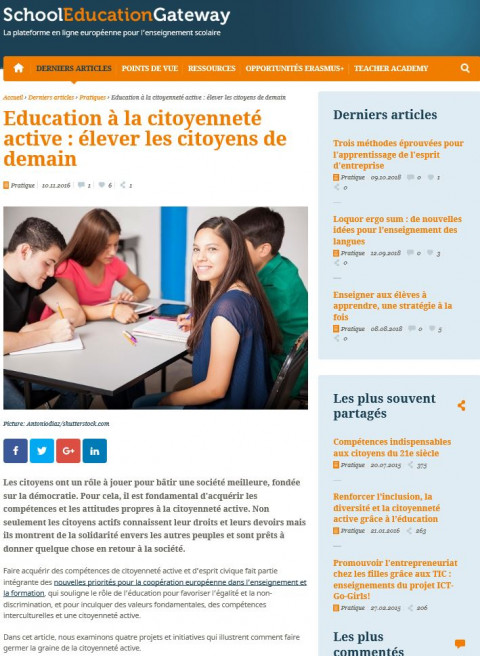 Éducation à la citoyenneté active: élever les citoyens de demain Year of publication: 2016 Corporate author: Centre européen Wergeland Les citoyens ont un rôle à jouer pour bâtir une société meilleure, fondée sur la démocratie. Pour cela, il est fondamental d'acquérir les compétences et les attitudes propres à la citoyenneté active. Non seulement les citoyens actifs connaissent leur droits et leurs devoirs mais ils montrent de la solidarité envers les autres peuples et sont prêts à donner quelque chose en retour à la société.Faire acquérir des compétences de citoyenneté active et d’esprit civique fait partie intégrante des nouvelles priorités pour la coopération européenne dans l’enseignement et la formation, qui souligne le rôle de l’éducation pour favoriser l’égalité et la non-discrimination, et pour inculquer des valeurs fondamentales, des compétences interculturelles et une citoyenneté active. Dans cet article, nous examinons quatre projets et initiatives qui illustrent comment faire germer la graine de la citoyenneté active.
  L’ÉDUCATION À LA CITOYENNETÉ Author: Nathalie Mons | Éric Favey | Jean-Michel Zakhartchouk Corporate author: CANOPé Le Parcours citoyen a pour ambition de favoriser une culture de l’engagement durant le temps scolaire. Si l’élève acquiert des connaissances et des compétences avec l’Éducation morale et civique (EMC), ou bien l’Éducation aux médias et à l’information (ÉMI), il devient par ailleurs véritablement sujet et acteur à travers une participation et des prises de responsabilité au sein des instances (conseils de classe, conseils d’administration, etc.), d’une classe coopérative ou dans la vie associative, par exemple. C’est par cette implication réelle et concrète qu’il éprouvera le mieux son rôle de citoyen.
 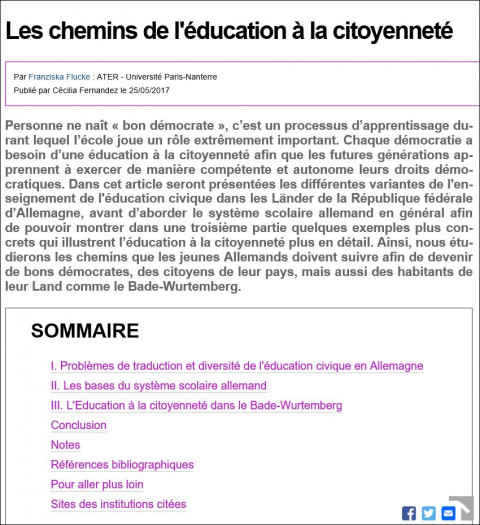 Les chemins de l'éducation à la citoyenneté Year of publication: 2017 Author: Franziska Flucke Corporate author: La Clé des Langues Personne ne naît « bon démocrate », c’est un processus d’apprentissage durant lequel l’école joue un rôle extrêmement important. Chaque démocratie a besoin d’une éducation à la citoyenneté afin que les futures générations apprennent à exercer de manière compétente et autonome leurs droits démocratiques. Dans cet article seront présentées les différentes variantes de l'enseignement de l'éducation civique dans les Länder de la République fédérale d’Allemagne, avant d’aborder le système scolaire allemand en général afin de pouvoir montrer dans une troisième partie quelques exemples plus concrets qui illustrent l’éducation à la citoyenneté plus en détail. Ainsi, nous étudierons les chemins que les jeunes Allemands doivent suivre afin de devenir de bons démocrates, des citoyens de leur pays, mais aussi des habitants de leur Land comme le Bade-Wurtemberg.
 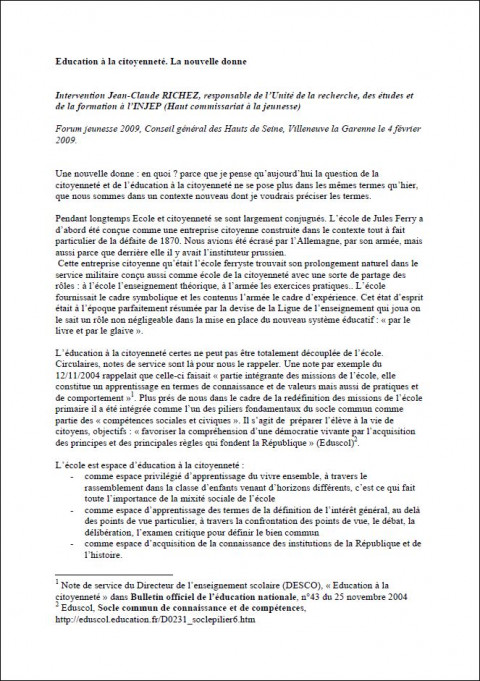 Éducation à la citoyenneté. La nouvelle donne Year of publication: 2009 Author: Jean-Claude Richez Corporate author: Haut commissariat à la jeunesse «Je pense qu'aujourd'hui, la question de la citoyenneté et de l'éducation à la citoyenneté ne se pose plus dans les mêmes termes qu'hier. (...) Nous sommes dans un contexte nouveau dont je voudais préciser les termes.»Selon Jean-Claude Richez1, la prise en compte de la dimension non formelle de l'éducation à la citoyenneté est un enjeu fondamenal dans la société d'aujourd'hui. Il a précisé pourquoi lors d'une intervention au forum jeunesse organisé par le conseil général des Hauts-de-Seine.
 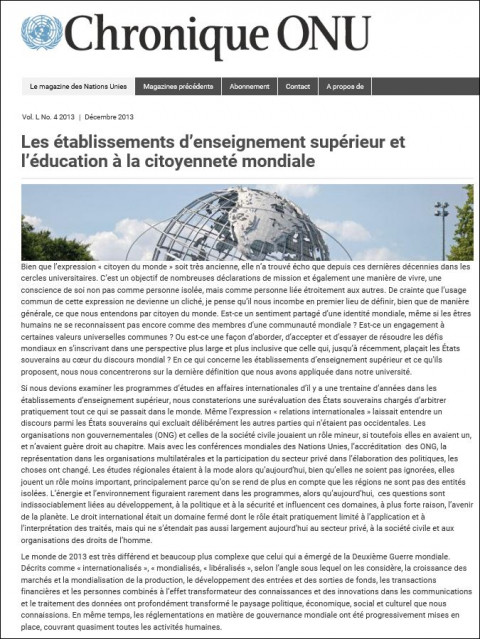 Les établissements d’enseignement supérieur et l’éducation à la citoyenneté mondiale Year of publication: 2013 Author: Vera Jelinek Corporate author: Chronique ONU Bien que l’expression « citoyen du monde » soit très ancienne, elle n’a trouvé écho que depuis ces dernières décennies dans les cercles universitaires. C’est un objectif de nombreuses déclarations de mission et également une manière de vivre, une conscience de soi non pas comme personne isolée, mais comme personne liée étroitement aux autres. De crainte que l’usage commun de cette expression ne devienne un cliché, je pense qu’il nous incombe en premier lieu de définir, bien que de manière générale, ce que nous entendons par citoyen du monde. Est-ce un sentiment partagé d’une identité mondiale, même si les êtres humains ne se reconnaissent pas encore comme des membres d’une communauté mondiale ? Est-ce un engagement à certaines valeurs universelles communes ? Ou est-ce une façon d’aborder, d’accepter et d’essayer de résoudre les défis mondiaux en s’inscrivant dans une perspective plus large et plus inclusive que celle qui, jusqu’à récemment, plaçait les États souverains au cœur du discours mondial ? En ce qui concerne les établissements d’enseignement supérieur et ce qu’ils proposent, nous nous concentrerons sur la dernière définition que nous avons appliquée dans notre université.
 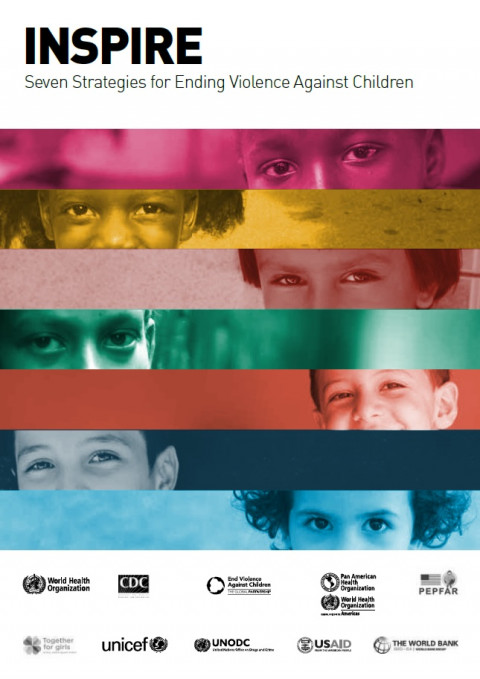 INSPIRE: семь стратегий по ликвидации насилия в отношении детей Year of publication: 2016 Corporate author: World Health Organization (WHO) Cборник информационных материалов, основанных на фактических данных и предназначенных для всех, кто заинтересован в профилактике насилия в отношении детей и подростков и принятии ответных мер — от государственных деятелей до обычных граждан и от организаций гражданского общества до представителей частного сектора. В этом документе представлен комплекс избранных стратегий, основанных на самых убедительных из имеющихся на сегодняшний день фактических данных и призванных помочь странам и сообществам сосредоточить усилия на профилактических программах и услугах, обладающих наибольшим потенциалом для снижения уровня насилия в отношении детей. В комплекс входят семь следующих стратегий: Implementation and enforcement of laws (Принятие и обеспечение соблюдения нормативных актов); Norms and values (Нормы и ценности); Safe environments (Создание безопасной среды); Parent and caregiver support (Поддержка родителей и воспитателей); Income and economic strengthening (Повышение доходов и улучшение экономического положения); Response and support services (Ответные меры и оказание поддержки); Education and life skills (Обучение и формирование жизненных навыков). Кроме того, в комплекс INSPIRE входят два типа сквозных мероприятий, сочетание которых позволяет связывать между собой и усиливать эти семь стратегий и одновременно оценивать ход их реализации.
  What Makes a Quality Curriculum?: In-Progress Reflection No.2 on Current and Critical Issues in Curriculum and Learning Year of publication: 2016 Author: Philip Stabback Corporate author: UNESCO International Bureau of Education (IBE) Sustainable Development Goal Four has to do with education in the post-2015 development agenda. It aims to “ensure inclusive and equitable quality education and promote lifelong learning opportunities for all”.Given the essential role of curriculum in enabling quality learning and in articulating and supporting education that is relevant to holistic development, our purpose in this paper is to identify what makes a quality curriculum, so as to support curricular innovation in UNESCO Member States to the end of the realization of Sustainable Development Goal Four.In this we are assuming that curriculum, given its essential role in the provision of quality learning for all children and young people, and in articulating and supporting education that is relevant to holistic development, is critical in the realization of SDG 4. It is the curriculum that determines to a large extent whether education is inclusive, thus playing a significant role in ensuring that provision is equitable. It is the curriculum that provides the structure for the provision of quality learning, especially where teachers might be under-qualified and inexperienced, their classrooms under-resourced, and their students lacking the prior frameworks within which to situate their learning. And it is the curriculum that articulates both the competencies necessary for lifelong learning and the competencies needed for holistic development.We thus argue that curriculum lies at the crossroads of these four key aspects of SDG 4: that education should be (1) inclusive and equitable, (2) characterized by quality learning, (3) promoting lifelong learning, and (4) relevant to holistic development. Curriculum, in other words, provides the bridge between education and development – and it is the competencies associated with lifelong learning and aligned with development needs, in the broadest, holistic sense of the term, that span that bridge.
  Content, Comprehensiveness and Coherence in Policies for Early Childhood: How the Curriculum Can Contribute Year of publication: 2016 Author: María Isabel Díaz Corporate author: UNESCO International Bureau of Education (IBE) In the context of international agreements and commitments concerning early childhood, the purpose of this document is to review and renew the challenges that are involved in forging educational and curriculum policies for the first level of education. In the light of early childhood being increasingly included in the public agenda, countries are making sustained efforts to increase equity and quality in the design and implementation of policies for the early years.These are policies that are in the process of changing by including quality and participation criteria; fine-tuning monitoring and assessment mechanisms; going beyond the lack of sectoral and territorial coordination, among other limitations; moving from a needs-based approach to a rights-based approach; and adopting a comprehensive view. The document analyses, from a long-term public policy perspective, some of the challenges that second-generation policies face, positioning the curriculum as the articulating factor for the development of comprehensive policies for early childhood.