
Resources
Explore a wide range of valuable resources on GCED to deepen your understanding and enhance your research, advocacy, teaching, and learning.
2,781 Results found
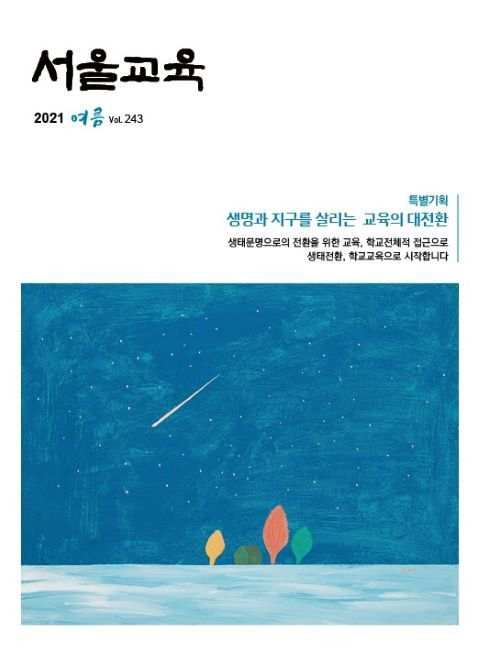 서울교육 2021년 여름호 (제63권 통권 243호) Year of publication: 2021 Corporate author: 서울특별시교육청 교육연구정보원 권두칼럼:포스트 코로나, 휴먼터치(Human touch)의 시대를 기대하다 특별기획: 생명과 지구를 살리는 교육의 대전환 생태문명으로의 전환을 위한 교육, 학교전체적 접근으로생태전환, 학교교육으로 시작합니다해외교육:독일의 지속가능발전교육(ESD)과 기후위기 대응 교육 정책연구:공감 능력 신장을 위한 학교 교육, 어떻게 할 수 있을까? 본 저작물은 서울특별시교육청교육연구정보원에서 2021년 작성하여 공공누리 제 4유형으로 개방한 ‘서울교육 2021년 여름호 (제63권 통권 243호)’ 을 이용하였으며 해당 저작물은 서울특별시교육청교육연구정보원 (www.serii.re.kr)에서 무료로 다운받으실 수 있습니다.
 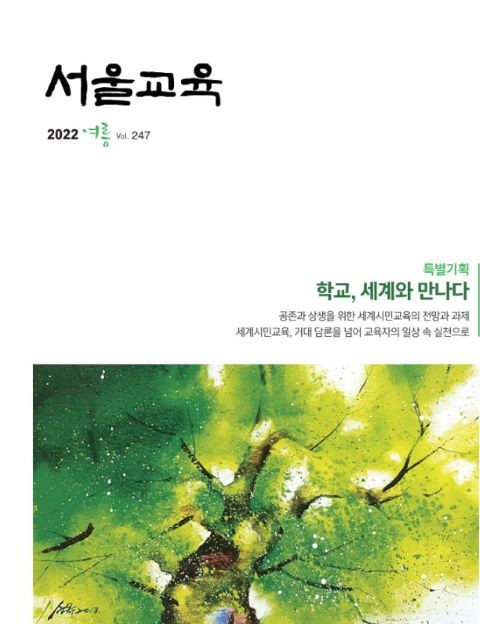 서울교육 2022년 여름호 (제64권 통권 247호) Year of publication: 2022 Corporate author: 서울특별시교육청 교육연구정보원 권두칼럼:세계시민으로 사는 길 특별기획: 학교, 세계와 만나다 공존과 상생을 위한 세계시민교육의 전망과 과제세계시민교육, 거대 담론을 넘어 교육자의 일상 속 실천으로 해외교육:프랑스, 왜 다시 시민교육 강화에 나서는가? 정책연구:메타버스의 교육적 활용 방안 - 확장된 학습 공간으로서의 가능성과 한계 본 저작물은 서울특별시교육청교육연구정보원에서 2022년 작성하여 공공누리 제 4유형으로 개방한 ‘서울교육 2022년 여름호 (제64권 통권 247호)’ 을 이용하였으며 해당 저작물은 서울특별시교육청교육연구정보원 (www.serii.re.kr)에서 무료로 다운받으실 수 있습니다.
 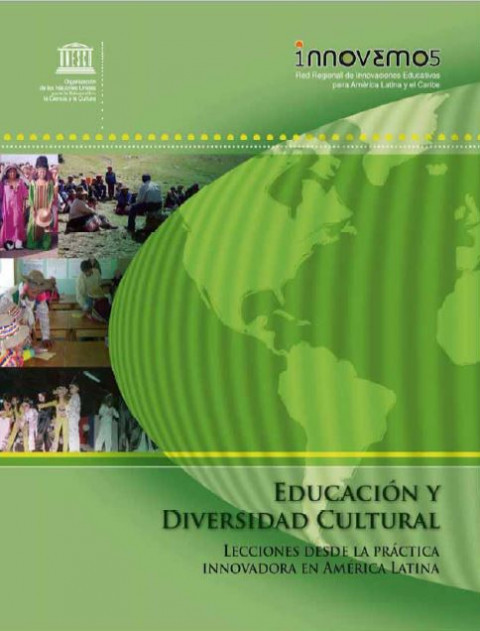 Education and Cultural Diversity Lessons from Innovative Practice in Latin America Year of publication: 2008 Author: Carolina Hirmas R. Corporate author: UNESCO Santiago This publication, which is the second volume of the collection, is the result of analysis and reflection on a series of innovative educational experiences from several Latin American countries, which respond with pedagogical relevance to the students' cultural context and offer an education oriented towards knowledge, understanding and dialogue between people of different cultures. The significant contribution of the aforementioned experiences lies in the recognition and appreciation of the ethnic and cultural diversity of its students and communities, as a starting point for the development of new learning and affirmation of their identity. In turn, life in educational centers promotes intercultural relations of respect and fraternity in a local and subregional sociogeographic context, characterized by multiculturalism.
 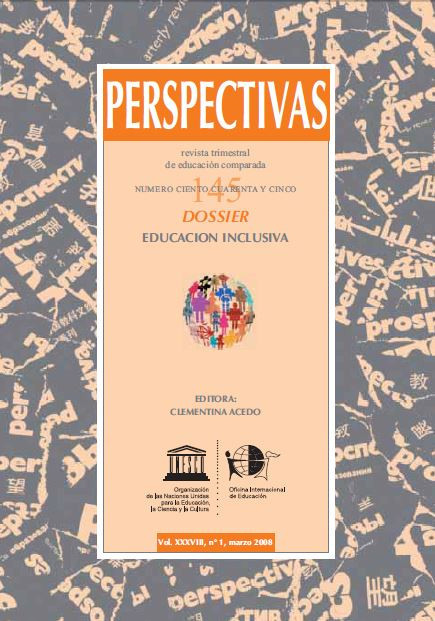 Inclusive Education Year of publication: 2008 Corporate author: UNESCO International Bureau of Education (IBE) Inclusive education: the road to the future is the subject of the forty-eighth meeting of the International Conference on Education (CIE) to be held in Geneva from November 25 to 28, 2008. I believe that a genuine dialogue and a frank debate between Ministers and other education actors on this central theme and on the four related sub-themes: approaches, scope and content; public politics; systems, interfaces and transitions, and students and teachers, will be both timely and appropriate.
 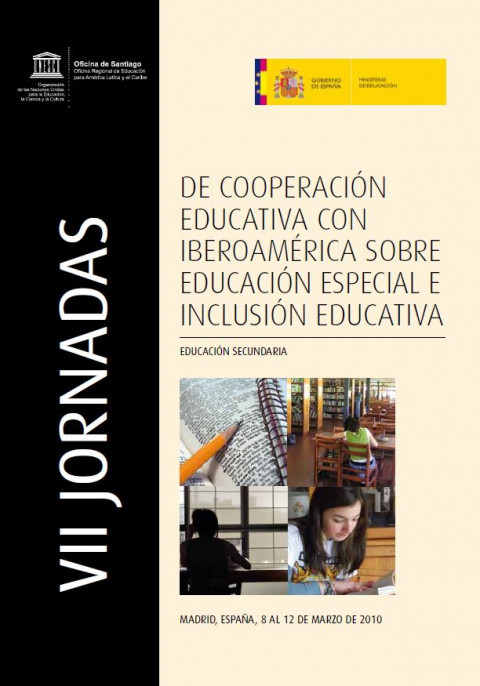 VII Days of Educational Corperation with Iberian America on Special Education and Educational Inclusion: Secondary Education Year of publication: 2011 Author: Daniela Eroles Corporate author: UNESCO Santiago | Spain. Ministry of Education The publication that we deliver contains some of the main papers and reflections emanating from the VII Conference on Educational Cooperation with Ibero-America on Special Education and Educational Inclusion, organized by the Ministry of Education of Spain and the Regional Office of Education for Latin America and the Caribbean ( OREALC / UNESCO Santiago). This publication has the inclusion in secondary education as a central theme, since it was the axis of the VII Conference. It is a particularly critical issue in our region since it establishes the minimum level necessary to escape poverty, to access decent employment and to exercise citizenship. However, access to secondary education is still very low in some countries and is especially low in the case of the most vulnerable populations, being those who most require access to this level of studies to overcome their situation of inequality. VII Jornadas de Cooperación Educativa con Iberoamérica sobre Educación Especial e Inclusión Educativa: Educación Secundaria Year of publication: 2011 Author: Daniela Eroles Corporate author: UNESCO Santiago | Spain. Ministry of Education La publicación que entregamos contiene algunas de las principales ponencias y reflexiones emanadas de las VII Jornadas de Cooperación Educativa con Iberoamérica sobre Educación Especial e Inclusión Educativa, organizadas por el Ministerio de Educación de España y la Oficina Regional de Educación para América Latina y el Caribe (OREAL C/UNESCO Santiago). Esta publicación tiene a la inclusión en la educación secundaria como tema central, pues constituyó el eje de las VII Jornadas. Es un tema especialmente crítico en nuestra región ya que establece el nivel mínimo necesario para salir de la pobreza, para acceder a un empleo digno y para ejercer la ciudadanía. Sin embargo, el acceso a la educación secundaria todavía es muy bajo en algunos países y es especialmente bajo en el caso de las poblaciones en situación de mayor vulnerabilidad, siendo quienes más requieren acceder a este nivel de estudios para superar su situación de desigualdad. Educación Inclusiva Year of publication: 2008 Corporate author: UNESCO International Bureau of Education (IBE) La educación inclusiva: el camino hacia el futuro es el tema de la cuadragésimo octava reunión de la Conferencia Internacional de Educación (CIE) que tendrá lugar en Ginebra del 25 al 28 de noviembre de 2008. Creo que un genuino diálogo y un franco debate entre los ministros y otros actores de la educación sobre este tema central y sobre los cuatro subtemas relacionados: enfoques, alcance y contenido; políticas públicas; sistemas, interfaces y transiciones, y alumnos y docentes, resultarán a la vez oportunos y apropiados. Education pour l'inclusion Year of publication: 2008 Corporate author: UNESCO International Bureau of Education (IBE) L’auteur présente ce numéro spécial qui offre une sélection d’articles alliant recherche théorique et pratique sur la notion de l’éducation pour l’inclusion et sur les problèmes rencontrés dans l’élaboration de politiques et leur application pratique. Ces articles reflètent les approches diversifiées et à volets multiples de l’inclusion, eu égard aux aspects théoriques, disciplinaires et méthodologiques. Tout au long de ce numéro, l’inclusion est le principe de base qui oriente l’Éducation pour tous (EPT) de qualité —- c’est-à-dire, l’établissement de systèmes éducatifs tirant profit de la diversité et visant à édifier une société plus juste et plus démocratique.Ce numéro spécial est consacré au thème de la quarante-huitième session de la Conférence internationale de l’éducation (CIE) « L’éducation pour l’inclusion : la voie de l’avenir » (Genève, 25-28 novembre 2008).
 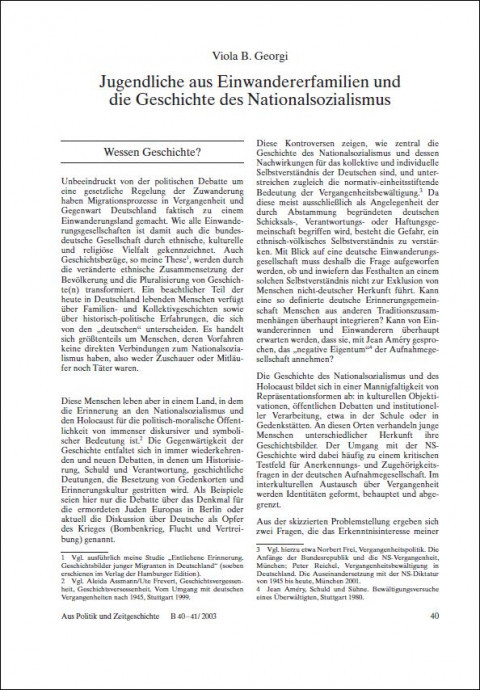 Jugendliche aus Einwandererfamilien und die Geschichte des Nationalsozialismus Year of publication: 2003 Author: V. B. Georgi Based on 55 interviews with young Germans with immigrant family background from the age of 15–20, Giorgi constructs a typology of how they position themesleves to the German Nazi past.
 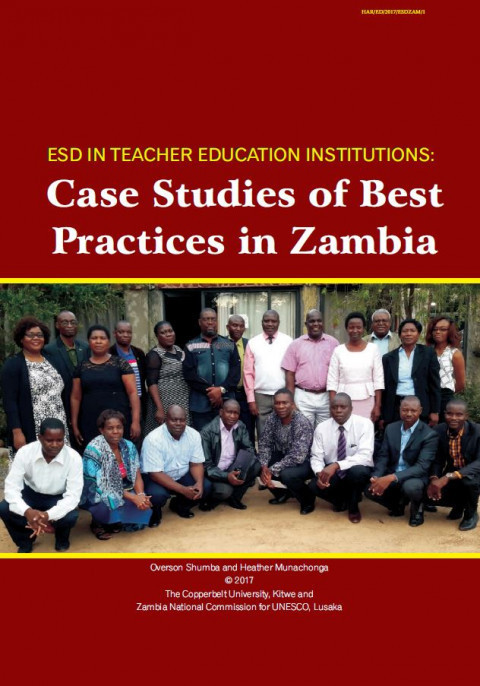 ESD in Teacher Education Institutions: Case Studies of Best Practices in Zambia Year of publication: 2017 Author: Overson Shumba | Heather Munachonga Corporate author: Zambia National Commission for UNESCO | Copperbelt University This book is a compilation of case studies on best practices in education for sustainable development in teacher education institutions in Zambia. It contributes to the dissemination of the best practices among the institutions and the wider society. It adds to examples of practices that are relevant to the UNESCO Global Action Programme on Education for Sustainable Development (GAP). The project was coordinated by Professor Overson Shumba at the Copperbelt university in Kitwe and Heather Munachonga, Programme Officer at the Zambia National Commission for UNESCO in Lusaka. The book was made possible with funding and support from UNESCO, Paris, the Ministry of General Education, the Copperbelt University, and the Zambia National Commission for UNESCO. All the institutions were supported by the teacher education institutions and their partners. The book illustrates some of the actions undertaken consistent with pursuit of the education SDG4 target 7. It is expected that this book will lead teacher educators and teachers to come up with further innovations and to integrate them in their professional work. Whole institution actions are encouraged so that best practices as found in this book can permeate and transform all aspects of the institution: the curriculum, teaching, assessment, research, extra-curricular activities, and operations, and must involve everyone, students, workers, lecturers, and the surrounding community.