
Resources
Explore a wide range of valuable resources on GCED to deepen your understanding and enhance your research, advocacy, teaching, and learning.
3,446 Results found
 تعزيز التربية على المواطنة العالمية في الجامعات العربية : الإجراءات المقترحة Year of publication: 2022 Author: Ellen Middaugh Corporate author: UNESCO Beirut "يمكن أن يؤدي التعليم العالي دورًا مهما في تعزيز التربية على المواطنة العالمية. فهو يوفر الحافز والفرصة والدعم للشباب ليتعرفوا إلى القضايا العالمية، ويتفاعلوا مع ثقافات متنوعة، ويمارسوا مهارات المواطنة العالمية في سن الاستكشاف الذاتي والاجتماعي والسياسي والمهني. ويمكن للجامعات أن تشجع الطالب على حمل هذه المهارات والقيم معهم عندما يكبرون لمشاركتها مع الآخرين ومواصلة هذه العملية طوال حياتهم. وتلتزم الجامعات العربية بشدة بالتربية على المواطنة العالمية، إلا أن طريقة تنفيذها للمواطنة العالمية بشكل ملموس بين الاجتماعي العاطفي والسلوكي - اللذين تحتاج إلى التحسين. فالمجال المعرفي للتعلم يحظى باهتمام أكبر من المجال يساهمان اكثر في المشاركة التحويلية الفعالة. واستنادًا إلى الممارسات الحالية، توفر هذه الوثيقة مقترحات ملموسة للجامعات واألوساط األكاديمية والطالب حول كيفية تعميم المواطنة العالمية وقيمها بشكل أفضل من خالل التعليم العالي في المنطقة العربية." Promoting Global Citizenship Education in Arab Universities: Proposals for Action Year of publication: 2022 Author: Ellen Middaugh Corporate author: UNESCO Beirut Higher education can play an important role in promoting Global Citizenship Education (GCED). It provides incentive, opportunity and support for young adults to learn about global issues, engage across diverse cultures, and practice the skills of GCED at a time of intensive personal, social, political and career exploration. Furthermore, universities can encourage students to take these skills and values into their adult lives to share with others and continue the lifelong process. Arab universities are very committed to GCED. However, the way GCED in concretely implemented needs improvement. While greater attention is paid to the cognitive domain of learning, the socio-emotional and behavioral domains of learning – which best lead to effective transformative engagement – tend to be left behind. Based on existing practices, this document provides universities, academia and students with concrete proposals on how to better mainstream GCED and its values, through higher education, in the Arab region.
  Sociolinguistic and Intercultural Training for SFL Teachers in the Context of Linguistic Diversity: A Case Study on the Brazil-Bolivia Border(Revista Iberoamericana De Educación; vol.81, no.1) Year of publication: 2019 Author: Vivianne Ferreira Martins Sociolinguistically complex contexts, such as border areas with languages in contact, demand language teaching in accordance with their specificities. In this sense, the study is a sociolinguistic and intercultural teacher training proposal for teachers of Spanish as a foreign language (SFL) from the Brazilian-Bolivian border, specifically the Brazilian city of Cáceres. The languages in the area, Portuguese, Spanish, Portuñol and indigenous languages, occupy hierarchical positions that respond to relations of inequality and prejudice between individuals of different ethnic origins or different nationalities. The proposed training can be an important factor for the development of interculturality and multilingualism in the region and, in addition, can serve as a model for the teaching of foreign languages in other contexts of linguistic diversity. Formación sociolingüística e intercultural para profesores de ELE en contexto de diversidad lingüística: un estudio de caso en la frontera Brasil-Bolivia Year of publication: 2019 Author: Vivianne Ferreira Martins Los contextos sociolingüísticamente complejos, como son las zonas de frontera con lenguas en contacto, demandan una enseñanza de lenguas acorde con sus especificidades. En este sentido, el estudio es una propuesta de formación docente de base sociolingüística e intercultural para los profesores de español como lengua extranjera (ELE) de la frontera de Brasil con Bolivia, en concreto la ciudad brasileña de Cáceres. Las lenguas en la zona, el portugués, el español, el portuñol y lenguas indígenas, ocupan posiciones jerárquicas que responden a las relaciones de desigualdad y prejuicios entre los individuos de diferentes orígenes étnicos o de diferentes nacionalidades. La formación propuesta puede ser un importante factor para el desarrollo de la interculturalidad y del plurilingüismo en la región y, además, puede servir como modelo para la enseñanza de lenguas extranjeras en otros contextos de diversidad lingüística.
  From Sustainable Development to Integrated Participation: Ecopedagogies as Decolonial Options (Revista Iberoamericana De Educación; vol.73) Year of publication: 2017 Author: Elson Santos SilvaCarvalho | Dernival Venâncio Ramos Junior In this article, reflections will be presented on the causes and effects of the incorporation of alternative logics of consumption (which are summarized in sustainability) perceived in propositions of formal education that emphasize the historical relationships of appropriation of nature. Even realigned with an Amerindian perspective of coexistence such as Good Living, the matrix relationship of formal education in modern times - material, predatory and individualistic - prevails in formats, institutional missions and prosperity commitments. The thesis of the possible emergence, through the new dimensions of ecopedagogy, of an integrated participation at the expense of vices and discourses related to sustainable development is sustained, recognizing that formal education requires a complex and adaptive system, not only the intentions of managers for your process. Del desarrollo sostenible a la participación integrada: Ecopedagogías como opciones decoloniales Year of publication: 2017 Author: Elson Santos SilvaCarvalho | Dernival Venâncio Ramos Junior En este artículo, se presentarán reflexiones sobre las causas y efectos de la incorporación de lógicas alternativas de consumo (que se resumen en la sostenibilidad) percibidos en proposiciones de la educación formal que hacen hincapié en las relaciones históricas de apropiación de la naturaleza. Incluso realineada con una perspectiva amerindia de convivencia como el Buen Vivir, la relación matriz de la educación formal en los tiempos modernos - material, depredadora e individualista - prevalece en los formatos, las misiones institucionales y los compromisos de prosperidad. Se sostiene la tesis de la posible emergencia, mediante las nuevas dimensiones de la ecopedagogía, de una participación integrada a expensas de vicios y discursos relacionados con el desarrollo sostenible, reconociendo que la educación formal requiere un sistema complejo y adaptativo, no solo las intencionalidades de gestores para su proceso.
 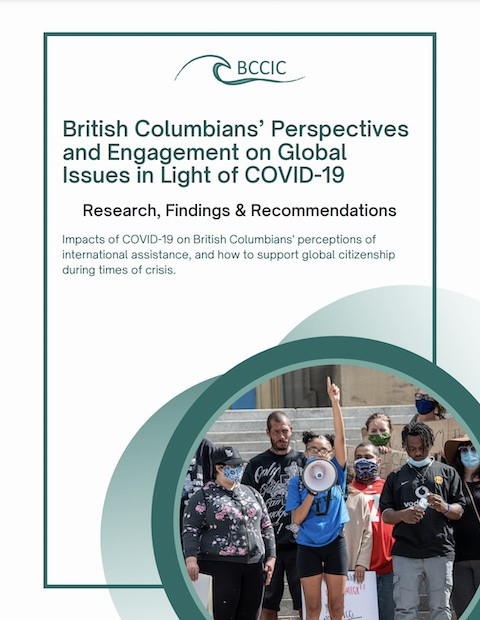 British Columbians’ Perspectives and Engagement on Global Issues in Light of COVID-19 Year of publication: 2022 Author: Kaylie D. Higgs Corporate author: British Columbia Council for International Cooperation (BCCIC) | Kenoli Foundation | Global Affairs Canada (GAC) The COVID-19 pandemic has presented immense challenges and injustices, while also highlighting acts of resilience and possibilities to transition to a more social and environmentally just society. This context of challenge and possibility has led to new and renewed questions around how to navigate these times to promote a just, sustainable and resilient future. For the British Columbia Council for International Cooperation (BCCIC), these questions prompted primary research to explore current public perspectives and to support thriving public engagement and global citizenship initiatives, especially considering the perspectives of British Columbians who are typically less engaged in international cooperation. Compiled and reflected in this report, the key findings of this research are summarized, along with ten recommendations to support public engagement that emerged from this research.
 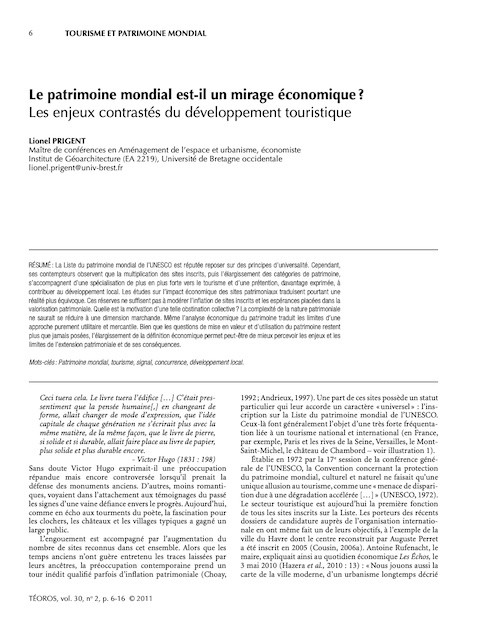 Is World Heritage an Economic Mirage? (Téoros; vol. 30, no. 2) Year of publication: 2011 Author: Lionel Prigent Corporate author: Université du Québec à Montréal (UQAM) The UNESCO World Heritage List is deemed to be based on principles of universality. However, its critics observe that the multiplication of listed sites, then the widening of heritage categories, is accompanied by an increasingly strong specialization towards tourism and a claim, more expressed, to contribute to local development. . Studies on the economic impact of heritage sites, however, reflect a more equivocal reality. These reserves are not enough to moderate the inflation of listed sites and the hopes placed in heritage enhancement. What is the motivation for such collective obstinacy? The complexity of the nature of heritage cannot be reduced to a commercial dimension. Even the economic analysis of heritage reflects the limits of a purely utilitarian and mercantile approach. Although the questions of enhancement and use of heritage remain more than ever raised, the broadening of the economic definition perhaps makes it possible to better understand the issues and the limits of the extension of heritage and its consequences. Le patrimoine mondial est-il un mirage économique? : Les enjeux contrastés du développement touristique (Téoros; vol. 30, no. 2) Year of publication: 2011 Author: Lionel Prigent Corporate author: Université du Québec à Montréal (UQAM) La Liste du patrimoine mondial de l’UNESCO est réputée reposer sur des principes d’universalité. Cependant, ses contempteurs observent que la multiplication des sites inscrits, puis l’élargissement des catégories de patrimoine, s’accompagnent d’une spécialisation de plus en plus forte vers le tourisme et d’une prétention, davantage exprimée, à contribuer au développement local. Les études sur l’impact économique des sites patrimoniaux traduisent pourtant une réalité plus équivoque. Ces réserves ne suffisent pas à modérer l’inflation de sites inscrits et les espérances placées dans la valorisation patrimoniale. Quelle est la motivation d’une telle obstination collective ? La complexité de la nature patrimoniale ne saurait se réduire à une dimension marchande. Même l’analyse économique du patrimoine traduit les limites d’une approche purement utilitaire et mercantile. Bien que les questions de mise en valeur et d’utilisation du patrimoine restent plus que jamais posées, l’élargissement de la définition économique permet peut-être de mieux percevoir les enjeux et les limites de l’extension patrimoniale et de ses conséquences.
 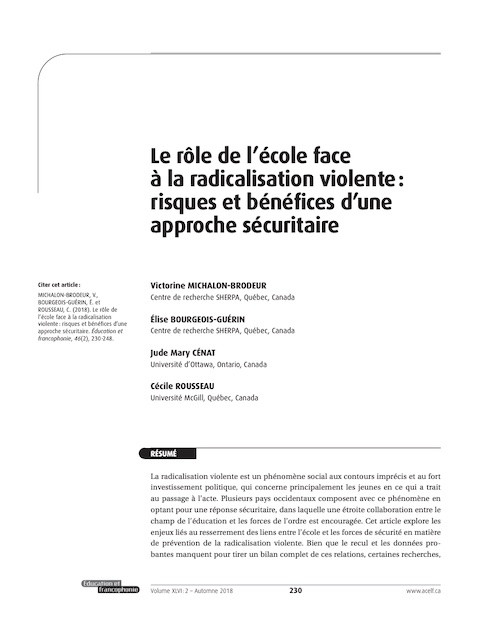 The Role of the School in Dealing With Violent Radicalization: The Risks and Benefits of a Safe Approach (Éducation et francophonie; vol. 46, no. 2) Year of publication: 2018 Author: Victorine Michalon-Brodeur | Élise Bourgeois-Guérin | Jude Mary Cénat | Cécile Rousseau Corporate author: Association canadienne d’éducation de langue française Violent radicalization is a social phenomenon with vague contours and strong political investment. Those mainly at risk of becoming involved are young people. Several Western countries are dealing with this phenomenon by opting for a security response, encouraging close collaboration between education and law enforcement. This article explores issues related to strengthening connections between the school and law enforcement for the prevention of violent radicalization. While there is a lack of evidence that would be needed to paint a full picture of these relationships, some studies on the impact of the War on Terror on young people and securing American schools in response to school shootings call for restraint. In light of these studies, this article argues that clear boundaries must be established between the mandates of the school and the police. The importance of these firewalls must be emphasized in the training school personnel in the prevention of violent radicalization in order to preserve the school’s ability to be a place that promotes the development of critical thinking and awareness of the Other.