
Resources
Explore a wide range of valuable resources on GCED to deepen your understanding and enhance your research, advocacy, teaching, and learning.
10 Results found
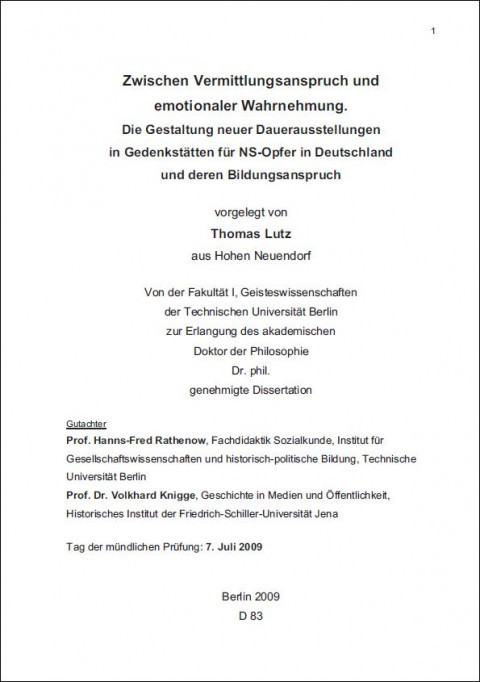 Zwischen Vermittlungsanspruch und emotionaler Wahrnehmung: Die Gestaltung neuer Dauerausstellungen in Gedenkstätten für NS-Opfer in Deutschland und deren Bildungsanspruch Year of publication: 2009 Author: Thomas Lutz Over the last decade, as part of the federal concept for memorial sites, twenty new permanent exhibitions were developed. This dissertation undertakes to examine exhibitions created at memorial sites for victims of the Nazi regime from an educational and museological viewpoint. Expert interviews with exhibition curators serve as the basis for the empirical study. The author has worked for many years in the field of memorial museums education. He applied “action research,” developed in German-speaking countries under the term “Handlungsforschung.” The study analyzes the specific characteristics of the work conducted in museums, memorial sites and educational centres and also addresses the strained connection between commemoration and learning in the educational work of the memorial museums for the Nazi victims. The study also evaluates the practical impact of these aims. The very intense form of commemorative work that is conducted in Germany is justified by the nature of its subject matter: the stigmatization of specific victim groups during the Nazi era according to a system of political, racist-biological and social characteristics and the vast dimensions of the genocide. The socially and politically explosive nature of this task is manifested by the commemoration of the “other” victims as well as by the responsibility that Germany bears for addressing its “own” perpetrators in society. The central findings of the study show that the new exhibitions embrace a much more comprehensive foundation of historical material (historical knowledge, building history and archeological significance of the crime sites, written and audio-visual survival testimony and artifacts) as was previously the case. The professionalization of the “field of memorial museums” has led to a more intensively reflected and sensitive approach to handling documents, illustrations and objects on display in a museum. In particular, the significance of the relationship between the artifacts and their location, their sources, an appreciation for their origins and a critical reflection of what it is they convey is achieved. This also applies to photography. (Written by author) The above abstract is taken from the International Holocaust Remembrance Alliance Education Research Project. Please also consult the full list of abstracts in 15 languages and the accompanying publication Research in Teaching and Learning about the Holocaust: A Dialogue Beyond Borders.Ed: IHRA, Monique Eckmann, Doyle Stevick, Jolanta Ambrosewicz-Jacobs, 2017, Metropol Verlag at http://www.holocaustremembrance.com/publications.
  Early Historical Learning about National Socialism and the Persecution of Jews: Family Conditions, Interests and Acquisition of Knowledge among Fourth Graders Year of publication: 2012 Author: Christina Klätte The original title: Frühes Historisches Lernen über Nationalsozialismus und Judenverfolgung: Familiäre Bedingungen, Interessen und Wissenserwerb bei Viertklässlern(Kinder und Zeitgeschichte: Jüdische Geschichte und Gegenwart, Nationalsozialismus und Antisemitismus Supplement 8, pp. 85–99) This is a quantitative study of German primary school children’s knowledge about the Holocaust. It demonstrates the importance of family background, family discussion and a general interest in history. It also displays how teachers’ willingness to bring up the Nazi period at a comparatively early age, among other things, depends upon the socio-economic status of the school children’s parents. The above abstract is taken from the International Holocaust Remembrance Alliance Education Research Project. Please also consult the full list of abstracts in 15 languages and the accompanying publication Research in Teaching and Learning about the Holocaust: A Dialogue Beyond Borders. Ed: IHRA, Monique Eckmann, Doyle Stevick, Jolanta Ambrosewicz-Jacobs, 2017, Metropol Verlag at www.holocaustremembrance.com/resources/publications.
  “Why Do We Have to We Apologize for It All the Time, We Can’t Help it”: History Education between Memory-Pedagogy Challenges and Fantasies about Effectiveness Year of publication: 2006 Author: Matthias Proske The original title: “Wieso Müssen Wir Uns Jedes Mal Wieder dafür Entschuldigen, Wir Können Doch Gar Nichts Mehr Dafür”: Geschichtsunterricht zwischen Erinnerungspädagogischen Herausforderungen und Wirksamkeitsphantasien(Widerstand sachunterricht, 7, pp. 1–10)Against the background of public expectations on the schools’ history education, the article connects a theoretical analysis of the changes in the German historical culture and their consequences for history education about the Holocaust and Nazism with a discussion about how students and teachers take on these themes in educational practice. This is exemplified with a case study from a 9th grade history class. The above abstract is taken from the International Holocaust Remembrance Alliance Education Research Project. Please also consult the full list of abstracts in 15 languages and the accompanying publication Research in Teaching and Learning about the Holocaust: A Dialogue Beyond Borders. Ed: IHRA, Monique Eckmann, Doyle Stevick, Jolanta Ambrosewicz-Jacobs, 2017, Metropol Verlag at www.holocaustremembrance.com/resources/publications.
  Constructions of Generational Relations: Childhood and the Theme of National Socialism in Primary-School Education Year of publication: 2012 Author: Alexandra Flügel The original title: Konstruktionen des Generationalen Verhältnisses: Kindheit und das Thema Nationalsozialismus im Grundschulunterricht(Kinder und Zeitgeschichte: Jüdische Geschichte und Gegenwart, Nationalsozialismus und Antisemitismus, Supplement 8, pp. 75–84) This is a qualitative study, based on the results in Fügel 2009, of German primary school children’s communication about Nazism and the Holocaust. It demonstrates how interwoven these exchanges are with general German memory discourses about these topics, but also how the children already at the age of 9–10 reflect upon their need to learn about this dark side of German history.The above abstract is taken from the International Holocaust Remembrance Alliance Education Research Project. Please also consult the full list of abstracts in 15 languages and the accompanying publication Research in Teaching and Learning about the Holocaust: A Dialogue Beyond Borders. Ed: IHRA, Monique Eckmann, Doyle Stevick, Jolanta Ambrosewicz-Jacobs, 2017, Metropol Verlag at www.holocaustremembrance.com/resources/publications.
 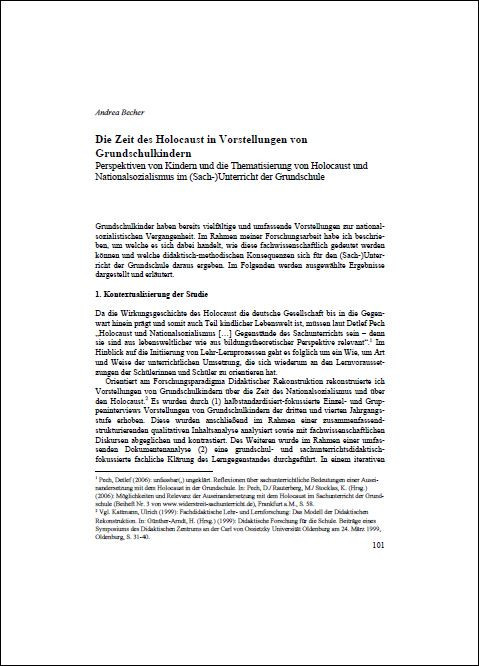 The Time Period of the Holocaust in the Beliefs of Primary School Children – Children’s Perspectives and the Thematization of the Holocaust and National Socialism in Primary-School Instruction (in General Subjects) Year of publication: 2012 Author: Andrea Becher The original title: Die Zeit des Holocaust in Vorstellungen von Grundschulkindern – Perspektiven von Kindern und die Thematisierung von Holocaust und Nationalsozialismus im (Sach-)Unterricht der Grundschule(In I. Enzenbach, C. Klätte, & D. Pech, (Eds.). Kinder und Zeitgeschichte: Jüdische Geschichte und Gegenwart, Nationalsozialismus und Antisemitismus, Supplement, 8, pp. 101–120) This is a summary of a study of German primary school children’s beliefs about the Holocaust, based on interviews conducted in two classes in 2005. The author finds that the children almost exclusively focus on Hitler; that one can find “latent anti-Semitic fragments” in their statements; that, even without formal education, the pupils still possess knowledge about the Holocaust; and their main source of information about Nazi Germany seems to be family members. However, the family narratives mainly touch upon everyday-life and avoid the topic of the Holocaust. From these findings, the author argues that one could and should teach the Holocaust already in the German primary school. The above abstract is taken from the International Holocaust Remembrance Alliance Education Research Project. Please also consult the full list of abstracts in 15 languages and the accompanying publication Research in Teaching and Learning about the Holocaust: A Dialogue Beyond Borders. Ed: IHRA, Monique Eckmann, Doyle Stevick, Jolanta Ambrosewicz-Jacobs, 2017, Metropol Verlag.
 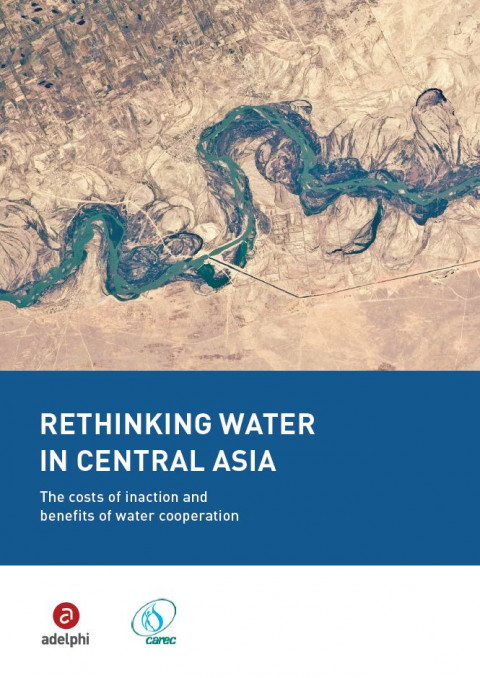 Rethinking Water in Central Asia: The Costs of Inaction and Benefits of Water Cooperation Year of publication: 2017 Author: Benjamin Pohl | Annika Kramer | William Hull | Sabine Blumstein | Iskandar Abdullaev | Jusipbek Kazbekov | Tais Reznikova | Ekaterina Strikeleva | Eduard Interwies | Stefan Görlitz Corporate author: adelphi | Central Asia Regional Economic Cooperation (CAREC) A joint study conducted by CAREC and adelphi within the framework of the Switzerland’s Blue Peace Central Asia Initiative is published. The publication demonstrates the cost of inaction and benefits of cooperation in the field of water management between the countries of the region.entral Asia is witnessing intense competition over water resources and their use for irrigation and hydropower generation. Despite general political commitment to cooperation, water policies in Central Asia are largely driven by uncoordinated and partly contradicting national strategies. This limited water cooperation, however, entails significant costs and major risks for the future development of the region.“Rethinking Water in Central Asia” analyses these “costs of inaction” – defined here as the difference between the current, limited cooperation and the benefits that would result from full cooperation. Even if only parts of these costs are taken into account, they amount to more than US$ 4.5 billion per year for the whole region and are significant for each of the five countries studied. Due to deteriorating infrastructure, environmental degradation and demographic and economic pressures, these costs will increase if water management remains as it currently is.By raising awareness of these costs of inaction, and by setting out a variety of pathways towards eliminating them in the future, the present report seeks to encourage and support Central Asian policy-makers in strengthening regional water cooperation and improved water governance. The costs of inaction mirror the potential benefits of water cooperation, and their scale hence demonstrates the scale of the benefits and opportunities that better water management and closer cooperation can deliver for Central Asia. Переосмысление водного вопроса в Центральной Азии: Цена бездействия и преимущества водного сотрудничества Year of publication: 2017 Author: Benjamin Pohl | Annika Kramer | William Hull | Sabine Blumstein | Iskandar Abdullaev | Jusipbek Kazbekov | Tais Reznikova | Ekaterina Strikeleva | Eduard Interwies | Stefan Görlitz Corporate author: adelphi | Central Asia Regional Economic Cooperation (CAREC) Исследование «Переосмысление водной проблематики в центральноазиатском контексте: ущерб от бездействия и преимущества водного сотрудничества», проведенное РЭЦЦА совместно с немецким консультационным бюро «adelphi» при поддержке Швейцарского агентства по развитию и сотрудничеству.В работе представлен всесторонний анализ так называемой «цены бездействия» – разницы между преимуществами текущего ограниченного сотрудничества в сфере управления водными ресурсами и вероятными преимуществами полноценного всестороннего сотрудничества. С учетом лишь некоторых соответствующих затрат, общий ущерб из-за недостаточного уровня взаимодействия может составить более $4,5 млрд для стран региона. Таким образом, данный отчет ставит своей целью повысить осведомленность о высокой цене бездействия и представить рекомендации для лиц, принимающих решения по расширению регионального сотрудничества по водным вопросам и улучшению системы управления водными ресурсами.Авторы настоящего отчета надеются, что представленный анализ потерь вследствие бездействия и ряда возможных путей их предотвращения послужит полезным источником информации для лиц, принимающих решения в сфере водного сотрудничества в регионе Центральной Азии, а также будет содействовать совершенствованию системы управления водными ресурсами. Потери от бездействия коррелируют с потенциальными выгодами от сотрудничества, масштаб которых отражает объем преимуществ и возможностей в результате повышения качества управления водными ресурсами и более тесного сотрудничества в данной области.
  Recommendations for Teaching and Learning about the Holocaust Year of publication: 2019 Corporate author: International Holocaust Remembrance Alliance (IHRA) These recommendations, written by a group of international experts, are crafted to help educators with fact-based and educationally sound techniques for teaching the complex and nuanced history of the Holocaust. These recommendations will allow you to: Explain why teaching and learning about the Holocaust matters. The guidelines provide compelling reasons for covering the Holocaust in classroom curricula, so that students have a deeper understanding of the past and how it shapes the present. Find appropriate sources for the classroom. Covering this subject in a way which is both sensitive and accurate can be difficult; these recommendations include practical guidance on how to make your choices. Bring curricula up to date with latest research. There’s a huge range of recent research in this field; we’ve made it easy to incorporate these findings into your classroom.
  Research in Teaching and Learning About the Holocaust: A Dialogue Beyond Borders Year of publication: 2017 Author: Monique Eckmann | Doyle Stevick | Jolanta Ambrosewicz-Jacobs Corporate author: International Holocaust Remembrance Alliance (IHRA) | Metropol A multilingual expert team of the International Holocaust Remembrance Alliance (IHRA) collected and reviewed research on teaching and learning about the Holocaust in fifteen languages identified nearly 400 studies resulting in more than 600 publications.This systematic review includes research conducted in most IHRA Member Countries as well as several non-member countries. The multilingual focus of the project enables cross-cultural analyses and the transfer of knowledge between various regions and countries. The book’s two parts present the research first by language and then by selected themes. This innovative transnational, trans-lingual study reflects IHRA’s core mission: to shape and advance teaching and learning about the Holocaust worldwide.The second outcome is a set of bibliographies in fifteen languages. These bibliographies comprise references to empirical research on teaching and learning about the Holocaust. They also include abstracts or summaries of most of publications. Each bibliography includes research from a single language or related group of languages.
 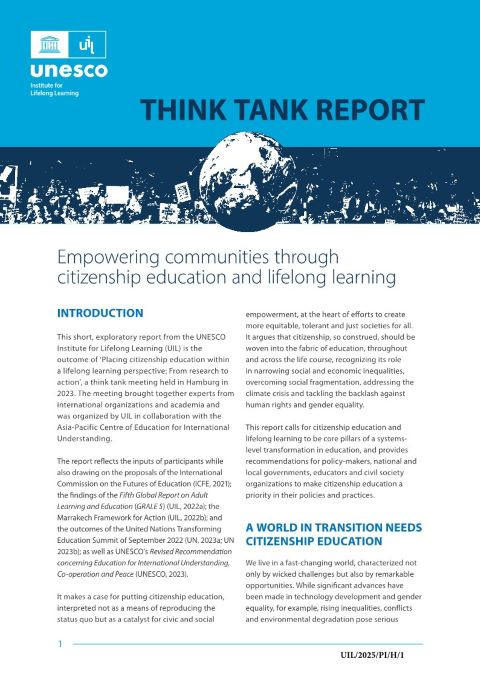 Think Tank Report: Empowering Communities through Citizenship Education and Lifelong Learning Year of publication: 2025 Corporate author: UNESCO Institute for Lifelong Learning (UIL) This short, explorator y repor t from the UNESCO Institute for Lifelong Learning (UIL) is the outcome of ‘Placing citizenship education within a lifelong learning perspective: From research to action’, a think tank meeting held in Hamburg in 2023. The meeting brought together experts from international organizations and academia and was organized by UIL in collaboration with the Asia-Pacific Centre of Education for International Understanding. The report reflects the inputs of participants while also drawing on the proposals of the International Commission on the Futures of Education (ICFE, 2021); the findings of the Fifth Global Report on Adult Learning and Education (GRALE 5) (UIL, 2022a); the Marrakech Framework for Action (UIL, 2022b); and the outcomes of the United Nations Transforming Education Summit of September 2022 (UN, 2023a; UN 2023b); as well as UNESCO’s Revised Recommendation concerning Education for International Understanding, Co-operation and Peace (UNESCO, 2023). It makes a case for putting citizenship education, interpreted not as a means of reproducing the status quo but as a catalyst for civic and social empowerment, at the heart of efforts to create more equitable, tolerant and just societies for all. It argues that citizenship, so construed, should be woven into the fabric of education, throughout and across the life course, recognizing its role in narrowing social and economic inequalities, overcoming social fragmentation, addressing the climate crisis and tackling the backlash against human rights and gender equality. This report calls for citizenship education and lifelong learning to be core pillars of a systems-level transformation in education, and provides recommendations for policy-makers, national and local governments, educators and civil society organizations to make citizenship education a priority in their policies and practices.