
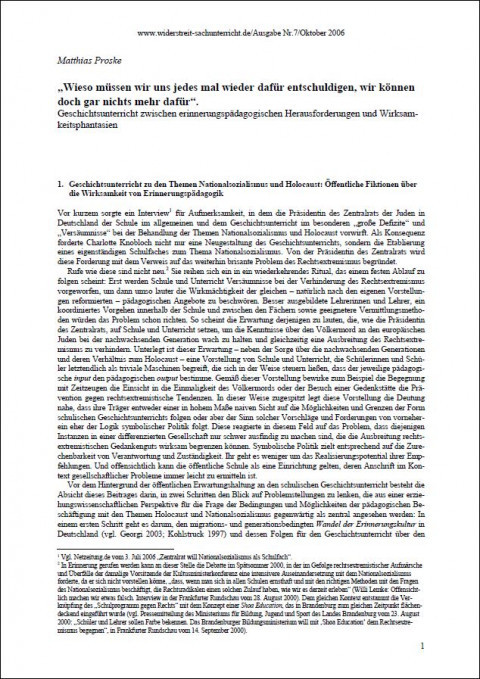
“Why Do We Have to We Apologize for It All the Time, We Can’t Help it”: History Education between Memory-Pedagogy Challenges and Fantasies about Effectiveness
- Author
- Matthias Proske
- Collation
- pp. 1-10
- Resource Language
- German
- Year of publication
- 2006
- Keyword
- GenocideCultural diversity
- Resource Type
- Research papers / journal articles
- Level of education
- Secondary education
- Region
- Europe and North America
- Place of publication
- Berlin
The original title: “Wieso Müssen Wir Uns Jedes Mal Wieder dafür Entschuldigen, Wir Können Doch Gar Nichts Mehr Dafür”: Geschichtsunterricht zwischen Erinnerungspädagogischen Herausforderungen und Wirksamkeitsphantasien
(Widerstand sachunterricht, 7, pp. 1–10)
Against the background of public expectations on the schools’ history education, the article connects a theoretical analysis of the changes in the German historical culture and their consequences for history education about the Holocaust and Nazism with a discussion about how students and teachers take on these themes in educational practice. This is exemplified with a case study from a 9th grade history class.
The above abstract is taken from the International Holocaust Remembrance Alliance Education Research Project. Please also consult the full list of abstracts in 15 languages and the accompanying publication Research in Teaching and Learning about the Holocaust: A Dialogue Beyond Borders. Ed: IHRA, Monique Eckmann, Doyle Stevick, Jolanta Ambrosewicz-Jacobs, 2017, Metropol Verlag at www.holocaustremembrance.com/resources/publications.
 Voices Against Violence: Middle Years
  Addressing Violent Pasts through Education: A Policy Guide
  The Representation of Jews, Judaism and Antisemitism in School Textbooks and Curricula in Europe
  Strategies to Counter Antisemitism: A Handbook for Educators