
Resources
Explore a wide range of valuable resources on GCED to deepen your understanding and enhance your research, advocacy, teaching, and learning.
27 Results found
 Guía para hacer verdes los currículos: enseñanza y aprendizaje para la acción climática Year of publication: 2025 Corporate author: UNESCO Hacer verdes los currículos con el fin de preparar a todos los estudiantes para el cambio climático. La educación es una herramienta poderosa para transformar el mundo e impulsar la acción contra el cambio climático a largo plazo.Esta guía responde a los llamados de las juventudes en favor de un enfoque holístico del cambio climático y la sostenibilidad en los planes de estudio. Define un lenguaje en común sobre cómo debe reflejarse con calidad el cambio climático y la sostenibilidad en los planes de estudio, mediante el establecimiento de los resultados de aprendizaje esperados por grupo etario (grupos de 5 años hasta mayores de 18 años, incluyendo un enfoque de aprendizaje a lo largo de toda la vida).Esto es crucial para acelerar la acción a nivel de los países y garantizar el seguimiento conjunto de los progresos. La meta es lograr que el 90 por ciento de todos los países incluyan el cambio climático en sus planes de estudio para el año 2030, según lo establecido por la Alianza para una Educación Verde.Esta guía tiene el propósito de apoyar a países, escuelas y profesionales en la revisión de las prácticas que tienen en marcha para adoptar un enfoque del cambio climático más orientado a la acción, holístico, científicamente preciso, impulsado por la justicia y con una perspectiva de aprendizaje a lo largo de toda la vida.
  Recomendación sobre la educación para la paz, los derechos humanos y el desarrollo sostenible: guía de implementación Year of publication: 2026 Corporate author: UNESCO Sin educación no hay paz. Una educación transformadora, orientada a la construcción y el mantenimiento de la paz es más urgente que nunca, dado el aumento de los conflictos en diversos frentes.La Recomendación sobre la Educación para la Paz y los Derechos Humanos, la Comprensión Internacional, la Cooperación, las Libertades Fundamentales, la Ciudadanía Mundial y el Desarrollo Sostenible, que fue adoptada por los 194 Estados Miembros de la UNESCO en 2023, articula la visión humanista y transformadora de la educación que ayuda a abordar los actuales y futuros agravios a la paz. Estos desafíos abarcan desde el resurgimiento de conflictos impulsados por desigualdades e injusticias sistémicas, el auge y la propagación del discurso de odio, el racismo y la discriminación—especialmente en línea—, hasta los efectos adversos de las tecnologías digitales y la amenaza existencial del cambio climático.La UNESCO ha elaborado esta Guía como la primera de varias herramientas que ayudarán a los Estados miembro a comprender e implementar plenamente la Recomendación de 2023. Su contenido ha sido desarrollado integrando la perspectiva transdisciplinaria para conectar conceptos y cuestiones clave de la Recomendación de 2023. Además, proporciona ideas concretas y recursos seleccionados para la acción en distintos niveles y tipos de educación. Asimismo, promueve un enfoque multisectorial que parte de las iniciativas positivas ya en marcha y busca la inclusión de todas las personas.Esta Guía es una incorporación oportuna al conjunto de recursos colectivos disponibles para implementar plenamente la Recomendación de 2023 y promover así una educación transformadora para un mundo justo y pacífico.
 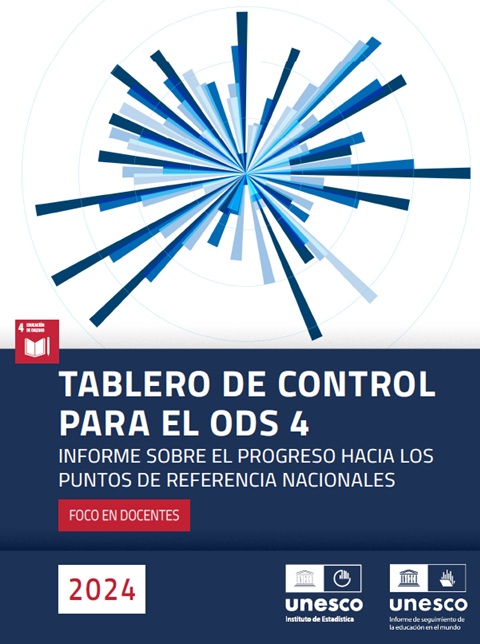 Tablero de control para el ODS 4: informe sobre el progreso hacia los puntos de referencia nacionales; foco en docentes Year of publication: 2024 Corporate author: Global Education Monitoring Report Team | UNESCO Institute for Statistics (UIS) Esta es la segunda evaluación del progreso de los países hacia los puntos de referencia, o metas nacionales, que los países han establecido para ocho indicadores del ODS 4 para marcar su contribución a las metas globales. La evaluación cubre el período desde 2015 y revisa la probabilidad de que cada país alcance su punto de referencia para 2025 o, cuando no se haya establecido dicho punto de referencia, el valor que habría alcanzado si hubiera progresado al ritmo histórico (2000–15) del 25 % de los países que mejoran más rápidamente.El Tablero de Control para el ODS 4 de 2024 revela que el progreso hacia las metas nacionales está desviado en la mayoría de los indicadores. En dos casos – la brecha de género a expensas de los niños que terminan la educación secundaria alta y el gasto público en educación como proporción del gasto público total – los países incluso están retrocediendo.Por el contrario, el progreso es más rápido en el octavo indicador de referencia, la conectividad a Internet en las escuelas, que se añadió tras la prioridad otorgada a la transformación digital en la Cumbre sobre la Transformación de la Educación en 2022. Un tercio de los países estableció objetivos nacionales en 2023 y el progreso en el indicador está siendo revisado por primera vez en esta edición.El progreso también es relativamente rápido en el porcentaje de docentes con las calificaciones mínimas requeridas, que también es el indicador central de esta edición. Se presenta nueva evidencia sobre políticas nacionales en cuanto a los niveles mínimos de calificación requeridos para ingresar a la profesión docente, políticas de desarrollo profesional continuo obligatorio y políticas de formación docente sobre tecnología en educación.
  Generative AI and the Future of Education Year of publication: 2023 Corporate author: UNESCO. Assistant Director-General for Education, 2018- (Giannini, Stefania) The digital revolution has brought about significant changes in how we live, learn, and interact, with multiple waves of technological advancements. The current AI revolution represents a new and profound shift, particularly through AI's ability to simulate human language and conversation. This development challenges our understanding of language, intelligence, and the role of technology in education and society.As AI begins to generate human-like responses and knowledge, it raises fundamental questions about its impact on education, societal values, and our concept of humanity. Education systems are now grappling with how to integrate and regulate AI, which has been rapidly introduced into classrooms without sufficient oversight. The author emphasizes the importance of carefully considering the risks and ethical implications of AI, particularly in its potential to manipulate and shape knowledge systems. There is a need for balanced development, where AI technology is aligned with human values, and education remains a deeply human-centered process.UNESCO is working with countries to develop strategies for the safe use of AI in education, emphasizing the need for a cautious approach and robust regulatory frameworks. The overarching message is that while AI offers immense possibilities, it must be integrated thoughtfully to ensure it enhances education and society without undermining human agency, equity, or the foundational values of learning. La IA generativa y el futuro de la educació Year of publication: 2023 Corporate author: UNESCO. Assistant Director-General for Education, 2018- (Giannini, Stefania) La revolución digital ha traído cambios significativos en cómo vivimos, aprendemos e interactuamos, con múltiples olas de avances tecnológicos. La actual revolución de la inteligencia artificial representa un cambio nuevo y profundo, particularmente a través de la capacidad de la IA para simular el lenguaje humano y la conversación. Este desarrollo desafía nuestra comprensión del lenguaje, la inteligencia y el papel de la tecnología en la educación y la sociedad. A medida que la IA comienza a generar respuestas y conocimientos similares a los humanos, surgen preguntas fundamentales sobre su impacto en la educación, los valores sociales y nuestro concepto de humanidad. Los sistemas educativos ahora están lidiando con la forma de integrar y regular la IA, que ha sido introducida rápidamente en las aulas sin una supervisión adecuada. El autor enfatiza la importancia de considerar cuidadosamente los riesgos y las implicaciones éticas de la IA, particularmente en su potencial para manipular y moldear los sistemas de conocimiento. Existe una necesidad de un desarrollo equilibrado, donde la tecnología de la IA esté alineada con los valores humanos y la educación siga siendo un proceso profundamente centrado en el ser humano. UNESCO está trabajando con los países para desarrollar estrategias para el uso seguro de la IA en la educación, enfatizando la necesidad de un enfoque cauteloso y marcos regulatorios robustos. El mensaje general es que, si bien la IA ofrece inmensas posibilidades, debe integrarse de manera reflexiva para asegurar que mejore la educación y la sociedad sin socavar la agencia humana, la equidad o los valores fundamentales del aprendizaje. L’IA générative et le futur de l’éducation Year of publication: 2023 Corporate author: UNESCO. Assistant Director-General for Education, 2018- (Giannini, Stefania) La révolution numérique a apporté des changements significatifs dans nos modes de vie, d'apprentissage et d'interaction, avec plusieurs vagues de progrès technologiques. La révolution actuelle de l'IA représente un nouveau tournant profond, notamment grâce à la capacité de l'IA à simuler le langage et la conversation humaine. Ce développement remet en question notre compréhension du langage, de l'intelligence et du rôle de la technologie dans l'éducation et la société.Alors que l'IA commence à générer des réponses et des connaissances semblables à celles des humains, cela soulève des questions fondamentales quant à son impact sur l'éducation, les valeurs sociétales et notre conception de l'humanité. Les systèmes éducatifs se retrouvent désormais face au défi d'intégrer et de réguler l'IA, qui a été introduite rapidement dans les salles de classe sans une supervision suffisante. L'auteur insiste sur l'importance de prendre en compte les risques et les implications éthiques de l'IA, en particulier son potentiel à manipuler et à influencer les systèmes de connaissance. Il est nécessaire d'adopter un développement équilibré, où la technologie de l'IA est en phase avec les valeurs humaines, et où l'éducation reste un processus profondément centré sur l'humain.L'UNESCO travaille avec les pays pour élaborer des stratégies visant à utiliser l'IA en toute sécurité dans l'éducation, en insistant sur la nécessité d'une approche prudente et de cadres réglementaires solides. Le message principal est que, bien que l'IA offre d'immenses possibilités, elle doit être intégrée de manière réfléchie afin de garantir qu'elle améliore l'éducation et la société sans compromettre l'autonomie humaine, l'équité ou les valeurs fondamentales de l'apprentissage.
  Making the Case For Inclusive Quality Physical Education Policy Development: A Policy Brief Year of publication: 2021 Author: Nancy McLennan Corporate author: UNESCO This evidence-based policy brief presents the benefits of investing in inclusive quality physical education (QPE) policy development. Content draws directly on findings from in-country interventions which demonstrate the value of inter-sectoral partnerships in QPE policy development and the delivery of low cost/high impact QPE programming which stands to accelerate post-COVID recovery efforts. A series of practical recommendations are included for public and private stakeholders in the sport-education ecosystem, alongside resources to support the implementation of recommendations. En defensa de un desarrollo inclusivo de políticas de educación física de calidad: Informe de políticas Year of publication: 2021 Author: Nancy McLennan Corporate author: Organización de las Naciones Unidas para la Educación, la Ciencia y la Cultura (UNESCO) Este informe presenta los beneficios de la inversión en el desarrollo de políticas inclusivas de educación física de calidad (EFC). Su contenido se funda directamente en evidencias observadas durante intervenciones en países que demuestran la importancia de las asociaciones intersectoriales en el desarrollo de políticas de EFC y en la ejecución de programas de EFC de bajo costo y alto impacto que ayudarán a agilizar los esfuerzos de recuperación tras la COVID. Se incluye una serie de recomendaciones para socios de los sectores público y privado en el ecosistema deportivo – educativo, así como también recursos para apoyar la aplicación de las recomendaciones. S’engager en faveur de l’élaboration inclusive de politiques d’éducation physique de qualité: Note de politique Year of publication: 2021 Author: Nancy McLennan Corporate author: Organisation des Nations Unies pour l'éducation, la science et la culture (UNESCO) Cette note de politique, fondée sur des faits, présente les avantages à investir dans l’élaboration inclusive de politiques d’Éducation Physique de Qualité (EPQ). Le contenu s’inspire directement des résultats issus d’interventions menées dans quatre pays, qui démontrent l’intérêt des partenariats intersectoriels dans le développement des politiques d’EPQ et de la mise en œuvre de programmes d’EPQ à faible coût/à fort impact qui devraient accélérer les efforts de rétablissement post-COVID. Cette note contient une sélection de recommandations pratiques à destination des acteurs publics et privés de l’écosystème sport-éducation, ainsi que des ressources pour soutenir la mise en œuvre de ces recommandations.
  Recomendación sobre la ética de la inteligencia artificial Year of publication: 2022 Corporate author: UNESCO La presente Recomendación trata de las cuestiones éticas relacionadas con el ámbito de la inteligencia artificial en la medida en que competen al mandato de la UNESCO. Aborda la ética de la IA como una reflexión normativa sistemática, basada en un marco integral, global, multicultural y evolutivo de valores, principios y acciones interdependientes, que puede guiar a las sociedades a la hora de afrontar de manera responsable los efectos conocidos y desconocidos de las tecnologías de la IA en los seres humanos, las sociedades y el medio ambiente y los ecosistemas, y les ofrece una base para aceptar o rechazar las tecnologías de la IA. Considera la ética como una base dinámica para la evaluación y la orientación normativas de las tecnologías de la IA, tomando como referencia la dignidad humana, el bienestar y la prevención de daños y apoyándose en la ética de la ciencia y la tecnología.