
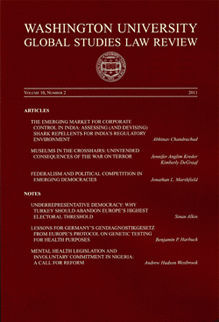
How Human Rights Shape Social Citizenship: On Citizenship and the Understanding of Economic and Social Rights (Washington University Global Studies Law Review. Vol.13, No.2)
- Autor
- Ulrike Davy
- Autor Corporativo
- Washington University
- ISBN
- ISSN 1546-6981
- Colección
- p. 201-263
- Idioma del recurso
- inglés
- Año de publicación
- 2014
- Palabra Clave
- Derechos humanosCitizenshipSocial rights
- Tema
- Civiles / Ciudadanía / DemocraciaDerechos humanosGlobalización y justicia social / Comprensión internacional
- Tipo de Recurso
- Research papers / journal articles
- Nivel de Educación
- Otros
- Región
- Global
- Lugar de publicación
- Saint Louis
This Article reconceptualizes citizenship, a notion usually tied to the nation state, as “layered.” Human rights may serve as the international “layer” of citizenship, addressing nationals and non-nationals alike. It took some time, however, for “social” citizenship to emerge as a human rights issue and, hence, for human rights to become an international layer for social citizenship rights granted on the national level. Around 1993, states started to accept a human rights-based obligation toward the poor, requiring social policies to focus on targeted, individual welfare. Nowadays, poverty mitigation is the human rights core of “social” citizenship. Nowadays, poverty mitigation is the human rights core of “social” citizenship.
Recursos Relacionados
-
 Voices Against Violence: Middle Years
 -
 Study on the Historical Impact of the 1974 Recommendation concerning Education for International Understanding, Cooperation and Peace and Education relating to Human Rights and Fundamental Freedoms
 -
 IIEP-UNESCO 12th Medium-Term Strategy: 2026–2029
 -
 More than Welcome: Intercultural Integration of Migrants in and Through Higher Education