
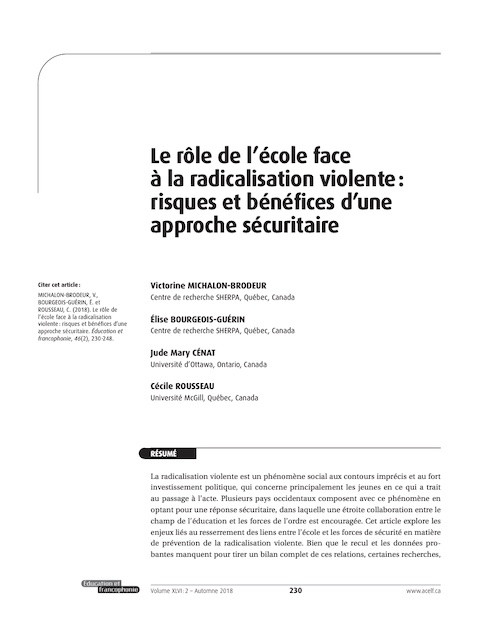
The Role of the School in Dealing With Violent Radicalization: The Risks and Benefits of a Safe Approach (Éducation et francophonie; vol. 46, no. 2)
- Autor Corporativo
- Association canadienne d’éducation de langue française
- ISBN
- ISSN 1916-8659 (digital)
- Colección
- p. 230-248
- Idioma del recurso
- francés
- Año de publicación
- 2018
- Tipo de Recurso
- Research papers / journal articles
- Nivel de Educación
- Educación primariaEducación secundaria
- Región
- Europa y América del Norte
- Lugar de publicación
- Montréal
Violent radicalization is a social phenomenon with vague contours and strong political investment. Those mainly at risk of becoming involved are young people. Several Western countries are dealing with this phenomenon by opting for a security response, encouraging close collaboration between education and law enforcement. This article explores issues related to strengthening connections between the school and law enforcement for the prevention of violent radicalization. While there is a lack of evidence that would be needed to paint a full picture of these relationships, some studies on the impact of the War on Terror on young people and securing American schools in response to school shootings call for restraint. In light of these studies, this article argues that clear boundaries must be established between the mandates of the school and the police. The importance of these firewalls must be emphasized in the training school personnel in the prevention of violent radicalization in order to preserve the school’s ability to be a place that promotes the development of critical thinking and awareness of the Other.
Recursos Relacionados
-
 Study on the Historical Impact of the 1974 Recommendation concerning Education for International Understanding, Cooperation and Peace and Education relating to Human Rights and Fundamental Freedoms
 -
 Addressing Violent Pasts through Education: A Policy Guide
 -
 The Representation of Jews, Judaism and Antisemitism in School Textbooks and Curricula in Europe
 -
 Strategies to Counter Antisemitism: A Handbook for Educators