
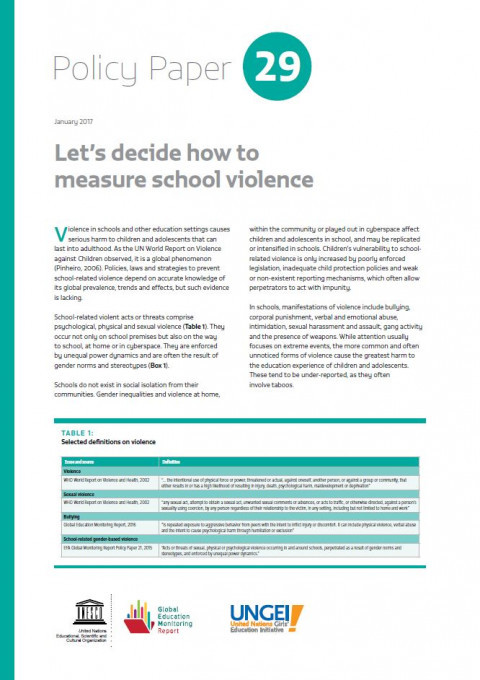
Let's Decide How to Measure School Violence (Policy Paper 29)
- Autor Corporativo
- Organización de las Naciones Unidas para la Educación, la Ciencia y la Cultura (UNESCO)
- Colección
- 15 p.
- Idioma del recurso
- inglésfrancésespañol
- Año de publicación
- 2017
- Tipo de Recurso
- Research papers / journal articlesInternational normative instruments / policy and advocacy documents
- Nivel de Educación
- Educación primariaEducación secundaria
- Región
- Global
- Lugar de publicación
- Paris
Violence in schools and other education settings causes serious harm to children and adolescents that can last into adulthood. As the UN World Report on Violence against Children observed, it is a global phenomenon (Pinheiro, 2006). Policies, laws and strategies to prevent school-related violence depend on accurate knowledge of its global prevalence, trends and effects, but such evidence is lacking.
In schools, manifestations of violence include bullying, corporal punishment, verbal and emotional abuse, intimidation, sexual harassment and assault, gang activity and the presence of weapons. While attention usually focuses on extreme events, the more common and often unnoticed forms of violence cause the greatest harm to the education experience of children and adolescents. These tend to be under-reported, as they often involve taboos.
To collect data on aspects of violence in schools, large-scale, multi-country school-based surveys are increasingly used; some countries also have well-established monitoring mechanisms. Overall, however, consistent evidence on the global prevalence and trends of school-related violence is lacking. To ensure reliable data is gathered, action is needed to bridge differences between the various monitoring methods. This paper, launched to coincide with the International Symposium on School Violence and Bullying: From Evidence to Action, in Seoul, Republic of Korea (January 17–19, 2017), aims to inform the current debate and propose options for the future.
Recursos Relacionados
-
 Youth Lens on the Silk Roads: Best Photos from the International Silk Roads Photo Contest; 6th Edition
 -
 Addressing Violent Pasts through Education: A Policy Guide
 -
 UNESCO Framework for Culture and Arts Education: Implementation Guidance
 -
 The Representation of Jews, Judaism and Antisemitism in School Textbooks and Curricula in Europe