
Recursos
Exploren una amplia gama de recursos valiosos en GCED para profundizar su comprensión y promover su búsqueda, incidencia, enseñanza y aprendizaje.
18 resultados encontrados
 OECD学习框架 2030: 经济合作与发展组织 (OECD) Año de publicación: 2018 Autor corporativo: Organisation for Economic Co-operation and Development (OECD) "教育公平" "高质量的教育" "核心素养" "减负'等已成为流行热词,在新时代背景下实践者对 究竟要"教什么"需要再思考。经济合作与发展组织(简称经合组织 OECD) 2015 年启动了"教育2030: 未来 的教育与技能"项目,项目中启动了"面向 2030 的学习指南"讨论,旨在开发一种新的学习框架,描述需要用什 么样的能力来塑造未来的一代。学习框架包括知识、技能、态度和价值观,个人和社会的福祉 变革性能力,通 过反思、预期和行动的过程,调动知识 技能、态度和价值观,以便发展与世界接触所需的相互关联的能力.此 外, "教育与技能2030项目"专家组也提出了设计教育体系与课程改革的指导原则,包括概念、内容和主题设计 以及流程设计.
  Preparing Our Youth for an Inclusive and Sustainable World: The OECD PISA Global Competence Framework Año de publicación: 2018 Autor corporativo: Organisation for Economic Co-operation and Development (OECD) OECD Programme for International Student Assessment (PISA), the global yardstick for educational success, includes global competence in its metrics for quality, equity and effectiveness in education. The global competence assessment in PISA 2018 is composed of two parts: a cognitive assessment and a background questionnaire. The cognitive assessment is designed to elicit students' capacities to critically examine global issues; recognise outside influences on perspectives and world views; understand how to communicate with others in intercultural contexts; and identify and compare different courses of action to address global and intercultural issues. In the background questionnaire, students will be asked to report how familiar they are with global issues; how developed their linguistic and communication skills are; to what extent they hold certain attitudes, such as respect for people from different cultural backgrounds; and what opportunities they have at school to develop global competence. Answers to the school and teacher questionnaires will provide a comparative picture of how education systems are integrating global, international and intercultural perspectives throughout the curriculum and in classroom activities.
  Education at a Glance 2019: OECD Indicators Año de publicación: 2019 Autor corporativo: Organisation for Economic Co-operation and Development (OECD) Education at a Glance is the authoritative source for information on the state of education around the world. It provides data on the structure, finances and performance of education systems across OECD countries and a number of partner economies.The 2019 edition includes a focus on tertiary education with new indicators on tertiary completion rates, doctoral graduates and their labour market outcomes, and on tertiary admission systems, as well as a dedicated chapter on the Sustainable Development Goal 4. Regards sur l'éducation 2019: Les indicateurs de l'OCDE Año de publicación: 2019 Autor corporativo: Organisation for Economic Co-operation and Development (OECD) Regards sur l’éducation est la publication de référence sur l’état de l’éducation dans le monde. Elle fournit des données clés sur la structure, le financement et la performance des systèmes d’éducation des pays de l’OCDE, ainsi que d’un certain nombre de pays partenaires. Avec plus de 100 tableaux et graphiques – et des liens vers de nombreuses données supplémentaires sur notre base de données consacrée à l’éducation – cette publication présente des données clés sur les résultats des établissements d’enseignement ; l’impact de l’apprentissage dans les différents pays ; l’accès, la participation et la progression au sein des systèmes d’éducation ; les ressources financières investies dans l’éducation ; et les enseignants, l’environnement d’apprentissage et l’organisation scolaire.L'édition 2019 inclut un éclairage spécifique sur l'enseignement tertiaire, avec de nouveaux indicateurs sur le taux de réussite à ce niveau, sur les doctorants et leurs perspectives sur le marché du travail, sur les systèmes d'admission dans l'enseignement tertiaire, ainsi qu'un chapitre dédié au quatrième Objectif de développement durable.
 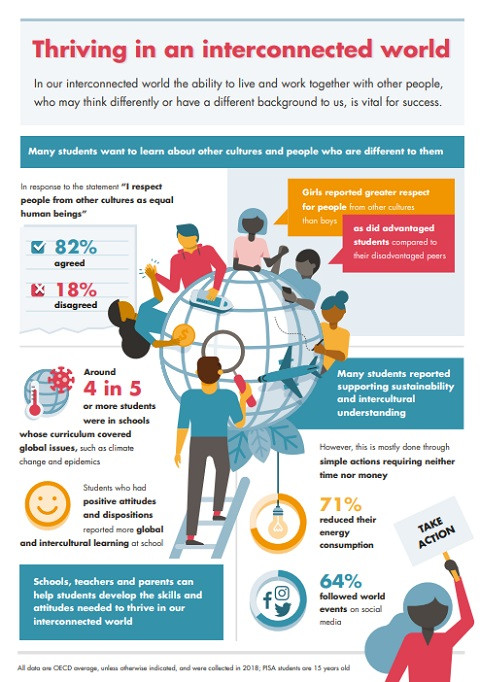 Thriving in an Interconnected World Año de publicación: 2020 Autor corporativo: Organisation for Economic Co-operation and Development (OECD) This infographic shows how ready students are to thrive in an interconnected world. All data were collected from PISA 2018 survey.
  PISA 2018 Results (Volume VI): Are Students Ready to Thrive in an Interconnected World? Año de publicación: 2020 Autor corporativo: Organisation for Economic Co-operation and Development (OECD) The OECD Programme for International Student Assessment (PISA) examines what students know in reading, mathematics and science, and what they can do with what they know. It provides the most comprehensive and rigorous international assessment of student learning outcomes to date. Results from PISA indicate the quality and equity of learning outcomes attained around the world, and allow educators and policy makers to learn from the policies and practices applied in other countries. This is one of six volumes that present the results of the PISA 2018 survey, the seventh round of the triennial assessment. Volume VI: Are Students Ready to Thrive in an Interconnected World? explores students’ ability to examine issues of local, global and cultural significance; understand and appreciate the perspectives and worldviews of others; engage in open, appropriate and effective interactions across cultures; and take action for collective well-being and sustainable development. The volume explores students’ outcomes on the cognitive test and corresponding questionnaire in addition to their experiences of global and intercultural learning at school and beyond.
  Education at a Glance 2020: OECD Indicators Año de publicación: 2020 Autor corporativo: Organisation for Economic Co-operation and Development (OECD) Education at a Glance is the authoritative source for information on the state of education around the world. It provides data on the structure, finances and performance of education systems across OECD countries and a number of partner economies. More than 100 charts and tables in this publication – as well as links to much more available on the educational database – provide key information on the output of educational institutions; the impact of learning across countries; access, participation and progression in education; the financial resources invested in education; and teachers, the learning environment and the organisation of schools.The 2020 edition includes a focus on vocational education and training, investigating participation in vocational education and training at various levels of education, the labour market and social outcomes of vocational graduates as well as the human and financial resources invested in vocational institutions. Two new indicators on how vocational education and training systems differ around the world and on upper secondary completion rate complement this topic. A specific chapter is dedicated to the Sustainable Development Goal 4, and investigates the quality and participation in secondary education.
  Education 21st Century Children: Emotional Well-being in the Digital Age (Educational Research and Innovation) Año de publicación: 2019 Autor corporativo: Organisation for Economic Co-operation and Development (OECD) This report examines modern childhood, looking specifically at the intersection between emotional well-being and new technologies. It explores how parenting and friendships have changed in the digital age. It examines children as digital citizens, and how best to take advantage of online opportunities while minimising the risks. The volume ends with a look at how to foster digital literacy and resilience, highlighting the role of partnerships, policy and protection.