
Recursos
Exploren una amplia gama de recursos valiosos en GCED para profundizar su comprensión y promover su búsqueda, incidencia, enseñanza y aprendizaje.
1,578 resultados encontrados
 Inclusion from the start: guidelines on inclusive early childhood care and education for Roma children Año de publicación: 2014 Autor corporativo: UNESCO | Council of Europe Inclusion from the start: guidelines on inclusive early childhood care and education for Roma children (Guidelines hereafter) is a joint contribution by the Council of Europe and UNESCO to improving access to quality early childhood services for Roma children. They are a concrete follow-up to the recommendations arising from an expert meeting, organised by the two organisations in 2007.1 Recognising that quality early childhood experience is an important stepping stone toward inclusive participation in school and society, the Guidelines address the challenges specifc to Roma children in the early years and transition to primary education. They provide guidance on key themes, such as the conceptualisation of early childhood care and education (ECCE) services, agenda-setting, stakeholders’ responsibilities, curricular and pedagogical approaches, staf training and professional development, assessment and transition to primary education. The Guidelines primarily address formal ECCE services – such as kindergartens and preschools – which typically cater for children from ages 3-6 years. The reason for this focus is that providing care and education experience prior to primary school entry is crucial for supporting Roma children’s school readiness and for facilitating an equal start in their frst year. This being said, the Guidelines also acknowledge the critical importance of the years pre-natal to age 3, and consider health and nutrition interventions and non-formal ECCE programmes (e.g. community-based childcare, parenting education) as essential services in deprived neighbourhoods and settlements. Inclusion dès le début: les lignes directrices sur les soins de la petite enfance inclusive et éducation pour les enfants roms Año de publicación: 2014 Autor corporativo: UNESCO | Council of Europe Inclusion dès le début: les lignes directrices sur les soins de la petite enfance inclusive et l'éducation des enfants roms (lignes directrices ci-après) est une contribution conjointe du Conseil de l'Europe et de l'UNESCO à l'amélioration de acesss aux services de la petite enfance de qualité pour les enfants roms. Ils sont un suivi concret aux recommandations découlant d'une réunion d'experts, organisée par les deux organisations en 2007.1. Reconnaissant que l'expérience de qualité de la petite enfance est une étape importante vers la participation inclusive à l'école et de la société, les lignes directrices abordent les défis spécifques aux enfants roms dans les premières années et la transition à l'enseignement primaire. Ils fournissent des conseils sur des thèmes clés, tels que la conceptualisation des soins de la petite enfance et les services d'éducation (EPPE), l'établissement de l'ordre du jour, les responsabilités des parties prenantes, des programmes et des approches pédagogiques, la formation des staf et le perfectionnement professionnel, l'évaluation et la transition à l'enseignement primaire. Les lignes directrices traitent principalement des services formels EPPE - tels que les jardins d'enfants et les écoles maternelles - qui répondent généralement pour les enfants âgés de 3-6 ans. La raison de cette mise au point est que la prestation de soins et de l'expérience de l'éducation avant l'entrée de l'école primaire est cruciale pour soutenir la maturité scolaire des enfants roms et pour faciliter un départ égal dans leur année frst. Ceci étant dit, les lignes directrices reconnaissent également l'importance critique des années pré-natal à 3 ans, et d'envisager des interventions de santé et de la nutrition et des programmes non formels EPPE (garde d'enfants, l'éducation parentale à base communautaire) comme des services essentiels dans les quartiers défavorisés et colonies.
 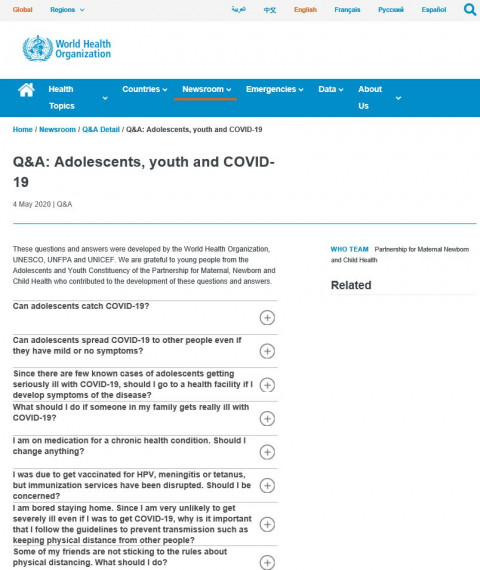 Q&A: Adolescents, Youth and COVID-19 Año de publicación: 2020 Autor corporativo: World Health Organization (WHO) | UNESCO | United Nations Population Fund (UNFPA) | United Nations Children's Fund (UNICEF) As part of UNESCO’s work in promoting better health and well-being for all children and young people, it has contributed to the development of a practical guide in a ‘questions and answers’ (Q&A) format on children and adolescents and COVID-19. This work was led by the World Health Organization, in collaboration with the Adolescents and Youth Constituency of the Partnership for Maternal, Newborn and Child Health, UNESCO, UNFPA, and UNICEF.The Q&A provide children and adolescents with accurate, non-judgmental information and advice around COVID-19, including how to help stop the spread of the virus, what to do if they develop symptoms of the disease, and how to best manage their health and well-being during the confinement period and after. It considers children and young people as critical actors in the response to COVID-19, not as passive beneficiaries.
  Rapport de synthèse sur l'application par les États membres de la Recommandation de 1974 sur l'éducation pour la compréhension, la coopération et la paix internationales et l'éducation relative aux droits de l'homme et aux libertés fondamentales Año de publicación: 2013 Autor corporativo: UNESCO Background: In accordance with 34 C/Resolution 87, 177 EX/Decision 35 (I) and 184 EX/Decision 20, the Executive Board has monitored the implementation of the 1974 Recommendation concerning Education for International Understanding, Cooperation and Peace and Education relating to Human Rights and Fundamental Freedoms. Pursuant to 192 EX/Decision 20 (III), the Director-General hereby submits the consolidated report on the implementation by Member States of the Recommendation.Purpose: This document reports on the results of the Fifth Consultation on the Implementation of the Recommendation concerning Education for International Understanding, Cooperation and Peace and Education relating to Human Rights and Fundamental Freedoms (covering the period 2009-2012). The analysis was prepared on the basis of 55 national reports from Member States received by the Secretariat. Сводный доклад о выполнении Рекомендации 1974 г. о воспитании в духе международного взаимопонимания, сотрудничества и мира и о воспитании в духе уважения прав человека и основных свобод Año de publicación: 2013 Autor corporativo: UNESCO Background: In accordance with 34 C/Resolution 87, 177 EX/Decision 35 (I) and 184 EX/Decision 20, the Executive Board has monitored the implementation of the 1974 Recommendation concerning Education for International Understanding, Cooperation and Peace and Education relating to Human Rights and Fundamental Freedoms. Pursuant to 192 EX/Decision 20 (III), the Director-General hereby submits the consolidated report on the implementation by Member States of the Recommendation.Purpose: This document reports on the results of the Fifth Consultation on the Implementation of the Recommendation concerning Education for International Understanding, Cooperation and Peace and Education relating to Human Rights and Fundamental Freedoms (covering the period 2009-2012). The analysis was prepared on the basis of 55 national reports from Member States received by the Secretariat. 关于1974年《关于促进国际了解、合作与和平的教育以及关于人权与基本自由的教育的建议书》执行情况的综合报告 Año de publicación: 2013 Autor corporativo: UNESCO Background: In accordance with 34 C/Resolution 87, 177 EX/Decision 35 (I) and 184 EX/Decision 20, the Executive Board has monitored the implementation of the 1974 Recommendation concerning Education for International Understanding, Cooperation and Peace and Education relating to Human Rights and Fundamental Freedoms. Pursuant to 192 EX/Decision 20 (III), the Director-General hereby submits the consolidated report on the implementation by Member States of the Recommendation.Purpose: This document reports on the results of the Fifth Consultation on the Implementation of the Recommendation concerning Education for International Understanding, Cooperation and Peace and Education relating to Human Rights and Fundamental Freedoms (covering the period 2009-2012). The analysis was prepared on the basis of 55 national reports from Member States received by the Secretariat.
  دور اليونسكو ومسؤولياتها في وضع تعليم المواطَنة العالمية موضع التطبيق وتعزيز التعليم من أجل السلام وحقوق الإنسان والتعليم من أجل التنمية المستدامة Año de publicación: 2015 Autor corporativo: UNESCO This document is an addendum to document 196 EX/32. This item was included in the provisional agenda of the 196th session of the Executive Board at the request of Austria and Italy
 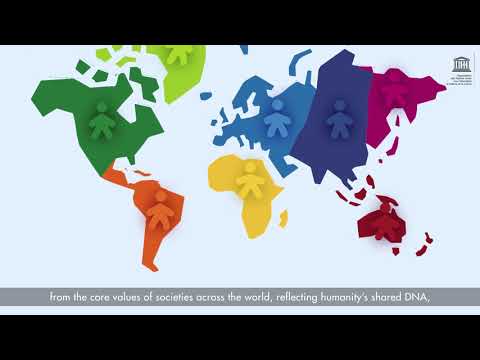 Éducation à la citoyenneté mondiale: Pour une approche locale Año de publicación: 2018 Autor corporativo: UNESCO Les sociétés à travers le monde ont longtemps vécu selon les principes de la solidarité, le dialogue et le respect de la diversité. Le programme d’éducation à la citoyenneté mondiale (ECM) de l’UNESCO est inspiré de ces savoirs, en inculquant aux apprenants les compétences, les valeurs et les attitudes pour vivre ensemble et construire un monde plus durable et pacifique. L’ECM n’est pas un nouveau concept, mais une aspiration de longue date à travers les continents.
  Education for Global Citizenship Education & Sustainable Development: Content in Social Science Textbooks Año de publicación: 2016 Autor: Patrica Bromley | Julia Lerch | Jeremy Jimenez Autor corporativo: UNESCO In times of violence and egregious destruction of human lives and the natural world, our recognition of the need for education that promotes peace and justice becomes particularly pressing. This background report reviews the state of existing research and data on relevant sustainable development content in social science education in countries around the world. Specifically, it examines the extent to which textbook content could help learners acquire the knowledge, skills, and values needed to meet goal 4.7 of the United Nation’s Sustainable Development Goals: “By 2030, ensure that all learners acquire the knowledge and skills needed to promote sustainable development, including, among others, through education for sustainable development and sustainable lifestyles, human rights, gender equality, promotion of a culture of peace and non-violence, global citizenship and appreciation of cultural diversity and of culture’s contribution to sustainable development.” It reviews relevant literature and analyzes three cross-national, longitudinal databases containing information coded from textbook content to assess the current state of knowledge. The paper concludes by indicating where future research efforts are most needed, identifying geographic and substantive needs, and considering monitoring mechanisms that could encourage on-going evaluation and monitoring of textbook content.
 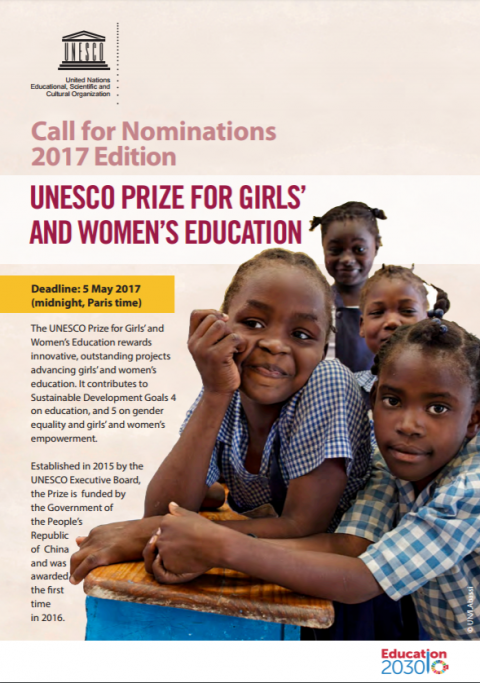 UNESCO Prize for Girls' and Women's Education, 2017 edition: call for nominations Año de publicación: 2017 Autor corporativo: UNESCO The UNESCO Prize for Girls’ and Women’s Education rewards innovative, outstanding projects advancing girls’ and women’s education. It contributes to Sustainable Development Goals 4 on education, and 5 on gender equality and girls’ and women’s empowerment.