
Recursos
Exploren una amplia gama de recursos valiosos en GCED para profundizar su comprensión y promover su búsqueda, incidencia, enseñanza y aprendizaje.
35 resultados encontrados
 Confronting the Causes and Repercussions of Climate Change: What Role for the Moroccan School and Educational Action? Año de publicación: 2016 Autor: Abdulaziz Faras Autor corporativo: Mohammed V University. Faculty of Education An article discussing the role that the public school and environmental education should play in tackling climate change. The study indicates the importance of the number of model programs for environmental education. The article also deals with the role imposed by the Moroccan school in confronting the causes and repercussions of climate change. مواجهة أسباب وتداعيات التغيرات المناخية: أي دور للمدرسة المغربية وللفعل التربوي؟ Año de publicación: 2016 Autor: Abdulaziz Faras Autor corporativo: Mohammed V University. Faculty of Education مقال يناقش الدور الذي يجب أن تساهم به المدرسة عامة والتربية البيئية في مواجهة تغير المناخ. تشير الدراسة لأهمية أعداد البرامج النموذجية للتربية البيئية. والمقال أيضا يتعرض للدور المفروض القيام به من قبل المدرسة المغربية في مواجهة أسباب وتداعيات التغير المناخي.
  Research on National Curriculum Standards and Framework Año de publicación: 2001 Autor: Cui Yunkuo This article is devoted to explaining the nature and framework of the national curriculum standards and the presentation techniques of the curriculum objectives. First, this article discusses the nature of the curriculum standard, describing the prescriptiveness of the curriculum standards, and then discussed the normative presentation of the curriculum standard framework. It also provides the framework of the first national curriculum standards in China and finally explains the presentation techniques of the course objectives, as well as the level of learning and behavioral verbs. 国家课程标准与框架的解读 Año de publicación: 2001 Autor: Cui Yunkuo 本文致力于阐释国家课程标准的性质、框架和课程目标的陈述技术。首先,探讨了课程标准的性质,对于课程标准的规定性作了描述。然后讨论了课程标准框架的规范性陈述方式,并提供了我国第一个国家课程标准的框架。最后阐述了课程目标的陈述技术,以及学习水平与行为动词等问题。
  Ten Clues for Rethinking Curriculum (In-Progress Reflection; No. 42, 2021) Año de publicación: 2021 Autor: Renato Opertti Autor corporativo: UNESCO International Bureau of Education (IBE) This discussion document highlights the urgency of rethinking curriculum in light of reinforcing the commitments of the Education 2030 Agenda on learning, disruptive systemic worldwide societal changes, and crucially, the profound transformation of education and education systems post Covid-19. Curriculum is always at the core of giving effect to social aspirations and ideals on the why, what, how, when, and where of teaching, learning, and assessing. We propose a series of 10 interconnected clues to deepen on the systemic and holistic understanding of curriculum as contributing to lay foundations for a better, sustainable and fair future. These clues are: understanding the new generations; combatting factors related to vulnerability; reinforcing understanding between school and families; deepening glo-local education; enhancing the focus on the person; promoting synergies among values; valuing diversity; focusing on education that enhances freedom; moving toward hybrid modes of education; and inspiring affection for educators.
 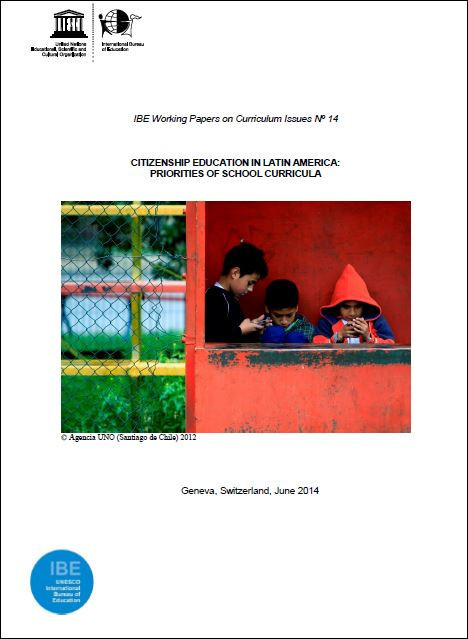 Citizenship education in Latin America: Priorities of School Curricula Año de publicación: 2014 Autor: Cristián Cox | Martín Bascopé | Juan Carlos Castillo | Daniel Miranda | Macarena Bonhomme Autor corporativo: UNESCO International Bureau of Education (IBE) This work focuses on the curricula of six Latin American countries – Colombia, Chile, the Dominican Republic, Guatemala, Mexico and Paraguay – which at the close of the past decade agreed to be part of the project Regional System of Evaluation and Development of Citizenship Competencies (SREDECC). With the support of the Inter-American Development Bank, SREDECC developed the Latin American module of the International Civic and Citizenship Study (ICCS- 2009) undertaken by the International Association for the Evaluation of Educational Achievement (IEA), in addition to encouraging the participation of the countries in that study (Cox 2010; Schulz, Ainley, Friedman and Lietz 2011). This document comprises four parts. The first section takes stock of the state of democratic belief in the region, drawing upon the most significant opinion studies of the past decade, so as to offer broader meaning bases for curriculum analysis and, more generally, for educational work in the field of citizenship. The second section describes the organizational (or structural) characteristics of the curricula of the six countries and presents a framework of categories for their comparative analysis. The subsequent section describes and analyses the contents of the six curricula examined and how they deal with the values, institutions and citizenship relations in their civic (political) and civil (coexistence) dimensions. On the basis of the most significant findings, the closing section includes some reflections regarding curriculum development with regard to citizenship. Educación Ciudadana en América Latina: Prioridades de los Currículos Escolares Año de publicación: 2014 Autor: Cristián Cox | Martín Bascopé | Juan Carlos Castillo | Daniel Miranda | Macarena Bonhomme Autor corporativo: UNESCO International Bureau of Education (IBE) El documento se organiza en cuatro partes. En la primera se da cuenta del estado de la creencia democrática en la región, recurriendo a evidencia de los estudios de opinión más importantes de la última década, de modo de ofrecer contexto y bases de significado amplios al análisis curricular, así como, más en general, al trabajo educativo en el área de ciudadanía. En la segunda sección se describe las características organizativas (o de estructura) de los currículos de los seis países y se presenta un esquema de categorías para el análisis comparado de los mismos. La sección siguiente describe y analiza los contenidos de los seis currículos examinados y su tratamiento de los valores, las instituciones y las relaciones de ciudadanía, en su dimensión cívica (política) y civil (convivencia). A partir de los hallazgos más importantes, la sección de cierre ofrece unas reflexiones orientadas al desarrollo curricular en el área.
 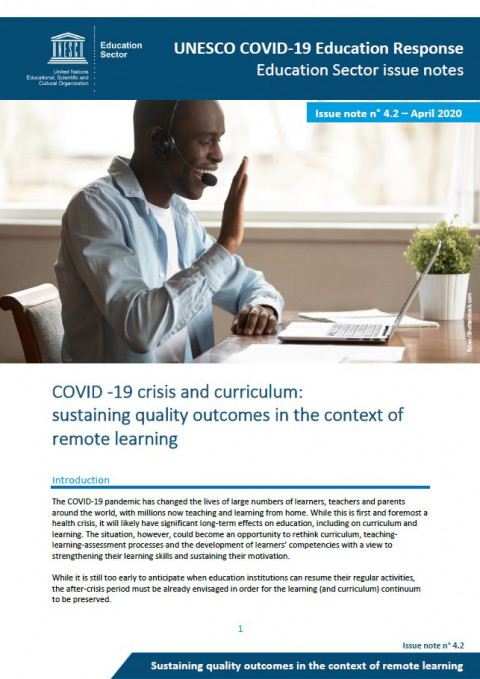 COVID-19 Crisis and Curriculum: Sustaining Quality Outcomes in the Context of Remote Learning (Issue Note no. 4.2 – April 2020) Año de publicación: 2020 Autor corporativo: UNESCO The COVID-19 pandemic has changed the lives of large numbers of learners, teachers and parents around the world, with millions now teaching and learning from home. While this is first and foremost a health crisis, it will likely have significant long-term effects on education, including on curriculum and learning. The situation, however, could become an opportunity to rethink curriculum, teaching-learning-assessment processes and the development of learners’ competencies with a view to strengthening their learning skills and sustaining their motivation.This crisis will likely provide an opportunity for schools to strengthen their ties with families, and for teachers to communicate and cooperate better with parents in the interest of learners. In the same vein, the crisis means teachers and parents may become more involved in decisions regarding curriculum appropriateness. This can support the development of a learner-centred, participative and inclusive learning paradigm that takes into account the interests of learners, as well as their environments and aspirations. Crisis y currículo durante el COVID-19: mantención de los resultados de calidad en el contexto del aprendizaje remoto (Nota temática No. 4.2 – Abril 2020) Año de publicación: 2020 Autor corporativo: Organización de las Naciones Unidas para la Educación, la Ciencia y la Cultura (UNESCO) La pandemia del COVID-19 ha cambiado la vida de una gran cantidad de estudiantes, docentes, padres y madres a lo largo del mundo y millones actualmente enseñan y aprenden desde sus hogares. Aunque se trata principalmente de una crisis sanitaria, es probable que tenga importantes secuelas a largo plazo en la educación, incluso en el currículo y el aprendizaje. No obstante, la situación puede transformarse en una oportunidad para reexaminar el currículo, los procesos de evaluación de la enseñanza y del aprendizaje y el desarrollo de las competencias de las y los estudiantes, en vista de fortalecer sus habilidades de aprendizaje y mantener su motivación.Es probable que la crisis ofrezca una oportunidad para que las escuelas fortalezcan sus vínculos con las familias y para que las y los docentes se comuniquen y cooperen mejor con los padres y las madres en beneficio de las y los estudiantes. En la misma línea, la crisis significa que docentes, madres y padres podrían participar más en las decisiones respecto de la idoneidad del currículo. Esto puede servir como apoyo al paradigma de aprendizaje inclusivo, participativo y centrado en la y el estudiante, que considera tanto los intereses de las y los estudiantes como sus entornos y aspiraciones.
  一起重新构想我们的未来:为教育打造新的社会契约 Año de publicación: 2022 Autor corporativo: International Commission on the Futures of Education | UNESCO 我们人类和地球正遭受着威胁。新冠肺炎疫情只不过证明了我们的脆弱性和相互关联性。我们现在需要采取紧急行动,一起改变方向,重新构想我们的未来。“教育的未来”国际委员会的这份报告认可教育可以带来深刻变革。我们目前面临着双重挑战,即兑现尚未实现的承诺,确保每位儿童、青少年和成年人都有权接受优质教育,以及把教育当作我们通往可持续共同未来的路径,充分实现其变革潜力。为了做到这一点,我们需要一份能够在改变未来的同时,修复现有不公正的新的教育社会契约。这一新的社会契约必须以人权为依据,以非歧视性、社会正义、尊重生命、人的尊严和文化多样性等原则为基础。它必须包含关怀、互惠和团结的伦理。它必须加强教育作为公共事业、共同利益的地位。这份报告建立在历时两年、约100万人参与的全球协商过程的基础之上,它邀请世界各地政府、机构、组织和公民为教育订立一份新的社会契约,帮助我们为所有人创造和平、公正和可持续的未来。这份报告所提出的愿景、原则和建议只是一个起点。对其进行解读和本土化实践,是我们需要共同努力完成的事业。目前的工作中已经存在许多亮点,本报告试图捕捉这些亮点,同时也以其为基础进行构建。本报告既不是一部指南,也不是一幅蓝图,而是一场至关重要的对话的起点。