
Recursos
Exploren una amplia gama de recursos valiosos en GCED para profundizar su comprensión y promover su búsqueda, incidencia, enseñanza y aprendizaje.
54 resultados encontrados
 Recorridos nacionales rumbo a la educación para el desarrollo sostenible, 2011: análisis de las experiencias de los países Chile, Indonesia, Kenya, Omán, Países Bajos Año de publicación: 2011 Autor: I. Mulà | Daniella Tilbury Autor corporativo: UNESCO This publication has sourced information from a series of national reviews commissioned by UNESCO in 2010 and written by authoritative stakeholders in Chile, Indonesia, Kenya, the Netherlands and Oman. The selection of countries was based on: i) work showcased at the 2009 World Conference on Education for Sustainable Development held in Bonn, Germany; ii) submissions to the monitoring and evaluation process for the Decade of Education for Sustainable Development (DESD); as well as iii) through evaluation material submitted by UNESCO staff in regional bureaux of education. The countries showcased in this report are not necessarily the ‘best’ examples of the region, as many other countries are also progressing effectively towards implementing ESD. Rather, the countries selected illustrate the wide diversity of ESD approaches and initiatives taking place in different parts of the learnt world. The national studies were then edited and harmonized before common themes and lessons learned were identified to support other national efforts in moving towards the second half of the UN Decade of Education for Sustainable Development. Educación sobre el Cambio Climático para el Desarrollo Sostenible: Iniciativa de la UNESCO sobre el Cambio Climático Año de publicación: 2010 Autor corporativo: UNESCO The UNESCO Climate Change Initiative was launched by Director-General Irina Bokova in Copenhagen during the 15th Conference of the Parties to the UN Framework Convention on Climate Change (UNFCCC COP15). It seeks to reinforce the scientific, mitigation and adaptation capacities of countries and communities that are most vulnerable to the effects of climate change. It focuses on a select number of strategic issues in line with The UN System Delivering as One on Climate Change action plan and The UNESCO Strategy for Action on Climate Change. The Initiative is based on four thematic areas: scientific, educational, environmental and ethical. Key objectives will be achieved through intersectoral and interdisciplinary cooperation, coordinated field activities, and networking. Special attention is given to UNESCO’s two global priorities, Africa and gender equality, as well as to the increased vulnerability of Small Island Developing States (SIDS). The UN System “Delivering as One” on Climate Change During the 13th session of the Conference of Parties to the UNFCCC in Bali, Indonesia, UN Secretary General Ban Ki-Moon presented an unprecedented coordination effort to bring together all the diverse perspectives, expertise and strengths of the UN system so as to deliver as one in the critical area of climate change. The initiative brings together expertise and ongoing work in diverse areas ranging from science and technology to agriculture, transport, forestry and disaster risk reduction, to address both mitigation and adaptation. It brings together the normative, standard setting and knowledge sharing capacities of the system with its operational reach in order to support the most vulnerable. The overall objective is to maximize existing synergies, eliminate duplication and overlap, and optimize the impact of the collective effort of the UN system. To ensure better coordination, convening responsibilities were assigned to UN system entities with a large volume of activities in the five focus areas and four cross-cutting areas. Focus areas ㆍAdaptation – High-Level Committee on Programmes collectively ㆍ Technology transfer – UNIDO, UN-DESA ㆍReduction of emissions from deforestation and degradation (REDD) – UNDP, FAO, UNEP ㆍ Financing mitigation and adaptation action – UNDP, World Bank Group ㆍCapacity building – UNDP, UNEP Cross-cutting areas ㆍClimate knowledge: science, assessment, monitoring and early warning – WMO, UNESCO ㆍSupporting global, regional and national action – UN-DESA, UN Regional Commissions, UNDP ㆍClimate-neutral UN – UNEP ㆍPublic awareness – UNCG, UNEP.
  Aprender a Vivir de Manera Sostenible en Ciudades de América Latina y el Caribe, Villa María (Argentina), 26-28 de abril de 2017: informe de la reunión Año de publicación: 2017 Autor corporativo: UNESCO Villa Maríia, la primera ciudad argentina que entróo a formar parte de la Red Mundial de Ciudades del Aprendizaje de la UNESCO, fue una de las organizadoras de la primera reunióon de esta Red en la regióon, titulada “Aprender a vivir de manera sostenible en ciudades en Améerica Latina y el Caribe”. Este acto, de tres díias de duracióon, fue una iniciativa conjunta de la ciudad de Villa Maríia, el Instituto de la UNESCO para el Aprendizaje a lo Largo de Toda la Vida (IUAL), la Sede de la UNESCO y la Oficina Regional de Educacióon de la UNESCO para Améerica Latina y el Caribe (OREALC/UNESCO Santiago). Los participantes estudiaron nuevas formas de poner en práactica soluciones sostenibles a escala local, asíi como de fomentar una mayor sensibilizacióon y formacióon en materia de educacióon para el desarrollo sostenible (EDS). Villa Maríia acogióo a máas de 170 representantes de máas de 40 ciudades y 20 paíises, entre los que se encontraban alcaldes y tenientes de alcalde, expertos, autoridades y profesionales. Durante la primera jornada de la reunióon tuvieron lugar reuniones plenarias y la segunda jornada se dividióo en dos sesiones paralelas de talleres: 1) un taller regional sobre el Programa de Accióon Mundial de EDS y las ciudades, y 2) un taller regional sobre las ciudades del aprendizaje.
 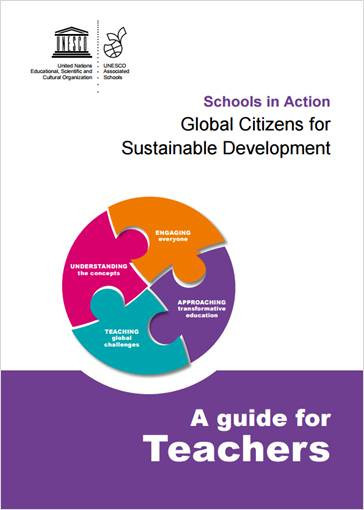 Escuelas en acción, ciudadanos del mundo para el desarrollo sostenible: guía para el profesorado Año de publicación: 2016 Autor corporativo: UNESCO The Global Citizens for Sustainable Development Teachers’ guide aims to introduce teachers to Global Citizenship Education (GCED) and Education for Sustainable Development (ESD). It provides secondary school teachers with ideas and activities to help students become global citizens and sustainable development actors. The Teachers’ guide draws on the discussions and activities of almost 1,100 participants from 104 countries, including ASPnet National Coordinators, school principals, teachers, students and experts who contributed to the Online Collaborative Platform ASPnet in Action: Global Citizens Connected for Sustainable Development in 2014 and 2015 [http://en.unesco. org/aspnet/globalcitizens] with associated activities and initiatives. The Teachers’ guide provides: An overview of what it means for learners to become global citizens and of how learners can contribute to sustainable development. Ideas for classroom activities that can help secondary school students to develop knowledge, skills, values, attitudes and behaviours that promote GCED and ESD. Selected activities on GCED and ESD from ASPnet schools around the world.
 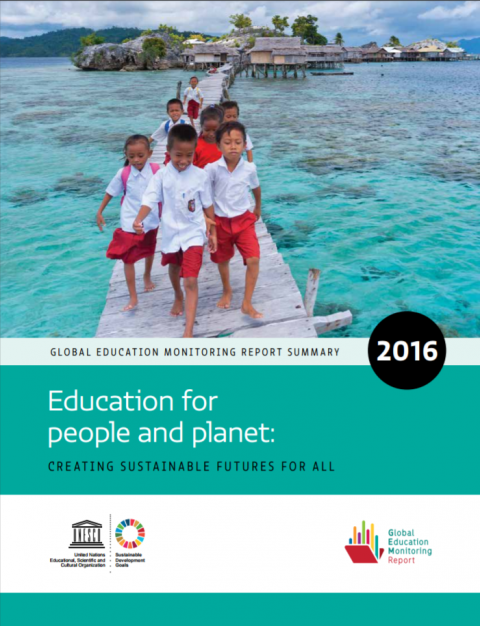 La Educación al servicio de los pueblos y el planeta: creación de futuros sostenibles para todos, resumen del informe de seguimiento de la educación en el mundo 2016; Año de publicación: 2016 Autor corporativo: UNESCO The GEM Report provides an authoritative account of how education is the most vital input for every dimension of sustainable development. Better education leads to greater prosperity, improved agriculture, better health outcomes, less violence, more gender equality, higher social capital and an improved natural environment. Education is key to helping people around the world understand why sustainable development is such a vital concept for our common future. Education gives us the key tools – economic, social, technological, even ethical – to take on the SDGs and to achieve them. These facts are spelled out in exquisite and unusual detail throughout the report. Yet the report also emphasizes the remarkable gaps between where the world stands today on education and where it has promised to arrive as of 2030.
  Función y responsabilidades de la UNESCO en la realización de la educación para la ciudadanía mundial y la promoción de la educación para la paz y los derechos humanos y la educación para el desarrollo sostenible Año de publicación: 2015 Autor corporativo: UNESCO This document is an addendum to document 196 EX/32. This item was included in the provisional agenda of the 196th session of the Executive Board at the request of Austria and Italy Los dos primeros años del Decenio de las Naciones Unidas de la Educación para el Desarrollo Sostenible (2005-2014) Año de publicación: 2007 Autor corporativo: UNESCO The implementation of the DESD has made considerable progress since its international launch in March 2005. Apart from regional and national launches, progress has been achieved in both institutional and programmatic areas at international, regional and national levels. The objective of this report is not solely to highlight and showcase to Member States all that has been achieved in the two years since the international launch. The report also takes stock of on-going UNESCO initiatives, established prior to the Decade, which are providing major contributions to the implementation of the DESD, and thus cannot be by-passed. Equally important are the recommendations to remedy problems in the implementation of the DESD and strengthen those measures that are working efficiently. Educación para el desarrollo sostenible: edificar un mundo mejor y más justo para el siglo XXI Año de publicación: 2012 Autor corporativo: UNESCO Education for Sustainable Development allows every human being to acquire the knowledge, skills, attitudes and values necessary to shape a sustainable future. Education for Sustainable Development means including key sustainable development issues into teaching and learning; for example, climate change, disaster risk reduction, biodiversity, poverty reduction, and sustainable consumption. It also requires participatory teaching and learning methods that motivate and empower learners to change their behaviour and take action for sustainable development. Education for Sustainable Development consequently promotes competencies like critical thinking, imagining future scenarios and making decisions in a collaborative way. Education for Sustainable Development requires far-reaching changes in the way education is often practised today. UNESCO is the lead agency for the UN Decade of Education for Sustainable Development (2005-2014). Declaración de Aichi-Nagoya sobre la Educación para el Desarrollo Sostenible Año de publicación: 2014 Autor corporativo: UNESCO We, the participants of the UNESCO World Conference on Education for Sustainable Development held in AichiNagoya, Japan, from 10 to 12 November 2014, adopt this Declaration and call for urgent action to further strengthen and scale up Education for Sustainable Development (ESD), in order to enable current generations to meet their needs while allowing future generations to meet their own, with a balanced and integrated approach regarding the economic, social and environmental dimensions of sustainable development. This Declaration recognises that people are at the centre of sustainable development and builds on the achievements of the United Nations (UN) Decade of ESD (2005-2014); the deliberations of the UNESCO World Conference on ESD in Aichi-Nagoya; and the Stakeholder Meetings held in Okayama, Japan, from 4 to 8 November 2014, namely, UNESCO ASPnet International ESD events, the UNESCO ESD Youth Conference, the Global Regional Centres of Expertise Conference, and other relevant events and consultation processes, including regional ministerial meetings. We express our sincere gratitude to the Government of Japan for hosting the UNESCO World Conference on ESD.
 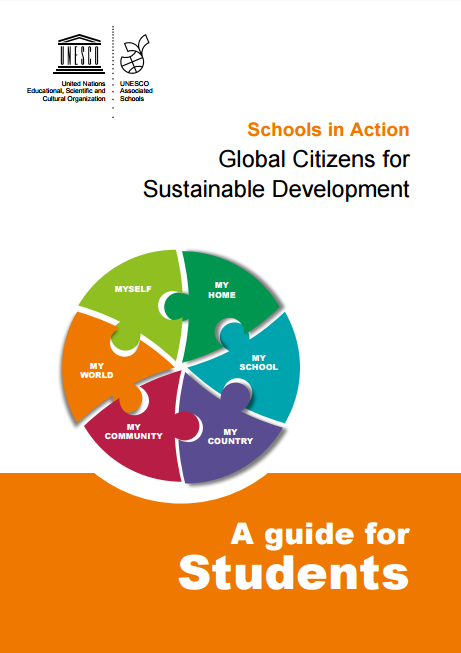 Escuelas en acción Ciudadanos del mundo para el desarrollo sostenible: guía para el alumnado Año de publicación: 2016 Autor corporativo: UNESCO The UNESCO Associated Schools Project Network (ASPnet) in Action: Global Citizens for Sustainable Development student guide aims to introduce secondary school students to Global Citizenship Education (GCED) and Education for Sustainable Development (ESD) and provide them with ideas and activities to contribute proactively to a more peaceful and sustainable world. The guide draws on the discussions and activities of almost 1,100 participants from 104 countries, including ASPnet National Coordinators, school principals, teachers, students and experts who contributed to the ASPnet Online Collaborative Platform: Global Citizens Connected for Sustainable Development in 2014 and 2015 [http://en.unesco.org/aspnet/globalcitizens]. You will find in this student guide: An overview of what it means to be a global citizen and of how you can contribute to sustainable development. Ideas for getting active yourself, as part of your home, school, community, country and globally. Selected activities on GCED and ESD from ASPnet schools around the world.