
Recursos
Exploren una amplia gama de recursos valiosos en GCED para profundizar su comprensión y promover su búsqueda, incidencia, enseñanza y aprendizaje.
201 resultados encontrados
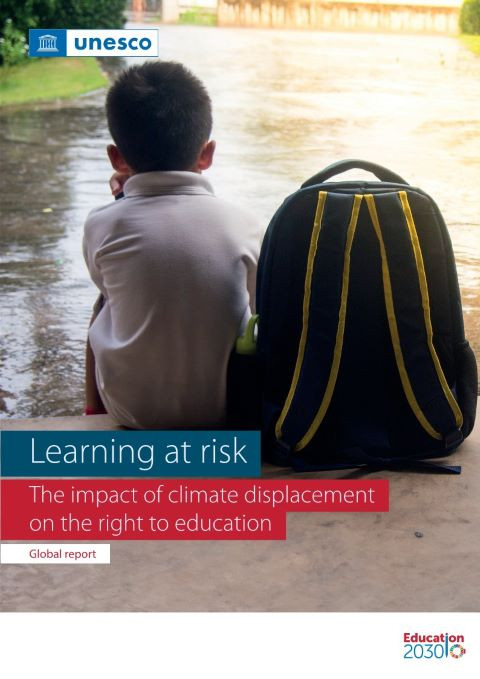 Learning at Risk: the Impact of Climate Displacement on the Right to Education; Global Report Año de publicación: 2023 Autor corporativo: UNESCO How climate displacement the impacts the right to education The growing impacts of climate change and displacement on education can no longer be ignored. The increasing number of people displaced due to climate change faces unique vulnerabilities, especially in terms of access to education. This challenge is not only attributed to the often limited political and legal recognition of these displaced persons, but also stems from the global community’s lack of awareness of the diverse obstacles they encounter in seeking access to education. This global report, which concludes the “Initiative on the impact of climate change and displacement on the right to education”, aims to provide guidance to policy-makers worldwide on how to better respect, protect and fulfil the right to education of climate-displaced people. It provides an overview of climate-induced barriers to education, and global policy guidance on how to ensure the protection of the right to education of these populations. The report will inform UNESCO’s Initiative on “The evolving right to education within a lifelong learning perspective” which is investigating how the right to education, as enshrined in international normative instruments, could be strengthened to meet modern needs in our rapidly changing societies.
  Recommendation on Education for Peace, Human Rights and Sustainable Development: An Implementation Guide Año de publicación: 2025 Autor corporativo: UNESCO There is no peace without education. With conflicts rising on so many fronts, there has never been a more urgent need for a transformed education geared towards building and sustaining peace.The Recommendation on Education for Peace and Human Rights, International Understanding, Cooperation, Fundamental Freedoms, Global Citizenship and Sustainable Development, adopted by all 194 Member States of UNESCO in 2023, articulates a humanistic and transformative vision of education that can help address contemporary and future affronts to peace. These challenges range from the resurgence of conflicts driven by systemic inequalities and injustices, the rise and spread of hate speech, racism and discrimination particularly online, to the adverse effects of digital technologies and the existential threat of climate change.UNESCO has developed this Guide as the first of several tools to assist Member States in unpacking and fully implementing the 2023 Recommendation. The Guide elaborates its contents, integrating the 2023 Recommendation’s transdisciplinary lens to connect key concepts and issues. It also provides concrete ideas and curated resources for action at different levels and types of education, while calling for a multi-stakeholder and whole-of-society approach that includes everyone and builds on existing positive efforts.The Guide is a timely addition to the pool of available collective resources to fully implement the 2023 Recommendation and foster an education that is transformative for a just and peaceful world.
  International Conference on Artificial Intelligence and Education, Planning Education in the AI Era: Lead the Leap; Final Report Año de publicación: 2019 Autor corporativo: UNESCO The current report is an exhaustive account of the discussion and debate at the International Conference on Artificial Intelligence and Education (hereafter referred to as ‘the conference’) held in Beijing from 16 to 18 May 2019. Under the overarching theme of ‘Planning Education in the AI Era: Lead the Leap’, the conference was structured into seven plenary sessions and 16 breakout sessions complemented by a live exhibition and study tours to facilitate forwardlooking debates, share cutting-edge knowledge and AI solutions, and deliberate on sector-wide strategies.
  Mainstreaming Social and Emotional Learning in Education Systems: Policy Guide; Highlights Año de publicación: 2024 Autor corporativo: UNESCO UNESCO’s policy guide unpacks social and emotional learning (SEL) as a broadening of the educational process, from a focus on cognitive aspects to a balance between cognitive, social and emotional, and behavioural dimensions of learning, putting forward initial action ideas to guide its systematic mainstreaming in education. It builds on and extends previous work undertaken by UNESCO on SEL from the perspective of Global Citizenship Education (GCED) and Education for Sustainable Development (ESD), Building Strong Foundations for Health and Well-being Education, the Happy Schools Framework, and in multiple UNESCO Offices and Institutes.
  Sub-Regional Study on Transforming TVET in Ensuring Learning and Skills to Support School-to Work Transitions in Southeast Asian Countries Año de publicación: 2023 Autor: Jann Hidajat Tjakraatmadja | Hary Febriansyah | Yorga Permana | Lala Nurfitria | Farenza Fadil Autor corporativo: UNESCO Jakarta Technical and Vocational Education and Training (TVET) and the transition from school to work are critical for young individuals to be prepared for entering the job market. The school-to-work transition signifies the transition from education to professional work and involves stages such as finding a job, applying theoretical knowledge and adapting to work expectations. In line with SDG-4, there is a need to improve the relevance of TVET systems, equipping individuals with the necessary skills for employment, entrepreneurship and lifelong learning. Three strategic priorities include promoting lifelong learning opportunities, fostering skills for an inclusive and sustainable economy, and ensuring inclusive and resilient communities. UNESCO supports Member States to address current and future challenges in the field of TVET, including the transition from school to work. Recognising the significant role of TVET in achieving SDG-4, UNESCO works closely with countries like Brunei Darussalam, Indonesia, Malaysia, the Philippines, and Timor-Leste to enhance the relevance and effectiveness of their TVET systems. These countries have demonstrated a strong commitment to improving the quality of education and equipping individuals with the necessary skills for employment, entrepreneurship, and lifelong learning. In the discussion of innovations and trends in TVET systems, there is a need to respond to rapidly changing labour markets through leveraging labour market data, tracer studies, and employer insights, expanding work-based learning to support the transition from school to work, modernising TVET curricula with new skills and competencies, strengthening TVET through private sector and community engagement. TVET is important for the transition from school to work in the sub-region of Southeast Asia, in line with SDG-4. Standardised practices are needed for better employability and mobility. Challenges include labour market mismatches and negative perceptions, but there are opportunities to partner with industry, update curricula, promote inclusivity and gender equality, and adapt to changing labour markets. Using labour market data, expanding work-based learning, and engaging the private sector and local communities are critical. TVET can transform individuals and contribute to sustainable development in the subregion of South-East Asia, creating prosperous and inclusive societies.
  Why the World Needs Happy Schools: Global Report on Happiness In and For Learning Año de publicación: 2024 Autor corporativo: UNESCO Seeing a teacher smile. Hearing students laugh. Feeling a hug from a friend. Smelling fresh air. Tasting a nutritious school meal. These five senses can stimulate happiness at school and improve the learning experiences, outcomes and well-being of students. Through the ‘Happy Schools’ initiative, UNESCO is placing happiness at the core of the transformation of education. It encourages education systems to recognize happiness as both a means to and a goal of quality learning. The initiative is informed by a growing evidence base linking happiness with better learning, teaching, well-being and overall system resilience. This report presents the UNESCO global Happy Schools framework consisting of 4 pillars – people, process, place and principles – and 12 high-level criteria to guide the transformation of learning. It offers a holistic model for embedding happiness into education policies and cultivating it in schools through systemic changes. The report illustrates how the ‘Happy Schools’ initiative aims to create top-down and bottom-up transformation, encouraging governments to recognize happiness as a core objective of education. It supports the scaling of promising practices of joyful learning from the school to the policy level.
  Education in a Post-COVID World: Towards a Rapid Transformation; Main Report Año de publicación: 2023 Autor corporativo: United Nations Children's Fund (UNICEF) On March 11, 2020, the World Health Organization declared COVID-19 a global pandemic, resulting in disruptions to education at an unprecedented scale. In response to the urgent need to recover learning losses, countries worldwide have taken RAPID actions to: Reach every child and keep them in school; Assess learning levels regularly; Prioritize teaching the fundamentals; Increase the efficiency of instruction; and Develop psychosocial health and wellbeing. Marking three years since the onset of the pandemic, this report looks back at policy measures taken during school closures and reopening based on country survey data, initiatives implemented by countries and regions to recover and accelerate learning, and their emerging lessons within each RAPID action. With schools now reopened worldwide, this report also looks ahead to longer-term education transformation, offering policy recommendations to build more resilient, effective and equitable education systems.
  Her Atlas: Interactive Advocacy Tool on Girls’ and Women’s Right to Education Año de publicación: 2023 Autor corporativo: UNESCO Many girls and women cannot exercise their right to education due to gender inequality and discriminatory practices. Poverty, early marriage, and gender-based violence are just some of the many reasons behind the high percentage of global female illiteracy and school drop-outs. Strengthening the right of girls and women to quality education is key to eliminate discrimination and to achieve equal rights between genders. This cannot be achieved without solid national legal frameworks that are rightsbased, gender responsive and inclusive. This is where HerAtlas comes in. HerAtlas, is a first of its kind online tool that maps the right to education of girls and women. It aims to enhance public knowledge and monitor the status of national constitutions, legislation and regulations related to education rights for girls and women to encourage countries to take action, strengthen their laws and policies, and lead to long term change. Concrete changes are already apparent. In 2019, 4% of countries were explicitly restricting the right to education of married, pregnant, and parenting girls. This has dropped to 2% in 2022, benefiting millions of girls who can now legally attend school when they marry or become pregnant. Son Atlas: Outil de plaidoyer interactif sur le droit à l’éducation des filles et des femmes Año de publicación: 2023 Autor corporativo: UNESCO De nombreuses filles et femmes ne peuvent pas exercer leur droit à l'éducation en raison des inégalités entre les genres et des pratiques discriminatoires. La pauvreté, les mariages précoces et les violences basées sur le genre ne sont que quelques-unes des nombreuses raisons qui expliquent le pourcentage élevé d'analphabétisme et de décrochage scolaire chez les filles et les femmes dans le monde. Le renforcement du droit des filles et des femmes pour une éducation de qualité est essentiel pour éliminer la discrimination et parvenir à l'égalité des droits entre les genres. Ceci ne peut être réalisé sans des cadres juridiques nationaux solides, basés sur les droits, sensibles au genre et inclusifs. C'est là qu'intervient SonAtlas. SonAtlas est un outil en ligne, le premier du genre, qui cartographie le droit à l'éducation des filles et des femmes. Il vise à améliorer les connaissances du public et à surveiller le statut des constitutions, législations et réglementations nationales relatives aux droits à l'éducation des filles et des femmes, afin d'encourager les pays à agir, à renforcer leurs lois et leurs politiques et à entraîner un changement à long terme. Des changements concrets sont déjà visibles. En 2019, 4 % des pays restreignaient explicitement le droit à l'éducation des filles mariées, enceintes et jeunes mères. Ce chiffre a chuté à 2 % en 2022, au profit de millions de filles qui peuvent désormais aller à l'école en toute légalité lorsqu'elles se marient ou sont enceintes ou jeunes mères.
  Protect Her Rights, Strengthen Your Laws: Her Atlas; Status Report on Girls’ and Women’s Right to Education Año de publicación: 2022 Autor corporativo: UNESCO UNESCO’s Her Education, our future initiative, Her Atlas was launched in 2019 with the aim to enhance public knowledge and monitor the status of national constitutions, legislation and regulations related to girls’ and women’s education rights in order to encourage countries to take actions to improve their legal frameworks. Three years after its launch, the research phase has been completed: overall, the legal frameworks of 196 countries have been thoroughly analyzed to evaluate the level of protection of girls’ and women’s right to education around the world. In an interactive world map format, Her Atlas uses a color-coded scoring system to monitor 12 indicators of legal progress towards gender equality in the right to education. This report marks the completion of the first research phase and intends to highlight some key trends outlined by the research work, and to emphasize examples of legal provisions regarding some aspects of girls’ and women’s right to education guaranteed by States’ domestic laws.