
Recursos
Exploren una amplia gama de recursos valiosos en GCED para profundizar su comprensión y promover su búsqueda, incidencia, enseñanza y aprendizaje.
276 resultados encontrados
 Enseigner l'histoire et la prévention des génocides - Peut on prévenir les crimes contre l'humanité ? La question de la barbarie domine les questions commémoratives. L'étude de la prévention des crimes contre l'humanité constitue un autre défi majeur. Mais ces débats délicats et complexes sont problématiques. Tous les champs sont concernés: l'histoire, la mémoire, le droit, la philosophie, la politique. Comment les écoles peuvent les aborder? Deux solutions: opter pour une étude comparative des génocides, en particulier l'Holocauste et les Tutsis au Rwanda; et en utilisant les « particuliers/universels» dialectiques, les institutions et les individus. Recollections du passé et de l'édification de l'avenir, ce livre donne un sens à l'éducation et présente une réflexion sensible des défis de l'histoire et le monde contemporain. (Par l'auteur - traduction)
  Discussion Papers Journal (Vol 1) In Volume I, students are introduced to the subject of the Holocaust and its implications through the writings of experts in this field of study and testimonies from survivors. German Professor Monika Richarz provides the reader with historical context and insight into Jewish culture before the war and French-born Holocaust survivor Simone Veil gives a first-hand account of experiencing the Holocaust as a Jew. Hungarian writer László Teleki talks about the Roma experience and how this group was similarly targeted by the Nazis. Historian and Professor Yehuda Bauer (Israel) explains how the Holocaust evolved from a utopian ideology that involved hatred of Jews, while Nobel Laureate and Holocaust survivor Elie Wiesel (USA) challenges the reader with the question “Why hate?” Other contributors include Professor Xu Xin (China), Professor Ben Kiernan (Australia), Professor Edward Kissi (South Africa), and Francis Deng (former Special Adviser to the United Nations Secretary-General on the Prevention of Genocide and today Permanent Representative of South Sudan to the United Nations). (By the publisher) Discussion Papers Journal (Vol 1) Dans le volume I, les élèves sont initiés au sujet de l'Holocauste et de ses implications à travers les écrits d'experts dans ce domaine d'étude et des témoignages de survivants. Professeur allemand Monika Richarz fournit au lecteur le contexte historique et un aperçu de la culture juive avant la guerre et survivant de l'Holocauste d'origine française Simone Veil donne un compte rendu de première main de l'expérience de l'Holocauste en tant que Juif. L’ écrivain hongrois László Teleki parle de l'expérience des Roms et la façon dont ce groupe a été ciblé de façon similaire par les nazis. Professeur Yehuda Bauer (Israël), historien, explique comment l'Holocauste a évolué à partir d'une idéologie utopiste qui a impliqué la haine des Juifs, alors que le prix Nobel et survivant de l'Holocauste Elie Wiesel (USA) défie le lecteur avec la question «Pourquoi la haine? » Parmi les autres contributeurs Professeur Xu Xin (Chine), le professeur Ben Kiernan (Australie), le professeur Edward Kissi (Afrique du Sud), et Francis Deng (ancien Conseiller spécial du Secrétaire général des Nations Unies sur la prévention du génocide et aujourd'hui Représentant permanent du Soudan du Sud auprès des Nations Unies ). (Par l'éditeur)
  Discussion Papers Journal (Vol 2) In Volume II, Chinese author Pan Guang delivers a gripping account of how Jews made their way to Shanghai during the Second World War while Polish writer Andrzej Mirga details the Nazi persecution of Roma and Sinti during the same period. Argentine professor Juan E. Méndez bring us to the 21st century with a discussion of the 2011 arrest and pending trial of accused Serbian war criminal Ratko Mladic. And the timeless value of Holocaust education is explored as South African Tali Nates shows how education is helping to heal the divisions wrought by apartheid in South Africa and Russian scholar Ilya Altman lays out Holocaust remembrance and education in contemporary Russia. Other contributors are Edward Mortimer and Kaja Shonick Glahn (UK / Germany), David Matas (Canada), Lenore Weitzman (USA), and Robert Krell (Canada). (By the publisher) Discussion Papers Journal (Vol 2) Dans le volume II, auteur chinois Pan Guang offre un compte de préhension de la façon dont les Juifs ont fait leur chemin à Shanghai au cours de la Seconde Guerre mondiale alors que l'écrivain polonais Andrzej Mirga détails la persécution nazie des Roms et des Sintis au cours de la même période. professeur argentin Juan E. Méndez nous amener au 21e siècle avec une discussion sur l'arrestation de 2011 et dans l'attente du procès des accusés de crimes de guerre serbe Ratko Mladic. Et la valeur intemporelle de l'Holocauste est explorée comme l'Afrique du Sud Tali Nates montre comment l'éducation contribue à guérir les divisions opérées par l'apartheid en Afrique du Sud et savant russe Ilya Altman expose la mémoire et l'éducation de l'Holocauste dans la Russie contemporaine. D'autres contributeurs sont Edward Mortimer et Kaja Shonick Glahn (UK / Allemagne), David Matas (Canada), Lenore Weitzman (USA), et Robert Krell (Canada). (Par l'éditeur)
  Teaching the Holocaust in School History: Teachers or Preachers? If we expose students to a study of human suffering we have a responsibility to guide them through it. But is this the role of school history? Is the rationale behind teaching the Holocaust primarily historical, moral or social? Is the Holocaust to be taught as a historical event, with a view to developing students' critical historical skills, or as a tool to combat continuing prejudice and discrimination? These profound questions lie at the heart of Lucy Russell's fascinating analysis of teaching the Holocaust in school history. She considers how the topic of the Holocaust is currently being taught in schools in the UK and overseas. Drawing on interviews with educationalists, academics and teachers, she discovers that there is in fact a surprising lack of consensus regarding the purpose of, and approaches to, teaching the Holocaust in history. Indeed the majority view is distinctly non-historical: there is a tendency to teach the Holocaust from a social and moral perspective and not as history. This book attempts to explain and debate this phenomenon. (By the publisher)
  T.E.A.C.H : Teaching emotive and controversial History 3-19 Many historical topics, including the Crusades, the Transatlantic Slave Trade or the Arab-Israeli conflict, can be considered emotive and controversial. The TEACH report found, in interviews with teachers carried out before 2007, that some teachers sometimes feel uncertain how best to approach such topics in such a way as to do the topics justice while respecting the feelings of particular groups of pupils. At no point did any teacher interviewed for the TEACH report claim to have avoided teaching about the Holocaust at Key Stage 3 for fear of offending Muslim children. The TEACH report outlines the sort of good practice in teaching sensitive topics which is available for teachers to share, not least through the Historical Association's programme of subject-specific training. (By the publisher)
 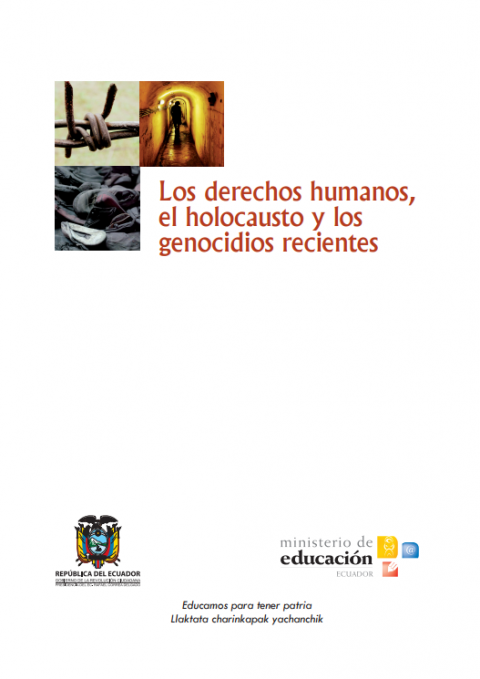 Los derechos humanos, el holocausto y los genocidos recientes Año de publicación: 2008 Autor corporativo: Ecuador. Ministerio de Educacion This resource guide designed for high school students in Ecuador broaches Holocaust history through broader thematics such as Human Rights, mass violence and a comparative analysis with other genocides. It is an valuable document for understanding worldwide issues.
  Enseigner la Shoah au college et au lycee - De la parole antisemite a la destruction des juifs d'Europe - Livret du Professeur Año de publicación: 2009 Autor: Joel Kotek, Iannis Roder This teacher booklet published by the Mémorial de la Shoah contains well-constructed lessons to use entirely or partially, based on photographs and literature extracts. This guideline offers pedagogical and scientific reflections on the Holocaust’s historical treatment.
 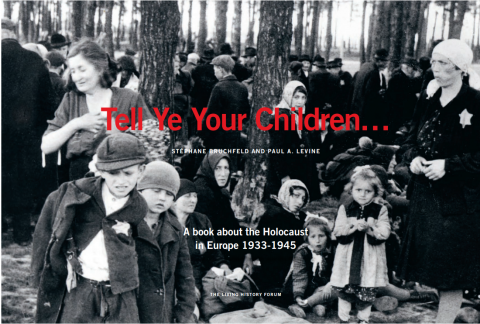 Tell Ye Your Children - A book about the Holocaust in Europe 1933-1945 Año de publicación: 2012 Autor: Stephane Bruchfeld, Paul. A. Levine This book is published by the Living History Forum. This Swedish public authority uses the teaching of the Holocaust and other crimes against humanity to promote tolerance, democracy and human rights. This booklet covers the rise of National Socialism until the end of the war, providing facts and information to encourage discussions.