
Recursos
Exploren una amplia gama de recursos valiosos en GCED para profundizar su comprensión y promover su búsqueda, incidencia, enseñanza y aprendizaje.
45 resultados encontrados
 Multilingual education: Why is it important? How to implement it? Año de publicación: 2014 Autor corporativo: UNESCO Mother tongue instruction is in the context of bilingual education / multilingual education (MLE) because it lays a solid foundation for learning, improves access to education (especially for girls), improves learning outcomes, raises the quality of education by emphasizing understanding and creativity rather than repetitive memorization. Furthermore, learners who are excluded from the education system are those who mosk likely benefit from multilingual education. There are several ways to implement MLE, such as by creating a favourable environment, using appropriate materials, training teachers and educators, and taking into account the learners' knowledge.
 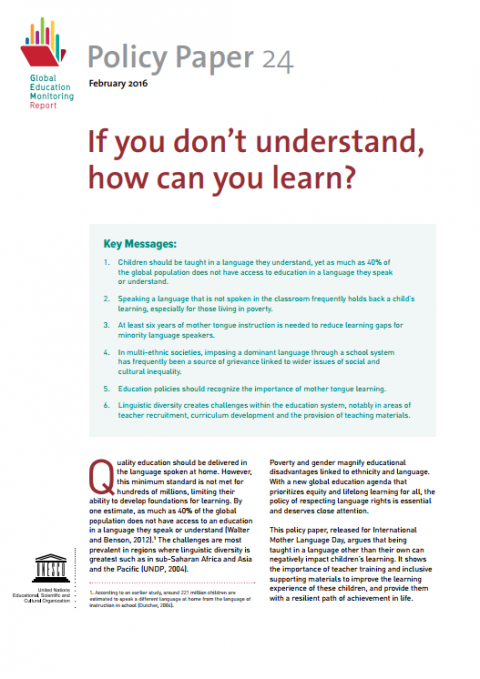 فيكف مهفت لا تنك اذإ ؟مَّلعتت نأ كل Año de publicación: 2016 Autor corporativo: UNESCO Key Messages:1. Children should be taught in a language they understand, yet as much as 40% of the global population does not have access to education in a language they speak or understand.2. Speaking a language that is not spoken in the classroom frequently holds back a child’s learning, especially for those living in poverty.3. At least six years of mother tongue instruction is needed to reduce learning gaps for minority language speakers.4. In multi-ethnic societies, imposing a dominant language through a school system has frequently been a source of grievance linked to wider issues of social and cultural inequality.5. Education policies should recognize the importance of mother tongue learning. 6. Linguistic diversity creates challenges within the education system, notably in areas of teacher recruitment, curriculum development and the provision of teaching materials. 听不懂,怎能学会? Año de publicación: 2016 Autor corporativo: UNESCO Key Messages:1. Children should be taught in a language they understand, yet as much as 40% of the global population does not have access to education in a language they speak or understand.2. Speaking a language that is not spoken in the classroom frequently holds back a child’s learning, especially for those living in poverty.3. At least six years of mother tongue instruction is needed to reduce learning gaps for minority language speakers.4. In multi-ethnic societies, imposing a dominant language through a school system has frequently been a source of grievance linked to wider issues of social and cultural inequality.5. Education policies should recognize the importance of mother tongue learning. 6. Linguistic diversity creates challenges within the education system, notably in areas of teacher recruitment, curriculum development and the provision of teaching materials. If you don't understand, how can you learn? Año de publicación: 2016 Autor corporativo: UNESCO Key Messages:1. Children should be taught in a language they understand, yet as much as 40% of the global population does not have access to education in a language they speak or understand.2. Speaking a language that is not spoken in the classroom frequently holds back a child’s learning, especially for those living in poverty.3. At least six years of mother tongue instruction is needed to reduce learning gaps for minority language speakers.4. In multi-ethnic societies, imposing a dominant language through a school system has frequently been a source of grievance linked to wider issues of social and cultural inequality.5. Education policies should recognize the importance of mother tongue learning. 6. Linguistic diversity creates challenges within the education system, notably in areas of teacher recruitment, curriculum development and the provision of teaching materials. Comment apprendre, quand on ne comprend pas? Año de publicación: 2016 Autor corporativo: UNESCO Key Messages:1. Children should be taught in a language they understand, yet as much as 40% of the global population does not have access to education in a language they speak or understand.2. Speaking a language that is not spoken in the classroom frequently holds back a child’s learning, especially for those living in poverty.3. At least six years of mother tongue instruction is needed to reduce learning gaps for minority language speakers.4. In multi-ethnic societies, imposing a dominant language through a school system has frequently been a source of grievance linked to wider issues of social and cultural inequality.5. Education policies should recognize the importance of mother tongue learning. 6. Linguistic diversity creates challenges within the education system, notably in areas of teacher recruitment, curriculum development and the provision of teaching materials. Si no entiendes, ¿cómo puedes aprender? Año de publicación: 2016 Autor corporativo: UNESCO Key Messages:1. Children should be taught in a language they understand, yet as much as 40% of the global population does not have access to education in a language they speak or understand.2. Speaking a language that is not spoken in the classroom frequently holds back a child’s learning, especially for those living in poverty.3. At least six years of mother tongue instruction is needed to reduce learning gaps for minority language speakers.4. In multi-ethnic societies, imposing a dominant language through a school system has frequently been a source of grievance linked to wider issues of social and cultural inequality.5. Education policies should recognize the importance of mother tongue learning. 6. Linguistic diversity creates challenges within the education system, notably in areas of teacher recruitment, curriculum development and the provision of teaching materials. Как вы можете учиться, если вы не понимаете? Año de publicación: 2016 Autor corporativo: UNESCO Key Messages:1. Children should be taught in a language they understand, yet as much as 40% of the global population does not have access to education in a language they speak or understand.2. Speaking a language that is not spoken in the classroom frequently holds back a child’s learning, especially for those living in poverty.3. At least six years of mother tongue instruction is needed to reduce learning gaps for minority language speakers.4. In multi-ethnic societies, imposing a dominant language through a school system has frequently been a source of grievance linked to wider issues of social and cultural inequality.5. Education policies should recognize the importance of mother tongue learning. 6. Linguistic diversity creates challenges within the education system, notably in areas of teacher recruitment, curriculum development and the provision of teaching materials.
  [Video] How Many Languages Can You Recognize? Año de publicación: 2018 Autor corporativo: UNESCO How many languages can you recognize in the video? People have the right to receive education in their mother language!More languages will be added to the SDG4 video!So don't forget to have a look at our playlist (link below) and let us know your mother tongue on our social media channels!SDG4 PLAYLIST: http://bit.ly/UNESCO-SDG4International Mother Language Day webpage: https://en.unesco.org/international-days/international-mother-language-day
 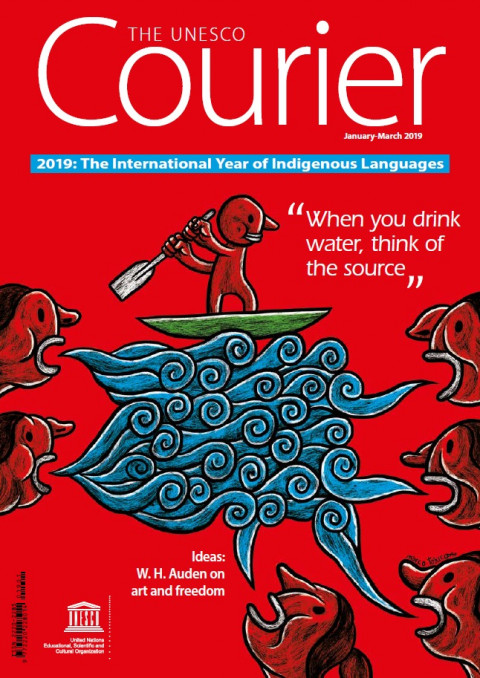 2019: The International Year of Indigenous Languages (The UNESCO Courier. January-March 2019) Año de publicación: 2019 Autor corporativo: UNESCO With the designation of 2019 as the International Year of Indigenous Languages (IYIL2019), officially launched at UNESCO on 28 January, the international community reaffirms its commitment to supporting indigenous peoples in their efforts to preserve their knowledge and enjoy their rights. Since the adoption of the Declaration on the Rights of Indigenous Peoples (link is external) by the United Nations General Assembly on 13 September 2007, considerable progress has been made in this regard. Nevertheless, indigenous peoples still have a long way to go before they emerge from marginalization and overcome the many obstacles they face. One-third of the world’s people living in extreme poverty belong to indigenous communities, just as in a number of countries, legislation that promotes the rights of indigenous peoples remains incompatible with other laws that deal with issues such as agriculture, land, conservation, forestry, mining and other industries, according to Victoria Tauli-Corpuz (link is external), United Nations Special Rapporteur on the Rights of Indigenous Peoples. The Wide Angle section in this issue of the Courier is dedicated to these indigenous peoples. It takes its title from the Chinese proverb: “When you drink water, think of the source”, to remind us that indigenous knowledge, the source of all knowledge, deserve a prominent place in modernity. The issue also marks the celebration of International Mother Language Day (link is external), 21 February. 2019 : Année internationale des langues autochtones Año de publicación: 2019 Autor corporativo: UNESCO À une époque où la tension ne cesse de croître, où les droits de l'homme, la liberté d'expression, la paix et l'avenir de la planète semblent plus que jamais remis en question, le pouvoir de transformation véhiculé par l'éducation revêt une importance cruciale.Avec la désignation de 2019 comme Année internationale des langues autochtones(IYIL2019), lancée officiellement à l’UNESCO le 28 janvier, la communauté internationale réaffirme sa volonté de soutenir les peuples autochtones dans leurs efforts de préserver leurs savoirs et de jouir de leurs droits.Depuis l’adoption de la Déclaration sur les droits des peuples autochtones, par l’Assemblée générale des Nations Unies, le 13 septembre 2007, des avancées considérables ont été faites dans ce sens. Il n’en reste pas moins que les peuples autochtones ont encore un long chemin à parcourir avant de sortir de la marginalisation et de surmonter les nombreux obstacles auxquels ils doivent faire face. Un tiers des personnes qui vivent dans l’extrême pauvreté à travers le monde appartiennent à des communautés autochtones, de même que dans un bon nombre de pays, les législations en faveur des peuples autochtones demeurent incompatibles avec d’autres lois qui traitent notamment de l’agriculture, de la terre, de la conservation et des industries forestières ou minières, selon Victoria Tauli-Corpuz, Rapporteuse spéciale des Nations Unies sur les droits des peuples autochtones. Le dossier Grand angle de ce numéro du Courrier leur est consacré. Il emprunte son titre au proverbe chinois : « Quand tu bois de l’eau, pense à la source », pour rappeler que les savoirs autochtones, source de tous les savoirs, méritent une place prééminente dans la modernité. Il s’associe également à la célébration de la Journée internationale de la langue maternelle, le 21 février.