
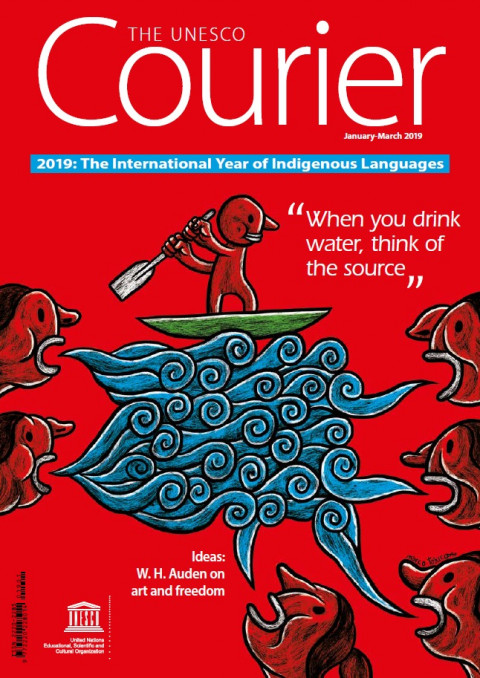
2019: The International Year of Indigenous Languages (The UNESCO Courier. January-March 2019)
- Corporate Author
- UNESCO
- ISBN
- ISSN 2220-2285
- Collation
- 61 p.
- Resource Language
- EnglishFrenchSpanishArabicRussianChinese
- Year of publication
- 2019
- Keyword
- Mother tongue
- Topic
- Diversity / Cultural literacy / InclusivenessHuman rightsGlobalisation and social justice / International understanding
- Resource Type
- Research papers / journal articles
- Level of education
- Early childhood care and educationPrimary educationSecondary educationHigher educationLifelong learningNon-formal education
- Region
- Global
- Place of publication
- Paris
With the designation of 2019 as the International Year of Indigenous Languages (IYIL2019), officially launched at UNESCO on 28 January, the international community reaffirms its commitment to supporting indigenous peoples in their efforts to preserve their knowledge and enjoy their rights. Since the adoption of the Declaration on the Rights of Indigenous Peoples (link is external) by the United Nations General Assembly on 13 September 2007, considerable progress has been made in this regard.
Nevertheless, indigenous peoples still have a long way to go before they emerge from marginalization and overcome the many obstacles they face. One-third of the world’s people living in extreme poverty belong to indigenous communities, just as in a number of countries, legislation that promotes the rights of indigenous peoples remains incompatible with other laws that deal with issues such as agriculture, land, conservation, forestry, mining and other industries, according to Victoria Tauli-Corpuz (link is external), United Nations Special Rapporteur on the Rights of Indigenous Peoples.
The Wide Angle section in this issue of the Courier is dedicated to these indigenous peoples. It takes its title from the Chinese proverb: “When you drink water, think of the source”, to remind us that indigenous knowledge, the source of all knowledge, deserve a prominent place in modernity. The issue also marks the celebration of International Mother Language Day (link is external), 21 February.
Related Resources
-
 Youth Lens on the Silk Roads: Best Photos from the International Silk Roads Photo Contest; 6th Edition
 -
 Addressing Violent Pasts through Education: A Policy Guide
 -
 UNESCO Framework for Culture and Arts Education: Implementation Guidance
 -
 The Representation of Jews, Judaism and Antisemitism in School Textbooks and Curricula in Europe