
Recursos
Exploren una amplia gama de recursos valiosos en GCED para profundizar su comprensión y promover su búsqueda, incidencia, enseñanza y aprendizaje.
3,505 resultados encontrados
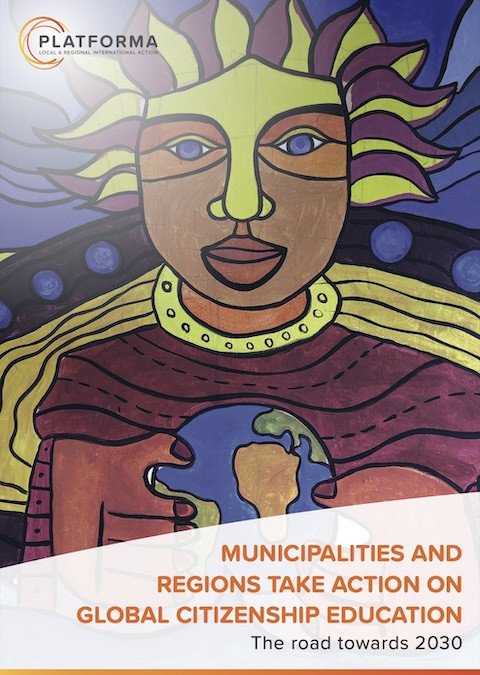 Municipalities and Regions Take Action on Global Citizenship Education: The Road Towards 2030 Año de publicación: 2021 Autor: Aurèle Destrée | Tereza Čajková Autor corporativo: PLATFORMA | European Union (EU) Development Education and Awareness Raising (DEAR)/Global Citizenship Education (GCE) can cultivate the spirit of the 2030 Agenda because it helps acquiring missing knowledge on global interconnections and creates spaces for enquiries.Whilst old constraints still remain and new challenges are appearing, local and regional governments continue to innovate, experiment and work hand in hand with key partners, including with their peers across the globe, to find new solutions and achieve their ambitions.Discover in this publication how local and regional governments are active in supporting learning and fostering changes in a context of socio-economic recovery plans. Actions des municipalités et des régions en faveur de l'éducation à la citoyenneté mondiale: En route vers 2030 Año de publicación: 2021 Autor: Aurèle Destrée | Tereza Čajková Autor corporativo: PLATFORMA | EU L’éducation au développement et la sensibilisation (DEAR) et l’éducation à la citoyenneté mondiale (ECM) soutiennent et alimentent l’esprit de l’Agenda 2030 car elles permettent d’acquérir les connaissances manquantes sur les interconnexions mondiales et de créer des espaces de recherche.Alors que d’anciennes contraintes subsistent et que de nouveaux défis apparaissent, les gouvernements locaux et régionaux continuent d’innover, d’expérimenter et de travailler de concert avec des partenaires clés, notamment avec leurs homologues du monde entier, pour trouver de nouvelles solutions et concrétiser leurs ambitions.Découvrez dans la présente publication comment les gouvernements locaux et régionaux s’emploient à soutenir l’apprentissage et à favoriser les changements dans un contexte de plans de relance socio-économique.
  Inequalities in Learning in Vietnam: Teachers’ Beliefs About and Classroom Practices for Ethnic Minorities (RISE Working Paper Series; 21/061) Año de publicación: 2021 Autor: Joan DeJaeghere | Vu Dao | Bich-Hang Duong | Phuong Luong Autor corporativo: Research on Improving Systems of Education (RISE) Global and national education agendas are concerned with improving quality and equality of learning outcomes. This paper provides an analysis of the case of Vietnam, which is regarded as having high learning outcomes and less inequality in learning. But national data and international test outcomes may mask the hidden inequalities that exist between minoritized groups and majority (Kinh) students. Drawing on data from qualitative videos and interviews of secondary teachers across 10 provinces, we examine the role of teachers’ beliefs, curricular design and actions in the classroom (Gale et al., 2017). We show that teachers hold different beliefs and engage in curricular design – or the use of hegemonic curriculum and instructional practices that produce different learning outcomes for minoritized students compared to Kinh students. It suggests that policies need to focus on the social-cultural aspects of teaching in addition to the material and technical aspects.
  On Education & Democracy: 25 Lessons from the Teaching Profession Año de publicación: 2019 Autor: Susan Hopgood | Fred van Leeuwen Autor corporativo: Education International (EI) On the occasion of the 25th anniversary of Education International, the authors have selected 25 lessons which educators and their organizations have learnt throughout history on education and democracy.These lessons serve as a set of recommendations to every classroom teacher working at all levels in education systems and in their education unions. These lessons are an invitation to take a stand in favour of democracy and its institutions and to consider contributions that teachers, schools, universities and representative organizations can make to solidify and progress democratic life. Sobre la educación y la democracia: 25 lecciones de la profesión docente Año de publicación: 2019 Autor: Susan Hopgood | Fred van Leeuwen Autor corporativo: Education International (EI) Con motivo del 25o aniversario de la Internacional de la Educación, que actualmente reúne a los sindicatos de la educación de 170 países, que representan a 32,5 millones de docentes y personal de apoyo educativo, hemos seleccionado 25 lecciones sobre la educación y la democracia que el personal docente y sus organizaciones han aprendido a lo largo de la historia. Nuestras lecciones ofrecen una serie de recomendaciones destinadas a todo el personal docente que trabaja en todos los niveles de nuestros sistemas educativos y en sus sindicatos de la educación. Estas lecciones son una invitación a posicionarse en favor de la democracia y sus instituciones y a analizar las contribuciones que el profesorado, las escuelas, las universi- dades y las organizaciones que los representan pueden aportar para consolidar y hacer progresar la vida democrática. Éducation & démocratie: 25 leçons de la profession enseignante Año de publicación: 2019 Autor: Susan Hopgood | Fred van Leeuwen Autor corporativo: Education International (EI) À l’occasion du 25e anniversaire de l’Internationale de l’Éducation, qui regroupe actuellement les syndicats nationaux de l’éducation de 170 pays représentant 32,5 millions d’éducateur·rice·s et de membres des personnels de soutien à l’éducation, les auteurs ont sélectionné 25 leçons que les éducateur·rice·s et leurs organisations ont tirées sur l’éducation et la démocratie au long de l’histoire. Ces leçons établissent une série de recommandations destinées à tou·te·s les enseignant·e·s travaillant à tous les niveaux de nos systèmes éducatifs et de leurs syndicats d’ensei- gnement. Les leçons sont une invitation à prendre position en faveur de la démocratie et de ses institutions et à examiner les contributions que les enseignant·e·s, les écoles, les universités et les organisations représentatives peuvent apporter pour consolider et faire avancer la vie démocratique.
 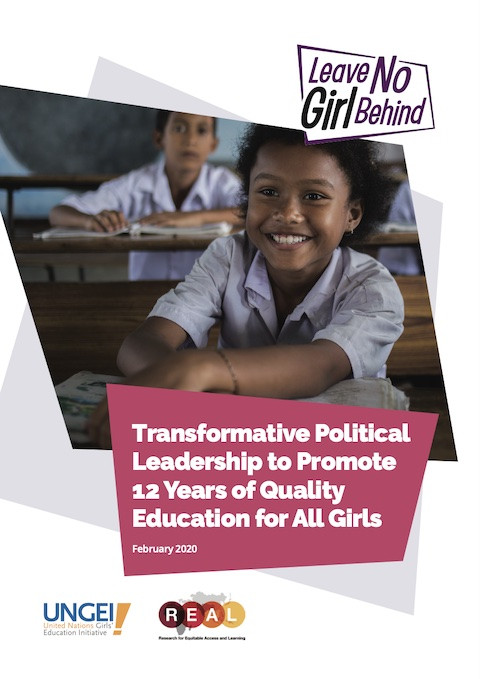 Transformative Political Leadership to Promote 12 Years of Quality Education for All Girls Año de publicación: 2020 Autor: Gloria Diamond Autor corporativo: University of Cambridge. Research for Equitable Access and Learning (REAL) Centre | United Nations Girls' Education Initiative (UNGEI) How can political leadership promote 12 years of quality education for all girls? This report from the Research for Equitable Access and Learning (REAL) Centre, University of Cambridge, seeks to answer this question. The study is based on a review of global evidence, with a focus on low- and lower-middle income countries where most action is needed to achieve the world’s development goals. The researchers also conducted interviews with 11 current and former political leaders involved in championing girls’ education. On the basis of this research, this report outlines seven recommendations on how political leadership can be leveraged to achieve 12 years of quality education for all girls.
  联合国 教科文组织 绿色学院: 气候适应型学校指南 Año de publicación: 2019 Autor corporativo: UNESCO Bangkok 本手册鼓励社区进行能力建设,并朝着适应气候变化的方向 过渡。它以科学知识为基础,按照“人与生物圈计划”的规 定改善人与环境之间的关系。
  What’s the Evidence?: Youth Engagement and the Sustainable Development Goals Año de publicación: 2018 Autor corporativo: Asian Development Bank (ADB) | Plan International UK This study represents an encouraging body of evidence, both primary and secondary, which will inform future practice and policymaking with regard to young women and men’s contributions towards the Sustainable Development Goals (SDGs). The learnings from this study provide important insight that will support the design and implementation of youth programming. It examines five programs across three youth-focused or youth-led organisations: Plan International UK, the Asian Development Bank (ADB), and AIESEC.
 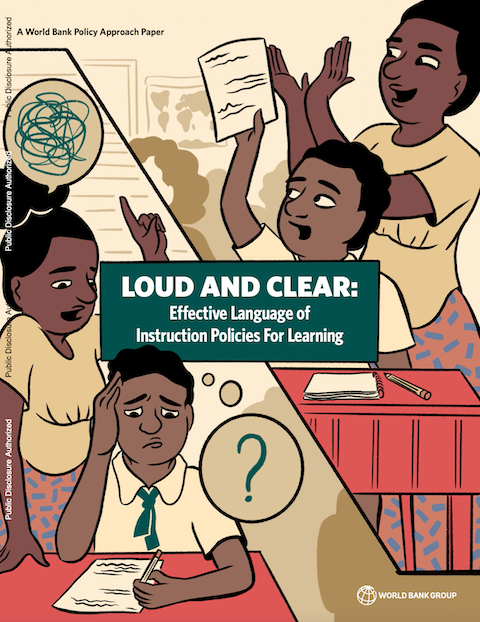 Loud and Clear: Effective Language of Instruction Policies for Learning Año de publicación: 2021 Autor corporativo: World Bank This paper describes the new World Bank policy approach on language of instruction(LoI), as part of the operationalization of the literacy policy package in support of the Bank’s new learning target. This new approach aims to support progress on language of instruction(LoI) Policies and interventions, as loi-based challenges are identified and addressed in light of each country’s context.