
Recursos
Exploren una amplia gama de recursos valiosos en GCED para profundizar su comprensión y promover su búsqueda, incidencia, enseñanza y aprendizaje.
2,768 resultados encontrados
 UNESCO Strategy for Youth and Adult Literacy and its Action Plan (2020-2025) Año de publicación: 2023 Autor corporativo: UNESCO I. Introduction1. The international community has set an ambitious 2030 Agenda for Sustainable Development1, with education and learning central to its achievement. The vision of the Incheon Declaration2, Education 2030, is fully captured by Sustainable Development Goal 4 (SDG4) “ensure inclusive and equitable quality education and promote lifelong learning opportunities for all”. Education 2030 devotes considerable attention to literacy and adult learning including through Target 4.6 and related indicative strategies.2. By 205 EX/Decision 6.III, the Executive Board requested the Director-General to review, update and improve the vision and strategy for literacy to contribute to SDG 4 – Education 2030, and to present it at its 207th session, with a view to transmitting it to the General Conference at its 40th session. The present document therefore contains the draft UNESCO Strategy for Youth and Adult Literacy (2020- 2025). The Strategy was developed through an inclusive and participatory process, including research and analysis of key trends, online consultation of Member States and expert meetings.
  Report of the Global Conference on Promoting Literacy for a World in Transition: Building the Foundation for Sustainable and Peaceful Societies Año de publicación: 2024 Autor corporativo: UNESCO The report presents an overview of the global celebration of International Literacy Day (ILD) 2023 held at UNESCO Headquarters in Paris, France on 8 September 2023. Under the ILD 2023 theme of ‘Promoting literacy for a world in transition: Building the foundation for sustainable and peaceful societies’, the Global Conference explored how literacy and numeracy can be better promoted as part of lifelong learning to achieve more peaceful and sustainable societies as envisioned by the international community through the Sustainable Development Goals (SDGs). The global celebration also included the award ceremony of the 2023 edition of the UNESCO International Literacy Prizes with six outstanding laureates from Bangladesh, Dominican Republic, Finland, Pakistan, South Africa and Uganda.
  Reconciliation through Global Citizenship Education Año de publicación: 2023 Autor corporativo: UNESCO This document zeroes in on how concepts of GCED and reconciliation are addressed in current research and practice and aims to provide existing grounds and future considerations for policy-makers concerned with reconciliation through education.
 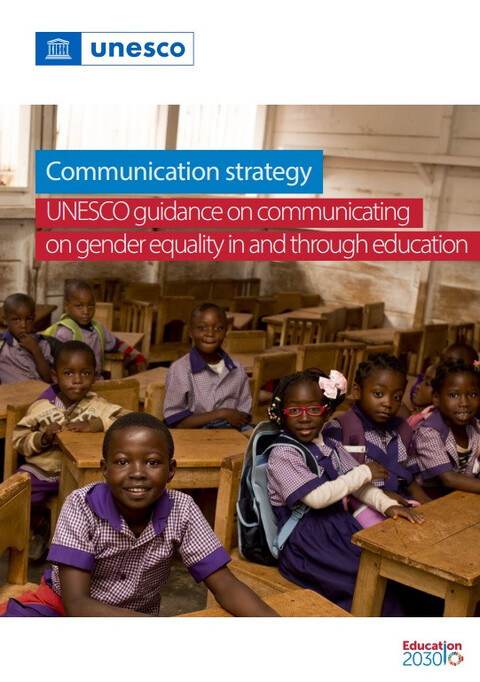 Communication Strategy: UNESCO Guidance on Communicating on Gender Equality in and through Education Año de publicación: 2022 Autor corporativo: UNESCO About 259 million children and youth are out of school according to the UNESCO Institute for Statistics, including 127 million girls and 132 million boys. Twothirds of the 750 million non-literate adults around the world are women. This gender disparity remains one of the persistent challenges in adult literacy and education. The COVID-19 pandemic has exacerbated existing challenges, disrupting the education of over 1.5 billion learners. UNESCO estimates that close to 24 million children and youth, including over 11 million girls and 13 million boys, may drop out of school due to the pandemic’s economic impact. A window of opportunity is now more than ever open to build back equal. This communication strategy is designed to provide strategic guidance on communicating on gender equality in and through education. While prepared for UNESCO Education Sector staff, including those at Headquarters, in Field/Regional/Cluster Offices and in Institutes as well as for implementing partners, a broader audience of gender focal points, partners, Member States and others with an interest in and commitment to gender equality in and through education may also find this strategy particularly useful. Estrategia de comunicación: Orientaciones de la UNESCO sobre la comunicación en materia de igualdad de género en y a través de la educación Año de publicación: 2022 Autor corporativo: UNESCO Según el Instituto de Estadística de la UNESCO, aproximadamente 259 millones de niños y jóvenes no están escolarizados, entre los cuales 127 millones de niñas y 132 millones de niños. Asimismo, dos tercios de los 750 millones de adultos analfabetos de todo el mundo son mujeres. Esta disparidad de género sigue siendo uno de los desafíos persistentes en la alfabetización de adultos y la educación. La pandemia de COVID-19 ha exacerbado los desafíos existentes, interrumpiendo la educación de más de 1 500 millones de alumnos. La UNESCO calcula que aproximadamente 24 millones de niños y jóvenes, incluyendo más de 11 millones de niñas y 13 millones de niños, pueden llegar a abandonar la escuela debido al impacto económico de la pandemia. Ahora más que nunca se abre la posibilidad de reforzar la igualdad. Esta estrategia de comunicación está diseñada para proporcionar una orientación estratégica sobre la comunicación de la igualdad de género en y a través de la educación. Aunque se ha preparado teniendo en cuenta al personal del Sector de la Educación de la UNESCO en la Sede, las oficinas fuera de la Sede, regionales y multipaís y los institutos, así como a los asociados en la ejecución, esta estrategia también puede resultar especialmente útil a un público más amplio de coordinadores en cuestiones de género, socios, Estados Miembros y otras personas interesadas y comprometidas con la igualdad de género en y a través de la educación. Stratégie de communication: Orientations de l’UNESCO pour la communication relative à l’égalité des genres dans et par l’éducation Año de publicación: 2022 Autor corporativo: UNESCO Selon l’Institut de statistique de l’UNESCO, 259 millions d’enfants et de jeunes ne sont pas scolarisés, dont 127 millions de filles et 132 millions de garçons. Les deux tiers des 750 millions d’adultes analphabètes à travers le monde sont des femmes. Cet écart entre les genres reste l’un des défis les plus persistants à relever en matière d’alphabétisme des adultes et d’éducation. La pandémie de la COVID-19 a exacerbé les difficultés préexistantes, perturbant l’éducation de plus de 1,5 milliard d’apprenants. L’UNESCO estime que près de 24 millions d’enfants et de jeunes, dont plus de 11 millions de filles et 13 millions de garçons, pourraient être déscolarisés en raison des répercussions économiques de la pandémie. Aujourd’hui, nous avons plus que jamais l’occasion de reconstruire l’égalité. Cette stratégie de communication est conçue pour orienter la communication relative à l’égalité des genres dans et par l’éducation. Bien que préparée avec des considérations pour le personnel du Secteur de l’éducation de l’UNESCO au siège, dans les bureaux hors siège, régionaux et multi-pays et instituts, ainsi que pour les partenaires de mise en œuvre, un public plus large de points focaux pour le genre, de partenaires, d’États membres et d’autres ayant un intérêt et un engagement pour l’égalité des genres dans et par l’éducation peuvent également trouver cette stratégie particulièrement utile.
 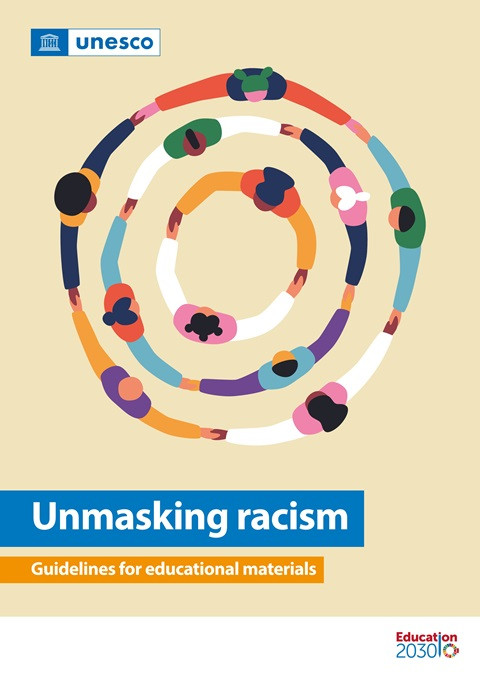 Unmasking Racism: Guidelines for Educational Materials Año de publicación: 2024 Autor corporativo: UNESCO These Guidelines developed by UNESCO provide recommendations on how to combat racism in textbooks and to develop learning materials that are free of prejudice and bias and do not perpetuate stereotypes or legitimize unequal social structures. Through a comprehensive analysis of recent studies of textbooks and other educational materials, the guide also demonstrates how countries around the world address racism and racialization. It increases awareness and improves our understanding of how racism manifests in educational materials, and aims to support education stakeholders to promote just, peaceful and multicultural societies.
 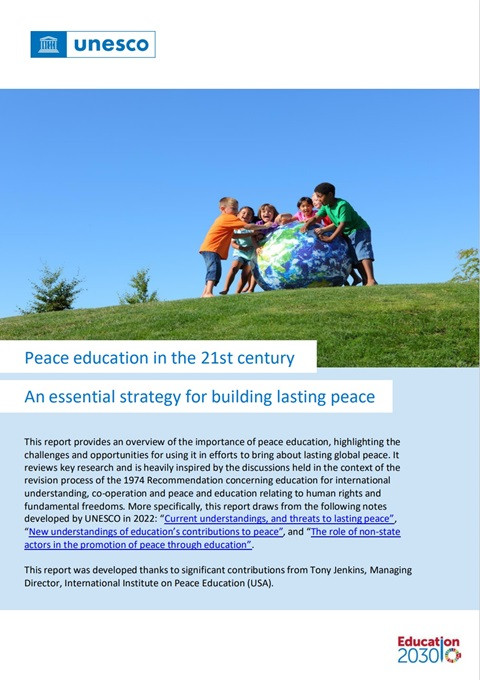 Peace Education in the 21st Century: An Essential Strategy for Building Lasting Peace Año de publicación: 2024 Autor corporativo: UNESCO This report provides an overview of the importance of peace education, highlighting the challenges and opportunities for using it in efforts to bring about lasting global peace. It reviews key research and is heavily inspired by the discussions held in the context of the revision process of the 1974 Recommendation concerning education for international understanding, co-operation and peace and education relating to human rights and fundamental freedoms. More specifically, this report draws from the following notes developed by UNESCO in 2022: “Current understandings, and threats to lasting peace”, “New understandings of education’s contributions to peace”, and “The role of non-state actors in the promotion of peace through education”.
  Revision Process of the 1974 Recommendation concerning Education for International Understanding, Co-operation and Peace and Education relating to Human Rights and Fundamental Freedoms: Comments from Observers to the Plenary Meetings of the International Expert Group (IEG) Año de publicación: 2023 Autor corporativo: UNESCO Adopted in 1974, the Recommendation concerning education for international understanding, co-operation and peace and education relating to human rights and fundamental freedoms is considered a landmark legal instrument that brings together for the first time peace, international understanding, human rights, fundamental freedoms and education. In line with the Resolution adopted at UNESCO’s General Conference at its 41st Session in November 2021 (41C/Resolution 17), UNESCO launched the revision of the Recommendation and convened an International Expert Group (IEG) to advise the Organization on the changes. The work of the IEG took place between May and June 2022. Though the meetings of the IEG were technical in nature (category VI), in order to ensure an open and transparent process, the Permanent Delegations were invited to listen-in to the deliberations of the IEG online, as observers, along with a select number of non-governmental organizations, intergovernmental organizations, and United Nations entities. At the end of each plenary meeting, observers to the IEG plenary meetings could submit written comments. This document compiles the comments received from observers during this process and submitted to the IEG members for their consideration.
  Because youth perspectives matter: UNESCO toolbox for youth policy and programming Año de publicación: 2023 Autor corporativo: UNESCO <Short summary>Placing trust in youth voicesYoung people fear for their future. Pandemics, conflict, climate change, inequality – these are the issues defining their reality.Yet their potential to provide solutions to the multiple crises is not realized. From low representation and tokenistic approaches, to institutional obstacles to participation and limited civic spaces, young people are disconnected from influencing decisions and actions that affect their lives. They need real opportunities to participate in decision-making and contribute to practical solutions.Policy-makers, public officials and practitioners – as well as development sector and civil society actors – can and should create such opportunities for youth. This Toolbox is a comprehensive go-to resource to make that possible. It is intended to support these stakeholders in designing and implementing effective policies and programmes to address the multidimensional needs of youth at national and local levels.It consists of:• A guide for participatory youth policy design;• Intergenerational dialogue tools on holistic youth development and youth civic engagement; and• A training tool on meaningful youth engagement. Together, we can prove that youth perspectives matter.