
Recursos
Exploren una amplia gama de recursos valiosos en GCED para profundizar su comprensión y promover su búsqueda, incidencia, enseñanza y aprendizaje.
2,771 resultados encontrados
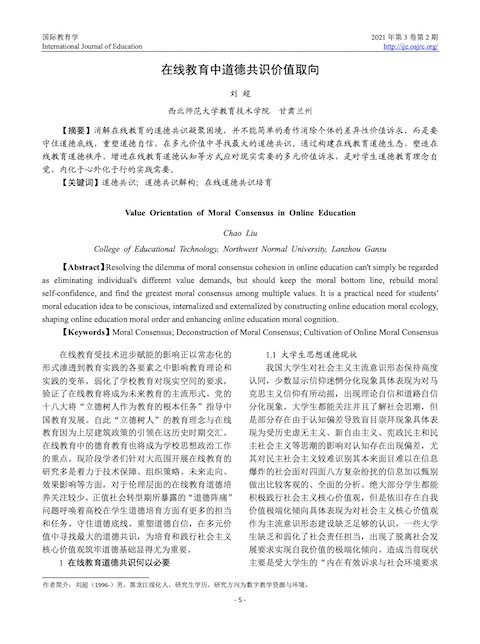 Value Orientation of Moral Consensus in Online Education (International Journal of Education; vol. 3, no. 2) Año de publicación: 2021 Autor: Chao Liu This paper discusses moral philosophy of. online education, and explores how to achieve moral consensus in online education. 在线教育中道德共识价值取向 (国际教育学; vol. 3, no. 2) Año de publicación: 2021 Autor: Chao Liu 本文探讨了在线教育道德哲学,并讨论了如何实现在线教育的道德共识。
 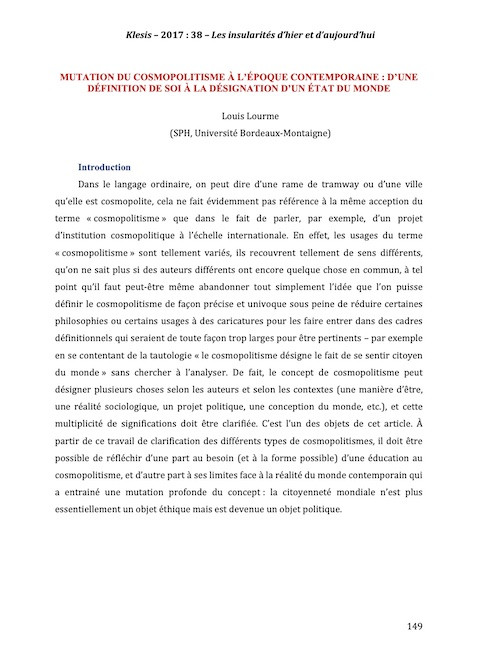 Mutation du cosmopolitisme à l’époque contemporaine : d’une définition de soi à la désignation d’un état du monde (Klesis Revue Philosophique; no. 38) Año de publicación: 2017 Autor: Louis Lourme Autor corporativo: Université Paul-Valéry Dans le langage ordinaire, on peut dire d’une rame de tramway ou d’une ville qu’elle est cosmopolite, cela ne fait évidemment pas référence à la même acception du terme « cosmopolitisme » que dans le fait de parler, par exemple, d’un projet d’institution cosmopolitique à l’échelle internationale. En effet, les usages du terme « cosmopolitisme » sont tellement variés, ils recouvrent tellement de sens différents, qu’on ne sait plus si des auteurs différents ont encore quelque chose en commun, à tel point qu’il faut peut-être même abandonner tout simplement l’idée que l’on puisse définir le cosmopolitisme de façon précise et univoque sous peine de réduire certaines philosophies ou certains usages à des caricatures pour les faire entrer dans des cadres définitionnels qui seraient de toute façon trop larges pour être pertinents – par exemple en se contentant de la tautologie « le cosmopolitisme désigne le fait de se sentir citoyen du monde » sans chercher à l’analyser. De fait, le concept de cosmopolitisme peut désigner plusieurs choses selon les auteurs et selon les contextes (une manière d’être, une réalité sociologique, un projet politique, une conception du monde, etc.), et cette multiplicité de significations doit être clarifiée. C’est l’un des objets de cet article. À partir de ce travail de clarification des différents types de cosmopolitismes, il doit être possible de réfléchir d’une part au besoin (et à la forme possible) d’une éducation au cosmopolitisme, et d’autre part à ses limites face à la réalité du monde contemporain qui a entrainé une mutation profonde du concept : la citoyenneté mondiale n’est plus essentiellement un objet éthique mais est devenue un objet politique.
  أسباب ظاهرة التطرف لدى طالب الجامعة وأساليب الحد منها من وجهة نظرهم) دراسة ميدانية ( Año de publicación: 2016 Autor: Ramadan Abdel-Hamid Mohamed El-Tantawi | Mahmoud Abdel-Hamid Hussein Kamal | El-Sayed Mohamed Abdel-Meguid Abdel-Aal | Osama Mahmoud Zidan | Moataz El-Morsi El-Nagari | Mohamed Ramadan Abdel-Hamid El-Tantawi Autor corporativo: Damietta University تسعى الدراسة الى التعرف على الأسباب التي تؤدي الى انتشار ظاهرة التطرف. وأيضا مناقشة الأساليب الأكثر جدوى ومناسبة في الحد من ظاهرة التطرف. وتنتهي الورقة بوضع توصيات وحلول للحد من هذه الظاهرة. The Causes of the Phenomenon of Extremism Among University Students and Methods of Reducing it from Their Point of View (A Field Study) Año de publicación: 2016 Autor: Ramadan Abdel-Hamid Mohamed El-Tantawi | Mahmoud Abdel-Hamid Hussein Kamal | El-Sayed Mohamed Abdel-Meguid Abdel-Aal | Osama Mahmoud Zidan | Moataz El-Morsi El-Nagari | Mohamed Ramadan Abdel-Hamid El-Tantawi Autor corporativo: Damietta University The study seeks to identify the reasons that lead to the spread of the phenomenon of extremism. And also discuss the most feasible and appropriate methods in curbing the phenomenon of extremism. The paper ends with recommendations and solutions to reduce this phenomenon.
  L'introduction de services-learnings dans l'enseignement universitaire de Belgique francophone, un instrument d'éducation à la citoyenneté mondiale et solidaire? Año de publicación: 2019 Autor: Frédérique Marsin Autor corporativo: Université de Liège Née d’une remise en question de l’éducation à la citoyenneté mondiale et solidaire (ECMS) dans les universités belges francophones, l’ambition de ce travail était de déceler l’influence que pourrait avoir sur celles-ci l’instauration des services-learnings comme pédagogie universitaire. Une telle interrogation nous a amené à nous questionner sur l’universalité de l’ECMS. Considérant qu’elle devrait être accessible à tous au regard de son essence même, cela n’est pourtant pas le cas, notamment du fait qu’elle est réservée à un public limité, à savoir aux élèves de l’enseignement fondamental et du secondaire ainsi qu’une portion infime d’étudiants universitaires, déjà sensibilisés aux thématiques de l’ECMS (SONECOM, 2018 ; cfr. annexe). Dès lors, nous questionnons l’efficacité des activités actuelles d’ECMS, organisées à l’université, grâce à une grille d’analyse adaptée des travaux de GÉRARD, psychopédagogue. Cette dernière nous permet de dresser l’état des lieux de l’ECMS, pouvant être résumé de la sorte : les activités d’ECMS actuelles à l’Université sont réservées, presqu’exclusivement, à des étudiants de master, sensibilisés par les enjeux globaux, issus de filières plutôt humanistes, comme les sciences sociales (SONECOM, 2018 ; Pirotte et Fettweis, 2018). Pourtant, le large pourcentage des étudiants restants n’est pas contre l’expression d’une citoyenneté plus active ; beaucoup y sont même très favorables mais expliquent leur inaction par un manque d’opportunités (SONECOM, 2018 ; cfr. annexe). Ne doutant pas pour autant de la qualité des activités d’ECMS, nous nous demandons quelle est la capacité pour ces acteurs de capter de nouveaux publics. Afin de pallier à ce manque de visibilité, nous proposons aux étudiants de s’essayer à l’ECMS, grâce à une application contraignante de la pédagogie des services-learnings.
 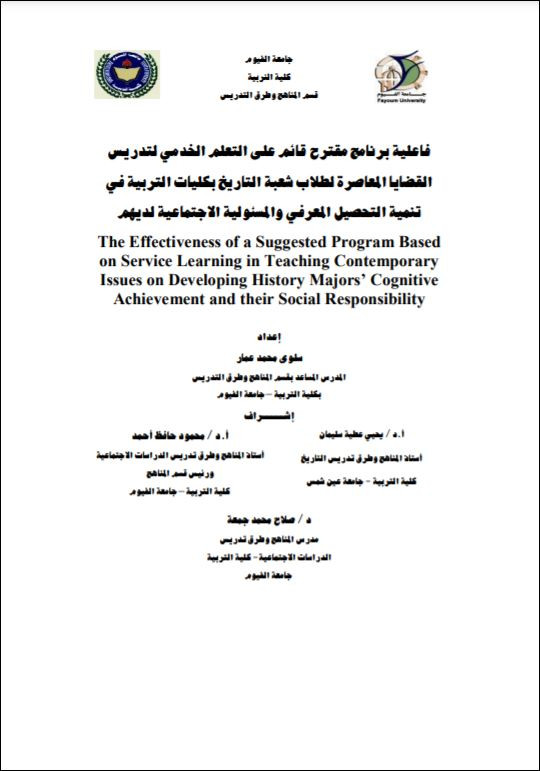 فاعلية برنامج مقترح قائم على التعلم الخدمي لتدريس القضايا المعاصرة لطلاب شعبة التأريخ بكليات التربية في تنمية التحصيل المعرفي والمسؤولة الاجتماعية لديهم Año de publicación: 2016 Autor: Salwa Ammar | Yahya Sulaiman | Mahmoud Ahmed | Salah Juma Autor corporativo: Fayoum University تسعى هذه الدراسة لتقييم فاعلية برنامج قائم على التعلم الخدمي لتدريس القضايا المعاصرة لطلاب شعبة التأريخ. وتبحث في تأثير هذا البرنامج في تنمية التحصيل المعرفي والمسؤولية الاجتماعية. وتبدأ الدراسة بوصف أسس ومكونات البرنامج التدريبي. The Effectiveness of a Proposed Program Based on Service Learning for Teaching Contemporary Issues to Students of the History Division in the Faculties of Education in Developing Their Cognitive Achievement and Social Responsibility Año de publicación: 2016 Autor: Salwa Ammar | Yahya Sulaiman | Mahmoud Ahmed | Salah Juma Autor corporativo: Fayoum University This study seeks to evaluate the effectiveness of a service-based learning program for teaching contemporary issues to students of the history department. It examines the impact of this program on the development of cognitive achievement and social responsibility. The study begins with a description of the foundations and components of the training program.
 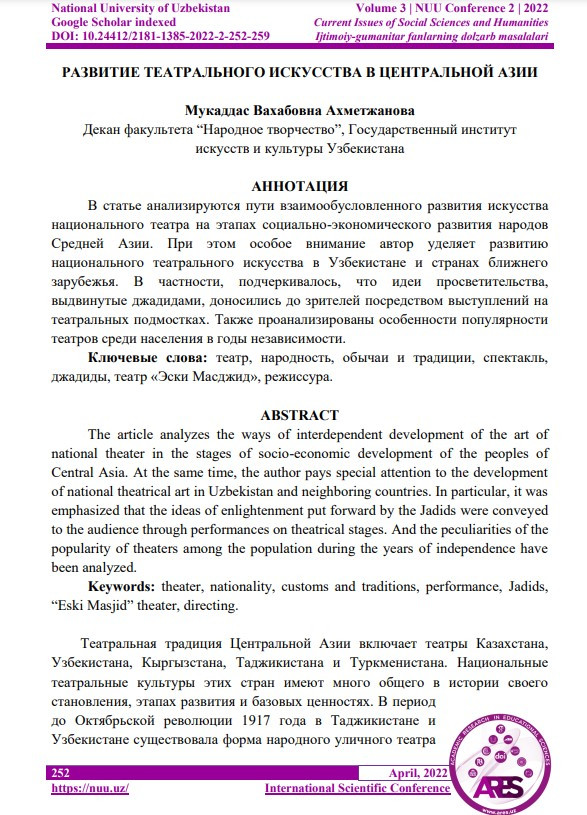 The Development of Theater Arts in Central Asia (Academic Research in Educational Sciences; vol. 3, no. NUU Conference 2) Año de publicación: 2022 Autor: Mukaddas Vakhabovna Akhmetzhanova The article analyzes the ways of interdependent development of the art of national theater in the stages of socio-economic development of the peoples in Central Asia. At the same time, the author pays special attention to the development of national theatrical art in Uzbekistan and neighboring countries. Also, the peculiarities of the popularity of theaters among the population during the years of independence have been analyzed. Развитие театрального искусства в Центральной Азии (Academic Research in Educational Sciences; vol. 3, no. NUU Conference 2) Año de publicación: 2022 Autor: Mukaddas Vakhabovna Akhmetzhanova В статье анализируются пути взаимообусловленного развития искусства национального театра на этапах социально-экономического развития народов Средней Азии. При этом особое внимание автор уделяет развитию национального театрального искусства в Узбекистане и странах ближнего зарубежья. Также проанализированы особенности популярности театров среди населения в годы независимости.