
Recursos
Exploren una amplia gama de recursos valiosos en GCED para profundizar su comprensión y promover su búsqueda, incidencia, enseñanza y aprendizaje.
1,951 resultados encontrados
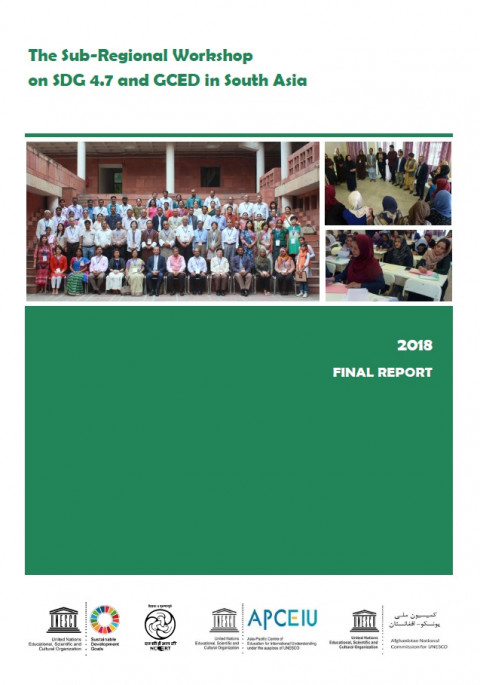 Final Report: 2018 Sub-regional Workshop on SDG 4.7 and GCED Año de publicación: 2018 Autor corporativo: APCEIU This report is the summary of the Sub-regional Workshop on SDG 4.7 and GCED in South Asia. Implemented by two occasions, the Workshop has offered the platform for the key educators from the South Asian region to discuss GCED in the regional context of achieving SDG 4.7. The report provides the overview of the two workshops held in India and Afghanistan in 2018.
  세계시민교육 학교 만들기 가이드 -전학교적 접근으로 실천하는 세계시민교육 Año de publicación: 2018 Autor corporativo: 유네스코 아시아태평양 국제이해교육원 '전학교적 접근으로 실천하는 세계시민교육'이라는 부제를 갖고 있는 본 도서는 학교 차원에서 세계시민교육을 실천할 때 참고할 수 있는 유용한 가이드를 제공한다. 세계시민교육은 지식뿐 아니라 가치관, 태도, 행동의 변화까지 아우르기 때문에 교실을 넘어 학교, 가정, 지역사회까지 그 실천 범위가 확장되었을 때 더욱 효과적이다. 본 도서는 세계시민교육의 범위를 확장시켜 전학교적으로 실천하기 위한 전략과 활동 계획 구축에 대한 가이드를 구체적으로 제공하고 있다. 또한, 현장의 목소리를 담아 세계시민교육을 실천하며 겪었던 어려움, 고민, 극복 방안, 참고 사례 등을 나누고자 하였다. 여는 글PART I. 함께 그려보는 세계시민교육 학교의 비전Step 1_세계시민교육 학교, 왜 필요한가요?Step 2_세계시민교육 학교, 누가 만들 수 있나요?Step 3_세계시민교육 학교, 어떻게 만들 수 있나요?Step 4_세계시민교육 학교, 무엇을 하면 되나요? PART II. 학교에 부는 변화의 바람Story 1_아이들을 위한 변화를 만드는 교사 Story 2_학교 변화의 디자이너, 교장Story 3_다시 생각하는 학교의 역할
  Global Citizenship Education: A Guide for Trainers Año de publicación: 2018 Autor corporativo: APCEIU APCEIU has published Global Citizenship Education: A Guide for Trainers in order to aid trainers to conduct introductory workshops for educators on Global Citizenship Education (GCED). Designed as a training manual for trainers, the Guide offers overview of GCED, including backgrounds and core concepts as well as pedagogical principles, but also provides guidelines on the workshop design and facilitation. Consisting of five chapters, the Guide first introduces the rise of GCED within the latest shift in education and global development agendas. Under this framework, the next chapter explores the meanings of a ‘global citizen’ and ‘global citizenship,’ and introduces key concepts and principles of GCED. The next two chapters deal with how to teach GCED, presenting topic areas and themes as well as pedagogies and strategies. The Guide concludes with the last chapter that summarizes and integrates the contents learned in previous chapters by sharing case studies as examples and providing guidelines on how to design GCED activities.The Guide is available in English and French. <Contents> Chapter 1- Why GCED Now?Chapter 2- What is GCED?Chapter 3- GCED: What to Teach?Chapter 4- How to Teach GCED?Chapter 5- Preparing for ActionAnnex: Global Education AgendasUNESCO’s Topics and Learning ObjectivesGCED Resources & Reference Materials ECM: Un guide pour les formateurs Año de publicación: 2018 Autor corporativo: Centre Asie-Pacifique d'éducation pour la compréhension internationale (APCEIU) Ce guide est un manuel de formation pour les formateurs qui organiseront un atelier de formation des éducateurs en éducation à la citoyenneté mondiale (ECM) avec les objectifs suivants: - Présenter les informations de base et les concepts clés de l’ECM aux participants de l’atelier- Aider les participants à découvrir les notions de base de l’ECM et les méthodes constructifs connexes en termes d’enseignement/apprentissage - Encourager les participants à explorer les méthodes et les opportunités à travers lesquelles ils peuvent pratiquer l’ECM à l’école et dans d’autres contextes éducatifs
  Europe and North America Regional GCED Network Meeting: Final Report (21-22 November 2018, Lisbon, Portugal) Año de publicación: 2018 Autor corporativo: APCEIU This meeting report is for the meeting, held on 21-22 November 2018 in Lisbon, Portugal, which aimed to strengthen global action on Global Citizenship Education. The event was jointly organized by the Asia-Pacific Centre of Education for International Understanding (APCEIU) under the auspices of UNESCO, the UNESCO Venice Office and ANGEL project partners GENE.The meeting brought together over 50 GCED-related stakeholders, including those from academia, nongovernmental organizations (NGOs), intergovernmental organizations, ministries, and the National Commissions for UNESCO. The meeting featured a range of presentations and reflections from partners and provided a platform to discuss action to strengthen GCED networking strategies within and beyond the region. It also offered participants the opportunity to share experiences, insights and knowledge with one another, and encouraged them to explore areas of collaboration in the future.
  International Understanding and Cooperation in Education in the Post-Corona World Año de publicación: 2020 Autor: Dongjoon Jo | Edward Vickers | Dina Kiwan | Fei Yan | Kyujoo Seol | Kyoko Nakayama Autor corporativo: APCEIU Research Report of International Understanding and Cooperation in Education in the Post-Corona World APCEIU has published a report, including research studies from 6 experts in order to figure out the role of education in promoting international understanding and cooperation in the education sector in the post-pandemic world. Through this research project, APCEIU mainly sought to answer the following questions; ▲What will be the implications of COVID-19 for international exchange and cooperation especially in education?▲What should we as educators, researchers, and practitioners do to counter the rise of populist nationalism?▲What should be the focus and direction of international cooperation in education during and after the pandemic in order to promote international understanding and GCED? This research project is expected to provide insightful views on the desirable direction for international understanding and cooperation in the education sector. Table of Contents 1. The development of UNESCO’s exchange programmes and their possible rearrangements in the post-pandemic years (Dong-Joon Jo, Professor at Department of Political Science and International Relations, Seoul National University, Korea) 2. ‘Rethinking Schooling’ once again: Post-corona challenges for education for peace and sustainability in Asia (Edward Vickers, Professor of Comparative Education at Kyushu University, Japan) 3. Race, gender, disability, and their intersections under the impact of COVID-19 (Dina Kiwan, Professor in Comparative Education, University of Birmingham, United Kingdom) 4. Competition or cooperation: Configuring ‘International’ in Chinese school textbooks (Fei Yan, Post-Doctoral Research Fellow, South China University, China) 5. The implications of democratic citizenship education and global citizenship education in South Korea for the post-corona era (Kyujoo Seol, Professor of Social Studies Education, Kyeongin National University of Education, Korea) 6. What can we learn from the pandemic of COVID-19?: An attempt to develop teaching materials for international understanding and cooperation based on Japanese educational issues (Kyoko Nakayama, Professor of Social Studies Education and Multicultural Education, Teikyo University, Japan)
  Global Citizenship Concepts in the Curricula of Four Countries Año de publicación: 2017 Autor: Natalie Browes Autor corporativo: UNESCO International Bureau of Education (IBE) | APCEIU This report details the presence of Global Citizenship Education (GCED) concepts in the education systems of four countries: Cambodia, Colombia, Mongolia and Uganda. It highlights the main findings of eight reports: four expert reports, which predominately analyse curriculum content, and four situational analysis reports, which take a broader view and detail some of the country-specific challenges and opportunities with regard to GCED. Findings reveal the presence of GCED concepts across the curricula of the four countries. In addition to cognitive content related to GCED, competency-based content is also found present within the curricula of these countries. However, the majority of this content can only be indirectly linked to GCED, and it is better interpreted as part of the more traditional civics or citizenship education approach. As such, it generally lacks a global perspective and does not engage with all key themes of GCED. Furthermore, this content is often concentrated at the lower and upper secondary levels, instead of being equally distributed across all grade levels. This is particularly true in the case of behaviour-based competencies. Findings also reveal challenges beyond the curriculum. These include lack of teacher training and lack of support to implement GCED, which are concerns expressed by stakeholders in all four countries. A lack of GCED content in textbooks and lack of supplementary materials were also found to be issues. The report concludes with recommendations regarding the effective implementation of GCED within curricula. Among others, the report suggests the transversal integration of GCED - across the curriculum at all grade levels, while at the same time, actors from all levels of the education system, ranging from central government to teachers, should be engaged to ensure the use of complementary learning materials, pedagogies and assessment techniques.
  SDG 4.7: 세계시민교육 지표수립을 위한 기초연구 Año de publicación: 2018 Autor corporativo: 유네스코 아시아태평양 국제이해교육원 “SDG 4.7 세계시민교육 지표수립을 위한 기초연구 보고서”가 발간되었다. 본 연구보고서는 국제적으로 합의된 글로벌 지표의 부재로 현재까지 정의가 완료되지 않은 지속가능발전목표 (SDG) 4.7 지표 개발을 위한 기초 연구이다. 즉, 동 보고서는 세계시민교육 및 SDG 4.7 지표에 관한 기존의 국내·외 연구결과를 종합적으로 검토하여 글로벌 지표에 관한 주요 논의를 정리하고, 국내 지표 개발을 위한 함의를 도출하는 데에 목적을 두고 있다. 이를 위하여 유네스코 통계원 (UIS)의 최신 SDG 4.7.1 메타데이터 연구와 국내·외 연구결과에 기초하여 국내에서 활용할 수 있는 정보와 데이터를 검토하고 있다.
  Kit de Herramientas de incidencia Juvenil sobre ECM Año de publicación: 2019 Autor corporativo: Centro de Asia y el Pacífico de Educación para el Entendimiento Internacional (APCEIU) APCEIU ha publicado el Kit de Herramientas de incidencia Juvenil sobre Educación para la Ciudadanía Mundial (ECM) para proveer a líderes jóvenes con una guía de incidencia sobre ECM. Enfocado en jóvenes activistas que actualmente participan en programas de ECM alrededor del mundo, el kit ofrece una mirada de la ECM e incidencia, así como consejos y herramientas para implementar de forma efectiva una campaña de incidencia en los niveles local y global. Por otro lado, a través de compartir casos de incidencia juvenil en diversos entornos, este kit también brinda ejemplos de la vida real presentados por jóvenes que se interesan en la incidencia sobre ECM.ÍndiceCapítulo 1 - Qué es la Educación por la Ciudadanía Mundial (ECM)?Capítulo 2 - Qué es la incidencia por la ECM?Capítulo 3 - La juventud como un agente activo por la ECMCapítulo 4 - Compartiendo casos de incidencia juvenilCapítulo 5 - Iniciativas juveniles de ECM
  Набор инструментов для молодежи по адвокации обучения для глобального гражданства (GCED) Año de publicación: 2019 Autor corporativo: Азиатско-тихоокеанский центр по воспитанию в духе международного взаимопонимания (APCEIU) APCEIU опубликовал набор инструментов для молодежи по адвокации обучения для глобального гражданства для того, чтобы обеспечить молодежным лидерам руководство по адвокации ОГГ (GCED). Этот набор, предназначен для молодежных активистов, которые в настоящее время участвуют в программах ОГГ (GCED) по всему миру, предлагает обзор ОГГ и информационно-адвокационной деятельности, а также советы и инструменты для эффективной реализации информационно-адвокационной кампании по ОГГ в локальном и глобальном контексте. Кроме того, посредством обмена историй адвокации молодежи в различных областях этот набор также предоставляет примеры из реальной жизни, которые могут быть легко использованы молодежью, заинтересованной в адвокации ОГГ. <Содержание> Набор инструментов для молодежи по адвокации обучения для глобального гражданства (GCED)Глава 1 - Что такое образование для глобального гражданства (ОГГ)?Глава 2. Что такое адвокация ОГГ?Глава 3 - Молодежь как активный агент для ОГГГлава 4 - Обмен историй молодежной адвокацииГлава 5 - Молодежные инициативы по ОГГ