
Recursos
Exploren una amplia gama de recursos valiosos en GCED para profundizar su comprensión y promover su búsqueda, incidencia, enseñanza y aprendizaje.
1,443 resultados encontrados
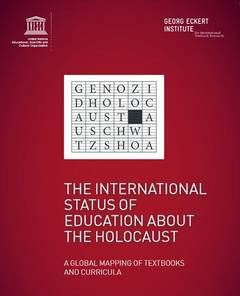 The International status of education about the Holocaust : A global mapping of textbooks and curricula Año de publicación: 2015 Autor corporativo: UNESCO This publication by UNESCO and the Georg Eckert Institute documents ways in which the Holocaust is presented in secondary school level history and social studies curricula worldwide, and conceptualized and narrated in textbooks from twenty-six countries, with all continents represented. Historical understandings of the Holocaust are defined in terms of the spatial and temporal scales with which the event is portrayed, the protagonists involved, interpretative patterns (according to definitions, comprehensiveness, causes, relativization or banalization), narrative techniques and viewpoints, didactic methods, and national idiosyncrasies. The study is based on 272 currently valid curricula from 135 countries, and on 89 textbooks published in 26 countries since 2000. The aim of the study is primarily to document information in such a way that it reflects local understandings of the Holocaust, principally by recording concepts and narratives of the Holocaust found in educational media currently in use in schools. The findings show both convergence and divergence in the representations analysed. The Holocaust is subject to shared patterns of representation, which include selectivity, personalization, appropriation, screening and omission. It is also subject to narrative idiosyncrasies. One of the main trends worldwide is domestication, a process whereby countries place emphasis on the local significance of the event or appropriate them in the interests of local populations. Drawing on such national and international patterns of representation, the publication concludes by formulating recommendations for future curricula and textbook narratives about the Holocaust. These recommendations relate to such issues as the use of terms, the comprehensiveness of historical facts, the definition of causes, the combination of universal and local approaches, and the development of historical literacy. (By the publisher) Le statut international de l'éducation sur l'Holocauste: Une cartographie mondiale des manuels et des programmes Año de publicación: 2015 Autor corporativo: Organisation des Nations Unies pour l'éducation, la science et la culture (UNESCO) Cette publication par l'UNESCO et l'Institut Georg Eckert documente façons dont l'Holocauste est présenté dans l'histoire du niveau de l'école et de programmes d'études sociales secondaire dans le monde, et conceptualiser et narré dans les manuels de vingt-six pays, avec tous les continents représentés. compréhensions historiques de l'Holocauste sont définis en fonction des échelles spatiales et temporelles avec laquelle l'événement est dépeint, les acteurs impliqués, les modèles d'interprétation (selon les définitions, l'intégralité, causes, relativisation ou banalisation), les techniques narratives et des points de vue, des méthodes didactiques, et les particularités nationales. L'étude est basée sur 272 programmes en cours de validité à partir de 135 pays, et 89 manuels publiés dans 26 pays depuis 2000. L'objectif de l'étude est d'abord de documenter l'information de façon à ce qu'il reflète la vision locale de l'Holocauste, principalement par l'enregistrement les concepts et les récits de la Shoah trouvés dans les médias éducatifs actuellement en usage dans les écoles. Les résultats montrent à la fois la convergence et de divergence dans les représentations analysées. L'Holocauste est soumis à des modèles communs de représentation, qui comprennent la sélectivité, la personnalisation, l'appropriation, le dépistage et l'omission. Il est également soumis à des particularités narratives. L'une des principales tendances dans le monde est la domestication, un processus par lequel les pays mettent l'aCECnt sur l'importance locale de l'événement ou les approprient dans l'intérêt des populations locales. Dessin sur ces modèles nationaux et internationaux de représentation, de la publication conclut en formulant des recommandations pour les futurs programmes et manuels scolaires récits sur l'Holocauste. Ces recommandations portent sur des questions telles que l'utilisation des termes, l'exhaustivité des faits historiques, la définition des causes, la combinaison des approches universelles et locales, ainsi que le développement de l'alphabétisation historique. (Par l'éditeur)
 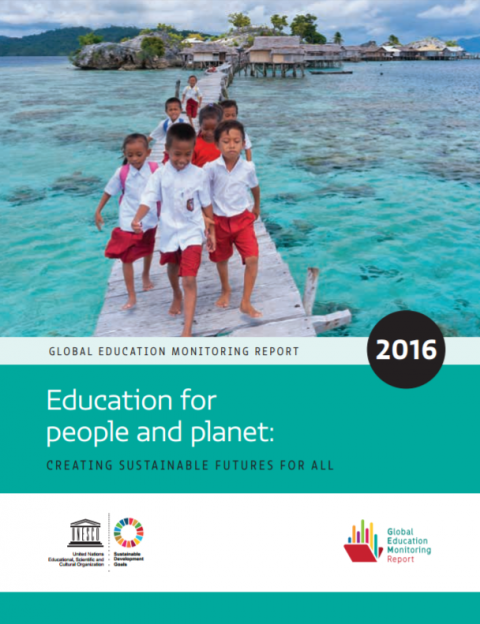 Education for People and Planet: Creating Sustainable Futures for All, Global Education Monitoring Report, 2016 Año de publicación: 2016 Autor corporativo: UNESCO | Global Education Monitoring Report Team Education for People and Planet: Creating Sustainable Futures for All explores the complex relationship between education and the new 2030 Agenda for Sustainable Development, covering six fundamental pillars – Planet, Prosperity, People, Peace, Place and Partnerships. This report shows that education will not deliver its full potential unless participation rates increase dramatically and sustainable development guides education system reform. It also warns of the destructive impact that climate change, conflict, unsustainable consumption and the increasing gap between rich and poor have on education. A huge transformation is needed if we are to create sustainable futures for all.
 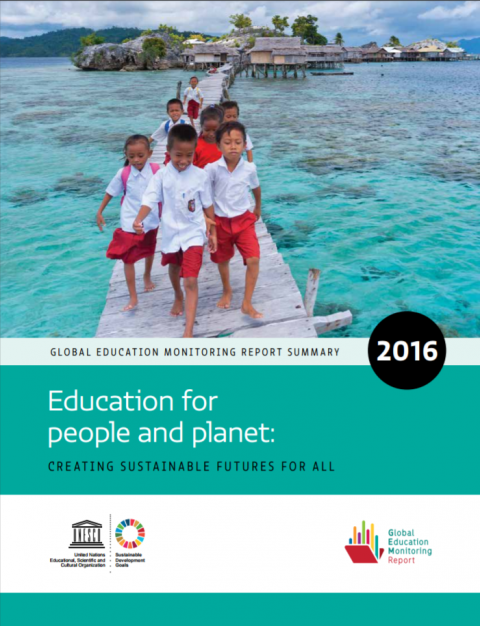 [Summary] Education for People and Planet: Creating sustainable Futures for All, Global Education Monitoring Report, 2016; Summary Año de publicación: 2016 Autor corporativo: UNESCO Education for People and Planet: Creating Sustainable Futures for All explores the complex relationship between education and the new 2030 Agenda for Sustainable Development, covering six fundamental pillars – Planet, Prosperity, People, Peace, Place and Partnerships. This report shows that education will not deliver its full potential unless participation rates increase dramatically and sustainable development guides education system reform. It also warns of the destructive impact that climate change, conflict, unsustainable consumption and the increasing gap between rich and poor have on education. A huge transformation is needed if we are to create sustainable futures for all.
  塑造明天的教育:联合国可持续发展教育十年2012年报告,简写本 Año de publicación: 2012 Autor corporativo: UNESCO As the lead agency for the UN Decade of Education for Sustainable Development (DESD, 2005 – 2014), UNESCO is responsible for monitoring and evaluating progress during the DESD. UNESCO is publishing three reports during the DESD – in 2009, 2012 and 2014. This second report focuses specifically on processes and learning in the context of Education for Sustainable Development (ESD). What kinds of learning processes have emerged in the course of the DESD? What is the role of ESD in supporting them? What changes in ESD have occurred since the early years of the Decade? The report is informed by a broad consultation process that includes input from hundreds of policy makers, scholars and practitioners engaged in ESD around the world. Каким быть образованию завтрашнего дня Доклад 2012 года о проводимом ООН Десятилетии образования в интересах устойчивого развития Сокращенный вариант Año de publicación: 2013 Autor corporativo: UNESCO As the lead agency for the UN Decade of Education for Sustainable Development (DESD, 2005 – 2014), UNESCO is responsible for monitoring and evaluating progress during the DESD. UNESCO is publishing three reports during the DESD – in 2009, 2012 and 2014. This second report focuses specifically on processes and learning in the context of Education for Sustainable Development (ESD). What kinds of learning processes have emerged in the course of the DESD? What is the role of ESD in supporting them? What changes in ESD have occurred since the early years of the Decade? The report is informed by a broad consultation process that includes input from hundreds of policy makers, scholars and practitioners engaged in ESD around the world. 내일의 교육을 그리다: 유엔 ‘지속가능발전교육 10년(DESD, 2005-2014)’의 선도기관인 유네스코가 발간하는 ‘지속가능한 세상을 위한’ DESD 모니터링 · 평가 시리즈의 두 번째 보고서 Año de publicación: 2013 Autor corporativo: 유네스코 As the lead agency for the UN Decade of Education for Sustainable Development (DESD, 2005 – 2014), UNESCO is responsible for monitoring and evaluating progress during the DESD. UNESCO is publishing three reports during the DESD – in 2009, 2012 and 2014. This second report focuses specifically on processes and learning in the context of Education for Sustainable Development (ESD). What kinds of learning processes have emerged in the course of the DESD? What is the role of ESD in supporting them? What changes in ESD have occurred since the early years of the Decade? The report is informed by a broad consultation process that includes input from hundreds of policy makers, scholars and practitioners engaged in ESD around the world. Connaissances pratiques: symbiose des programmes relatifs à l'enseignement des sciences, à l'éducation concernant l'environnement et à l'enseignement technique et professionnel Año de publicación: 2006 Autor: Saif R. Samady Autor corporativo: UNESCO UNESCO’s work in science teaching began shortly after the Organization was established. After the Second World War, many schools in Europe were in great need of science equipment. To meet this need, the Organization sponsored the publication of a small volume entitled Suggestions for Science Teachers in Devastated Countries. The book was further developed to include a wide range of guidelines for simple equipment and science experiments and published in 1956 as the UNESCO Source Book for Science Teaching. Over the years, the Source Book was revised several times and translated into more than twenty-five languages. During five decades, the Organization promoted worldwide exchange of information and innovations in science education and assisted many Member States, especially the developing countries, in setting up science teacher training programmes, curriculum development centres, and projects for design and development of science equipment. Working knowledge: symbiosis of programmes in science teaching, environmental education, and technical and vocational education Año de publicación: 2006 Autor: Saif R. Samady Autor corporativo: UNESCO UNESCO’s work in science teaching began shortly after the Organization was established. After the Second World War, many schools in Europe were in great need of science equipment. To meet this need, the Organization sponsored the publication of a small volume entitled Suggestions for Science Teachers in Devastated Countries. The book was further developed to include a wide range of guidelines for simple equipment and science experiments and published in 1956 as the UNESCO Source Book for Science Teaching. Over the years, the Source Book was revised several times and translated into more than twenty-five languages. During five decades, the Organization promoted worldwide exchange of information and innovations in science education and assisted many Member States, especially the developing countries, in setting up science teacher training programmes, curriculum development centres, and projects for design and development of science equipment. Inclusión, educación para el desarrollo sostenible, aprendizaje de adultos, educación superior e investigación: cuatro conferencias internacionales para promover la equidad, la calidad, la pertinencia y la responsabilidad social en materia de educación Año de publicación: 2008 Autor corporativo: UNESCO This cycle of conferences brings together a wide array of influential stakeholders in the common interest of creating education systems that serve the needs of all learners, address the challenges of today's world and make learning a springboard of development.