
Recursos
Exploren una amplia gama de recursos valiosos en GCED para profundizar su comprensión y promover su búsqueda, incidencia, enseñanza y aprendizaje.
1,443 resultados encontrados
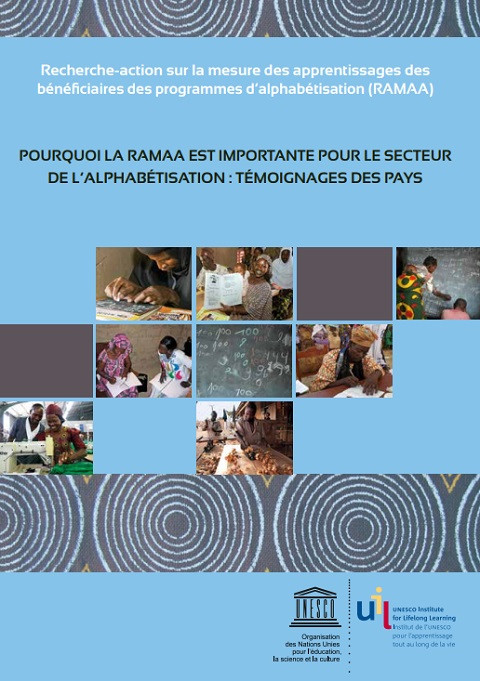 Why RAMAA Is Important for Literacy: Testimonies From Participating Countries; Action Research on Measuring Literacy Programme Participants’ Learning Outcomes (RAMAA) Año de publicación: 2016 Autor corporativo: UNESCO Institute for Lifelong Learning (UIL) The RAMAA action research, launched at the initiative of the UNESCO Institute for Lifelong Learning (UIL), and piloted in partnership with local UNESCO offices, responds to this vital need to assess the quality of literacy programmes by taking the learning effectively acquired by the beneficiaries at the end of their training as an objective variable.The first phase of RAMAA involved five countries, now twelve countries are participating in the second phase of RAMAA – Benin, Burkina Faso, Cameroon, Côte d'Ivoire, Central African Republic, Democratic Republic of Congo, Morocco, Mali, Niger, Senegal, Chad and Togo. The countries’ commitment throughout the implementation of the second phase of RAMAA and the integration of the results into the national systems are key to the project. Pourquoi la RAMAA est importante pour le secteur de l'alphabétisation: Témoignages des pays; Recherche-action sur la mesure des apprentissages des bénéficiaires des programmes d'alphabétisation (RAMAA) Año de publicación: 2016 Autor corporativo: UNESCO Institute for Lifelong Learning (UIL) La Recherche-action RAMAA, lancée à l’initiative de l’Institut de l’UNESCO pour l’apprentissage tout au long de la vie (UIL), et pilotée en partenariat avec les bureaux UNESCO répond à ce besoin vital d’évaluer la qualité des programmes d’alphabétisation en prenant comme variable objective les apprentissages réellement acquis par les bénéficiaires à la sortie de leur formation.La première phase de la RAMAA comptait cinq pays, douze pays sont désormais engagés dans la deuxième phase de la RAMAA - Bénin, Burkina Faso, Cameroun, Côte d’Ivoire, République centrafricaine, République démocratique du Congo, Maroc, Mali, Niger, Sénégal, Tchad et Togo. L’engagement des pays tout au long de la mise en œuvre de la deuxième phase de la RAMAA et l’intégration des résultats dans les dispositifs nationaux deviennent impératifs.
  CONFINTEA VI Mid-Term Review 2017: The Status of Adult Learning and Education in Sub-Saharan Africa; Regional Report Año de publicación: 2017 Autor: John Aitchison Autor corporativo: UNESCO Institute for Lifelong Learning (UIL) The Sustainable Development Goals include educational targets which are entirely congruent with the existing focuses of ALE in African countries – to ‘ensure that all youth and a substantial proportion of adults, both men and women, achieve literacy and numeracy’ (4.6), to ‘substantially increase the number of youth and adults who have relevant skills, including technical and vocational skills, for employment, decent jobs and entrepreneurship’ (4.4) and to ‘ensure that all learners acquire the knowledge and skills needed to promote sustainable development, including, among others, through education for sustainable development and sustainable lifestyles, human rights, gender equality, promotion of a culture of peace and non-violence, global citizenship and appreciation of cultural diversity and of culture’s contribution to sustainable development’ (4.7). National targets and the criteria for success in reaching those targets will need to be developed. Undoubtedly, international cooperation and international support can help this gearing-up process.
  CONFINTEA VI Mid-term Review 2017: The Status of Adult Learning and Education in Asia and the Pacific; Regional Report Año de publicación: 2017 Autor: Govinda, Rangachar Autor corporativo: UNESCO Institute for Lifelong Learning (UIL) Adult learning and education policies and practices should be closely aligned with developments in school education. A quick survey of the state of education in the region reveals that significant progress has been made in providing basic education to all children. However, the achievements are noticeably uneven across sub-regions. For example, around 16 million primary-school-aged children and around 34 million lower-secondary-aged adolescents in the Asia-Pacific region are not in school; two-thirds of these are in South Asia (UIS, 2015). Outof-school children are an important concern as, barring special intervention, they are likely to remain non-literate as they grow into adulthood.
  Suwon-Osan CONFINTEA VI Mid-Term Review Statement: The Power of Adult Learning and Education; A Vision Towards 2030 Año de publicación: 2018 Autor corporativo: UNESCO Institute for Lifelong Learning (UIL) The Sixth International Conference on Adult Education (CONFINTEA VI), held in Brazil in December 2009, closed with the adoption of the Belém Framework for Action, which recorded the commitments of Member States and presented a strategic guide for the global development of adult learning and education from a lifelong learning perspective. The third Global Report on Adult Learning and Education (GRALE III), published in 2016, drew on survey data to evaluate progress made by countries in fulfilling the commitments made in Brazil, while also highlighting some of the contributions adult learning and education can make to the 2030 Agenda for Sustainable Development. The CONFINTEA VI Mid-Term Review, held in Suwon, Republic of Korea, in October 2017, took stock of progress made by Member States in the past eight years, looking ahead to GRALE IV in 2019. This statement represents the overall perspective of delegates and their recommendations for the future. Bilan à mi-parcours de la CONFINTEA VI : Déclaration de Suwon-Osan - Le pouvoir de l'apprentissage et de l'éducation des adultes: Vision 2030 Año de publicación: 2018 Autor corporativo: UNESCO Institute for Lifelong Learning (UIL) La sixième Conférence internationale sur l'éducation des adultes (CONFINTEA VI) qui a eu lieu en décembre 2009 au Brésil, s’est achevée sur l’adoption du Cadre d'action de Belém qui a permis de rassembler les engagements des États membres et de présenter un guide stratégique pour le développement mondial de l’apprentissage et de l’éducation des adultes du point de vue de l’apprentissage tout au long de la vie. Le troisième Rapport mondial sur l'apprentissage et l'éducation des adultes (GRALE III), publié en 2016, s’est appuyé sur les données d'une enquête afin d’évaluer les progrès accomplis par les pays pour tenir leurs engagements pris au Brésil, tout en soulignant certaines des contributions que l’apprentissage et l’éducation des adultes peuvent apporter au Programme de développement durable à l'horizon 2030. Le Bilan à mi-parcours de la CONFINTEA VI qui s’est tenu en octobre 2017 à Suwon en République de Corée a fait l'inventaire des progrès réalisés par les États membres au cours des huit dernières années en vue du GRALE IV de 2019. La présente déclaration exprime les perspectives des délégués au niveau mondial et fait état de leurs recommandations pour l’avenir. Declaración de Suwon-Osan sobre la Revisión a Medio Término de la CONFINTEA VI: el poder del aprendizaje y la educación de adultos: una visión hacia el 2030 Año de publicación: 2018 Autor corporativo: UNESCO Institute for Lifelong Learning (UIL) La VI Conferencia Internacional de Educación de Adultos (CONFINTEA VI), celebrada en Belém (Brasil), en diciembre de 2009, se clausuró con la aprobación del Marco de acción de Belém que registró los compromisos de los Estados Miembros y presentó una guía estratégica para el desarrollo mundial del aprendizaje y la educación de adultos desde una perspectiva de aprendizaje a lo largo de toda la vida. El tercer Informe mundial sobre el aprendizaje y la educación de adultos (GRALE III), publicado en 2016, se basó en los datos de una encuesta destinada a evaluar el progreso realizado por los países en el cumplimiento de los compromisos formulados en Brasil, al mismo tiempo que hacía hincapié en algunas de las contribuciones que puede hacer el aprendizaje y la educación de adultos a la Agenda 2030 para el Desarrollo Sostenible. La Revisión a Medio Término de la CONFINTEA VI, realizada en Suwon (República de Corea) en octubre de 2017, hizo un balance del progreso realizado por los Estados Miembros en los últimos ocho años, mirando en la perspectiva del GRALE IV para 2019. Este pronunciamiento representa el punto de vista global de los delegados y sus recomendaciones para el futuro. 유네스코 제6차 세계성인교육회의 중간회의 수원-오산 선언문: 성인학습 교육(ALE)의 힘; 2030년을 향한 비전 Año de publicación: 2018 Autor corporativo: UNESCO Institute for Lifelong Learning (UIL) 2009년 12월 브라질 벨렘에서 개최된 제6차 세계성인교육회의(CONFINTEA VI)에서 벨렘 실행계획(Belém Framework for Action)이 채택되었다. 벨렘 실행계획은 회원국의 성인학습과 교육에 대한 공약을 기록하고, 평생학습 관점에서 성인학습과 교육의 세계적 발전을 위한 전략적 지침을 제시하였다. 2016년 발간된 유네스코의 제3차 성인학습과 교육(ALE)에 관한 글로벌 보고서(GRALE III)에서는 설문조사를 통해 수집된 데이터를 기반으로 2009년 제6차 회의 당시 회원국이 제시한 공약의 이행 현황을 평가하는 한편, 2030 지속가능발전의제(2030 Agenda for Sustainable Development) 이행에 있어 성인학습과 교육이 기여할 수 있는 부분을 강조하였다. 2017년 10월 대한민국 수원시에서 개최된 제6차 세계성인교육회의 중간회의(CONFINTEA VI Mid-Term Review)에서 회원국들은 지난 8년 동안 이행된 활동 현황을 검토하고, 2019년 발간 예정인 제4차 성인학습과 교육(ALE)에 관한 글로벌 보고서(GRALE IV)를 준비하였다. 이 선언문은 성인학습과 교육에 대한 각국 대표의 전반적 관점과 그들이 제시하는 미래에 대한 권고안이다.
  Literacy and the Promotion of Citizenship: discourses and effective practices Año de publicación: 2008 Autor corporativo: UNESCO Institute for Lifelong Learning (UIL) The UNESCO Institute for Lifelong Learning and its partners, the Agence Nationale de Lutte Contre L’Illettrisme (ANLCI) and the UNESCO French National Commission, organized a Regional Meeting on “Literacy and the Promotion of Citizenship: The Challenge of Learning” from 2-5 April 2005 in Lyon, France. Participants from 38 countries of what UNESCO considers to be the European Region (i.e. Europe, Canada, Israel and the United States of America) reviewed pertinent policies and shared good practices.By focusing on the theme of citizenship, the meeting sought to establish a link between literacy and the empowerment of citizens. This publication brings together the main presentations from that meeting, and as such documents the diversity of literacy-related thinking and practice in the region.
  Embracing a Culture of Lifelong Learning: Contribution to the Futures of Education Initiative Año de publicación: 2020 Autor corporativo: UNESCO Institute for Lifelong Learning (UIL) This report, a contribution to UNESCO's Futures of Education initiative, reflects on the potential contribution of lifelong learning both in transforming the field of education and in creating a more sustainable, healthy and inclusive future. Drawing on the insights of 12 distinguished experts from different disciplines and countries, the report presents a compelling vision for lifelong learning and the values and principles that must underpin it. It calls on the international community to acknowledge the social and private dimensions of education, and to recognize lifelong learning as a new human right. Realizing this vision, it argues, requires adopting a transdisciplinary approach that can effectively grasp the complex, multidimensional nature of the challenges faced by humanity. The report outlines the main features of the ‘enabling environment’ needed to make lifelong learning the governing principle of education policy and to offer people opportunities to learn throughout life, whatever their background or context. It concludes with a set of key messages, complemented by specific action points and a discussion of selected policy measures.