
Recursos
Exploren una amplia gama de recursos valiosos en GCED para profundizar su comprensión y promover su búsqueda, incidencia, enseñanza y aprendizaje.
3,448 resultados encontrados
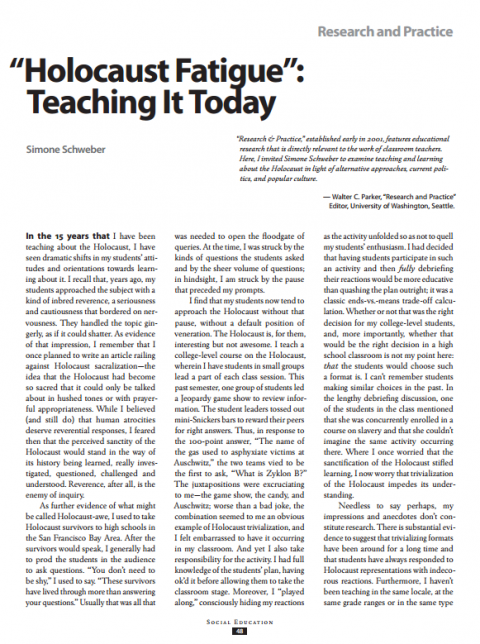 ´Holocaust Fatigue': Teaching it today The review "Research & Practice", established early in 2001, features educational research that is directly relevant to the work of classroom teachers. Here, I invited Simone Schweber to examine teaching and learning about the Holocaust in light of alternative approaches, current politics, and popular culture. (By the publisher)
  L'enseignement de la Shoah dans les écoles juives In this article, Katy Hazan studies the teaching of the Holocaust in Jewish schools. First, she portrays the educational systems of these specific schools and second, she establishes all the ethical, philosophical issues this theme entails. In the third part, she takes inventory of alternative ways of teaching the Holocaust, to conclude on the danger of emotional approaches. Teaching the Holocaust at a distance : reflections from the field As technology continues to improve and online learning programs continue to proliferate each year throughout the United States, it is necessary for teachers to establish a sound understanding of proper pedagogical techniques for a digital environment. This phenomenon has ushered in a new era of education, thus bringing forth a myriad of new questions and issues that must be addressed. For instance, how should online instructors properly transfer and teach traditional core subjects in an online milieu? Social studies educators are faced with additional quandaries, such as teaching democratic processes for effective citizenship and the teaching of controversial issues/topics like the Holocaust. Undeniably, controversial topics elicit strong emotions and come with a plethora of concerns that seem only possible to address in a face-to-face classroom. This current exploration draws upon the scholarship and experience of experts in the field of social studies education, distance learning, and Holocaust Studies to provide suggestions as to how teachers should approach controversial topics in a digital learning environment. An example lesson plan is also provided to showcase a successful integration of controversial issues into an online high school social studies classroom. (By the author)
  Seeing the world from today from a different viewpoint: The impact of the lessons from Auschwitz project on schools in Scotland Auschwitz remains the epitome of inhumanity and barbarism. In 2007, the Holocaust Educational Trust organised the first Lessons from Auschwitz (LFA) project for Scottish schools. Its participants were two plane-loads of Scottish pupils and teachers from 31 local authorities – typically two pupils from a school accompanied by a teacher. This research, funded by the Holocaust Educational Trust and the Pears Foundation, involved these participants being invited to complete an online questionnaire with selected follow-up interviews. The aims were to evaluate the LFA project and provide insight into the impact this project had on individuals, schools and communities. This paper will report on: Student evaluation of the LFA project ; The impact of the LFA project on individuals, schools and local communities. Conclusions as to the value of the LFA project in Scotland. (By the author)
  Learning from genocide: a study in the failure of Holocaust education The importance of learning lessons from the Holocaust and from the mass slaughter in Rwanda was recognised in the theme underpinning Britain’s Holocaust Memorial Day in 2004. This article is principally concerned with the lessons learnt from the Holocaust by a culturally diverse group of students aged 14 to 16. They all attended schools in an outer London borough and were interviewed after taking part in a local event held to mark the 2004 commemoration. The article concludes with a discussion of the main findings of the investigation. (By the author) Mémoire et pédagogie. Autour de la transmission de la destruction des Juifs d'Europe Based on qualitative interviews, "Memory and pedagogy" takes inventory of the representations and fears teachers can encounter when they broach the Holocaust, especially if their personal background echoes that part of history. The author then describes different postures they can adopt ‒ centred victim empathy, genocide as a general theme or focused on "lessons" from the past. This book, one of the first research projects on this topic in Switzerland, is a contribution to a collective reflection on the current and future transmission of the history and memory of the destruction of European Jews. (By the author - Translation)
  Mission Impossible? Creating a Monitoring Framework for Education for Global Citizenship Año de publicación: 2015 Autor: Amy Skinner Autor corporativo: Éducation des Adultes et Développement Global Citizenship Education (GCED) must be understood as a complex and multilayered process. It can be a force for transformation on the personal, local and system level. It would be a great help to be able to monitor the impact of GCED taking this complexity into account. The article presents some research results on monitoring and explains the challenges in setting up a monitoring framework. ¿Misión imposible? Crear un marco de seguimiento destinado a la educación para la ciudadanía mundial Año de publicación: 2015 Autor: Amy Skinner Autor corporativo: Éducation des Adultes et Développement La educación para la ciudadanía mundial (ECM) debe entenderse como un proceso complejo y de varios niveles. Puede ser una fuerza de transformación a nivel personal, local y sistémico. Sería muy útil poder realizar un seguimiento del impacto de la ECM, teniendo en cuenta su complejidad. En el artículo se presentan algunas conclusiones de investigaciones sobre el seguimiento, y se explican los desafíos que plantea la creación de un marco para llevarlo a cabo.
  Religion, “Community” and Citizenship: The Case of Steiner, Muslim and Jewish Schools in Montreal Año de publicación: 2012 Autor: Stéphanie Tremblay Autor corporativo: Diversité urbaine Drawing on ethnographic fieldwork in Montreal, this article explores the conception of citizenship in three private schools belonging to different minority groups (Waldorf, Muslim and Jewish). After a short overview of the main critiques circulating with regards to faith-based schools in current social and political debates, I look at the theoretical concepts of school community and citizenship. These considerations help us analyze how teachers in such schools try to develop, by simultaneously different and convergent strategies, a training in citizenship as a form of “universal particularism” (Riedel 2008). These three schools attempt to transmit an open attitude toward religious and cultural diversity, and they promote the participation of their students in the wider society through a religious or spiritual particularism, which appears to be a sort of sacred ground for civic values.
  La citoyenneté des adolescents du 21e siècle dans une perspective de justice sociale : pourquoi et comment ? Año de publicación: 2018 Autor: Caroline Caron Autor corporativo: Lien social et Politiques Comment sait-on ce que l’on sait sur la citoyenneté des adolescents et leurs pratiques de participation civique ? Cette question épistémologique a été négligée dans les écrits traitant de l’engagement civique et de la participation politique des jeunes. Cet article utilise la perspective théorique de la justice sociale pour examiner le rôle que jouent les rapports sociaux fondés sur l’âge dans la production de connaissances qui offrent un portrait pessimiste du rapport des jeunes à la politique. L’analyse montre que l’injustice épistémique et la validation empirique déficiente des connaissances à propos de la compétence civique appellent une théorisation alternative, précisément inclusive, de la citoyenneté des jeunes. L’analyse souligne aussi que l’avènement du Web social a créé de nouveaux besoins de connaissances que les cadres de recherche établis par tradition peinent à satisfaire. Un premier pas vers la production de connaissances socialement justes au sujet des compétences civiques des adolescents à l’ère du Web social consiste à analyser les fondements épistémologiques des approches de recherche prédominantes afin de susciter des échanges fructueux au sujet des critères normatifs qui devraient guider la confection des protocoles de recherche dans le futur.