
Recursos
Exploren una amplia gama de recursos valiosos en GCED para profundizar su comprensión y promover su búsqueda, incidencia, enseñanza y aprendizaje.
1,725 resultados encontrados
 Global Alliance for Literacy within the Framework of Lifelong Learning (GAL): Strategy 2020–2025 Año de publicación: 2020 Autor corporativo: UNESCO Institute for Lifelong Learning (UIL) This strategy presents GAL’s vision, mission, goals and objectives for the period from 2020 to 2025. It builds upon GAL’s achievements from 2016 and 2019, and upon UNESCO’s previous initiatives supporting youth and adult literacy, including the UN Literacy Decade (2003–2012), Literacy Initiative for Empowerment (LIFE) from 2006 to 2015, and the 2015 Recommendation on Adult Learning and Education (RALE).
  Think Tank Report: Empowering Communities through Citizenship Education and Lifelong Learning Año de publicación: 2025 Autor corporativo: UNESCO Institute for Lifelong Learning (UIL) This short, explorator y repor t from the UNESCO Institute for Lifelong Learning (UIL) is the outcome of ‘Placing citizenship education within a lifelong learning perspective: From research to action’, a think tank meeting held in Hamburg in 2023. The meeting brought together experts from international organizations and academia and was organized by UIL in collaboration with the Asia-Pacific Centre of Education for International Understanding. The report reflects the inputs of participants while also drawing on the proposals of the International Commission on the Futures of Education (ICFE, 2021); the findings of the Fifth Global Report on Adult Learning and Education (GRALE 5) (UIL, 2022a); the Marrakech Framework for Action (UIL, 2022b); and the outcomes of the United Nations Transforming Education Summit of September 2022 (UN, 2023a; UN 2023b); as well as UNESCO’s Revised Recommendation concerning Education for International Understanding, Co-operation and Peace (UNESCO, 2023). It makes a case for putting citizenship education, interpreted not as a means of reproducing the status quo but as a catalyst for civic and social empowerment, at the heart of efforts to create more equitable, tolerant and just societies for all. It argues that citizenship, so construed, should be woven into the fabric of education, throughout and across the life course, recognizing its role in narrowing social and economic inequalities, overcoming social fragmentation, addressing the climate crisis and tackling the backlash against human rights and gender equality. This report calls for citizenship education and lifelong learning to be core pillars of a systems-level transformation in education, and provides recommendations for policy-makers, national and local governments, educators and civil society organizations to make citizenship education a priority in their policies and practices.
  Digital Empowerment for Lifelong Learning and Transformative Andragogy (DELTA) for Adult Educators: Introduction to the DELTA Framework and Resources Año de publicación: 2025 Autor corporativo: UNESCO Institute for Lifelong Learning (UIL) | Shanghai Open University (SOU) The UNESCO Institute for Lifelong Learning (UIL), in partnership with Shanghai Open University (SOU), has unveiled the DELTA Framework — Digital Empowerment for Lifelong Learning and Transformative Andragogy. This global initiative aims to enhance adult educators’ digital competencies and foster inclusive, lifelong learning opportunities for all.
  학습도시와 지속가능발전목표: 실행을 위한 가이드 Año de publicación: 2017 Autor corporativo: UNESCO Institute for Lifelong Learning (UIL) 학습도시의 핵심 특징(Key Features of Learning Cities)에 맞추어 이 실행 가이드는 환경 친화적이며 건강한 학습도시(환경적 지속가능발전), 평등하고 포용적인 학습도시(개인 권한 부여, 상호문화적 대화, 사회적 통합), 학습도시 내에서의 고용 및 기업가정신(경제 발전 및 문화적 번영)이라는 세 가지 주제영역으로 구성되어 있다. 지속가능발전의 이 세 가지 영역은 근본적으로 서로 연계되어 있으며, 도시에서의 평생학습 활동이 언제나 여기에 영향을 미칠 것임을 인식하는 것은 중요하다. 지속가능발전목표의 다른 영역과 마찬가지로 중요한 네 번째 영역은 문화(문화적 표현, 유산, 그리고 다양성) 영역이며, 이는 다음 장에서 공통 주제로 포함시켰다.
 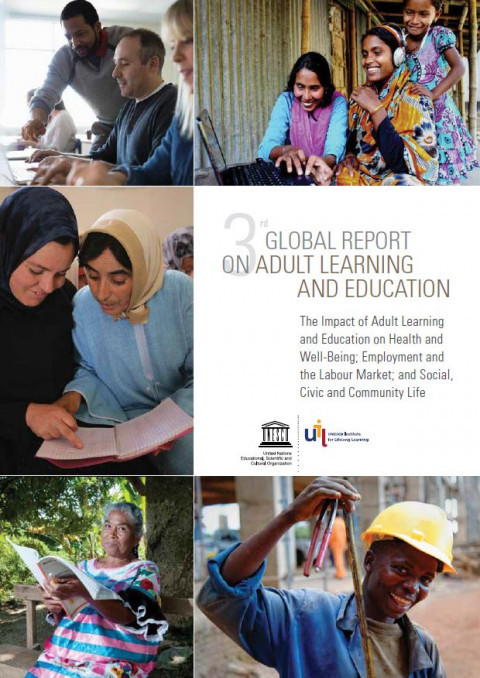 3rd Global Report on Adult Learning and Education: The Impact of Adult Learning and Education on Health and Well-being, Employment and the Labour Market, and Social, Civic and Community Life Año de publicación: 2016 Autor corporativo: UNESCO Institute for Lifelong Learning (UIL) The Global Reports on Adult Learning and Education (GRALE) play a key role in meeting UNESCO’s commitment to monitor and report on countries’ implementation of the Belém Framework for Action. This Framework was adopted by 144 UNESCO Member States at the Sixth International Conference on Adult Learning and Education (CONFINTEAVI), which was held in Belém, Brazil, in 2009. In the Belém Framework for Action, countries agreed to improve ALE across five areas of action: policy; governance; financing; participation, inclusion and equity; and quality (UNESCO Institute for Lifelong Learning, 2010b).GRALE III appears as the ALE community prepares for an important global conference: the 2017 Mid-Term Review of CONFINTEA VI. GRALE III will help high-level decision makers take stock of progress in delivering their Belém promises since 2009. It will also help them look ahead to 2030. Policymakers are now considering how to put into practice the ALE promises made in the 2030 Agenda for Sustainable Development (United Nations, 2015) and the Recommendation on Adult Learning and Education (2015) (UNESCO, 2015). GRALE III will support their deliberations by showing how ALE can help achieve broader health, economic and social outcomes. It will identify major challenges for ALE and examine the implications for ALE of major global trends like migration and demographic shifts.GRALE III brings together the latest data, policy analysis and case studies on ALE. Government leaders will find high quality evidence to inform their policies, strategies and budgets. Proponents of change will find compelling arguments showing how ALE promotes sustainable development, healthier societies, better jobs and more active citizenship. Policy analysts will find entry points and ideas for future research and policy.
  SDG4 - 교육 2030: 포용성과 교육에 관한 연구 Año de publicación: 2019 Autor: 임후남 | 이대식 | 류방란 | 박성호 | 김혜자 | 윤선애 | 조혜승 Autor corporativo: 한국교육개발원 이 연구는 한국 교육의 포용성 실태 및 수준을 분석하고, 포용적 교육의 목표를 실현하기 위해 정책적 개선이 필요한 과제가 무엇인지를 제안하는 것을 목적으로 하였다.포용적 교육 관련 이론들을 탐구하는 한편, 포용적 교육의 개념과 요소, 유사 개념들에 대한 논의를 고찰하였다. 논의를 종합하면, 포용적 교육은 모든 학생이 처한 상황과 조건, 특성과 요구를 반영한 동등한 양질의 교육 기회와 권리를 보장하고, 이를 통해 공동체의 지속가능한 발전 또한 보장하는 교육을 지향한다. 이는 기존의 공정성 및 형평성 교육을 계승한 것이며, 그 대상 및 가치와 지향을 확장한 것이다. 포용적 교육은 “누구도 소외(배제)되지 않고, 다양한 개인의 요구와 특성(차이)을 고려한 유연한 교육과정을 통해 성, 민족(인종), 경제력 등에 따라 차별받지 않고, 공동체의 지속가능한 발전과 웰빙에 기여할 수 있는 개인으로 성장할 수 있도록 하는 교육”이라고 정의될 수 있다. 포용적 교육은 취약계층 중심의 정책목표를 전체(누구나)로 확대하고, 교육의 접근, 참여를 넘어서 성취의 격차와 차별의 철폐를 강조한다.
  사회경제 변화에 대응하는 평생교육 확대 방안 (KEDI Brief, 2020년 제7호) Año de publicación: 2020 Autor: 박병영 | 이정우 Autor corporativo: 한국교육개발원 2019년 한국교육개발원 기본연구로 수행된 「사회적 형평성 제고를 위한 평생교육 확대 방안」 (박병영 외, 2019)의 일부 내용을 발췌하여 재구성한 자료로서 한국 사회에서 평생교육의 필요성을 짚어보고 그에 따른 평생학습 확대를 위한 정책 과제를 제시한다.
  The Tasks for Future Education through the Analysis of Educational Innovation Cases Año de publicación: 2019 Autor: Eunhee Hwang | Sujin Choi | Jongheon Lim | Heejin Park | Jaeduck Lee | Sungki Kim | Giljae Lee | Hunho Kim | Ammi Jang Autor corporativo: Korean Educational Development Institute (KEDI) It is predicted that the future society will be low populated of the school-age but high populated of the elderly, intelligent information centered, and multicultural society. According to these changes of the society, it is time for education to shift to preparing for a future education system rather than growth from competition. Based on this perspectives, this study aims to explore the tasks of the future education by analyzing domestic and international cases of educational innovations. Specifically, this study suggests several practical tasks that general high schools can implement for the future education, analyzing the selected cases contributed to the educational innovation. This is because the cases of educational innovation are the stepping stones for general high school to move forward to the future education, although the cases are not perfect examples. 교육 혁신 사례 분석을 통한 미래교육 실천 과제 Año de publicación: 2019 Autor: 최수진 | 임종헌 | 박희진 | 이재덕 | 김성기 | 이길재 | 김훈호 | 장암미 Autor corporativo: 한국교육개발원 미래사회의 특징으로 학생 수 감소 및 고령화, 지능정보사회, 다문화 사회 등이 언급되고 있다. 이러한 미래사회의 변화에 따라 우리나라의 교육도 경쟁을 통한 성장보다는 미래를 대비하는 체제로 전환해야 할 시점에 놓여있다. 이 연구는 국내・외에서 이루어진 교육 혁신의 사례를 통해 미래교육의 실천 과제를 탐색하기 위한 것이다. 미래교육의 수준이나 내용은 미래의 범위를 어디로 설정하는가에 따라 다양할 수 있다. 이 연구에서는 일반 고등학교의 실천 가능성에 중요성을 두고 현재 완벽한 미래교육 시스템을 구축하고 있다고는 할 수 없지만 현재의 일반학교보다 한 발 앞서 미래교육을 준비하며 다양한 시행착오를 거쳐 성과를 거두고 있는 교육 혁신의 사례를 현재의 학교교육과 미래의 학교교육의 연결고리로 보고, 이들 사례에서 도출된 미래교육 실천 과제를 현재 학교들이 미래교육의 방향을 향해 나아가야할 실천 과제로 제안하였다.
  Community-based Learning for Sustainable Development (UIL policy brief 8) Año de publicación: 2017 Autor corporativo: UNESCO Institute for Lifelong Learning (UIL) The 2030 Agenda for Sustainable Development sets ambitious goals to transform our world, balancing the economic, social and environmental dimensions of sustainable development. To rise to the challenges posed by these goals and to ensure no one is left behind, it is critically important that local communities are involved in the planning and management of sustainable development and the promotion of sustainable lifestyles. The 2030 Agenda encompasses all aspects of our lives, which implies that learning, if it is to contribute fully to this agenda, must be seen as both lifelong and life-wide. The relevance of community-based non-formal education and informal learning for children, young people and adults, especially those not in education or from marginalized or disadvantaged parts of society, must be recognized and fostered in every country of the world if the 17 Sustainable Development Goals are to be met. This Policy Brief proposes six action principles and four policy recommendations to advance community-based lifelong learning for sustainable development. They summarize the lessons of successful community-based learning for sustainable development, drawn from around the world.