
Recursos
Exploren una amplia gama de recursos valiosos en GCED para profundizar su comprensión y promover su búsqueda, incidencia, enseñanza y aprendizaje.
1,725 resultados encontrados
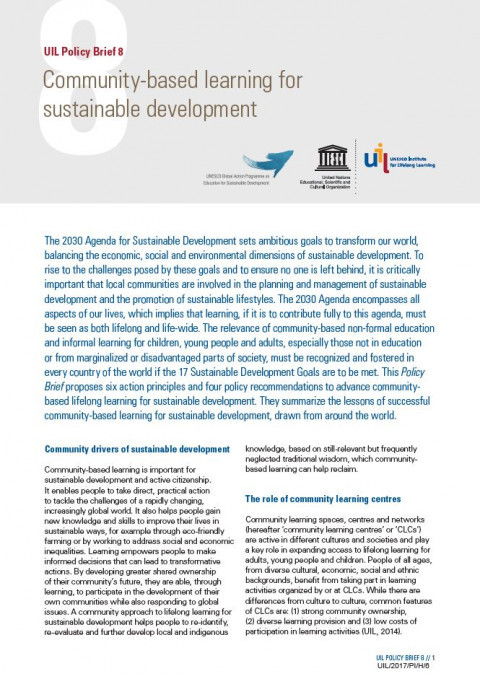 L’apprentissage communautaire pour le développement durable (Note d’orientation n° 8 de l’UIL) Año de publicación: 2017 Autor corporativo: UNESCO Institute for Lifelong Learning (UIL) Le Programme de développement durable à l’horizon 2030 définit des objectifs universels ambitieux pour transformer notre monde, qui visent à équilibrer les dimensions économiques, sociales et environnementales du développement durable. Pour relever les défis que posent ces objectifs et veiller à ce que personne ne soit laissé pour compte, il est crucial d’impliquer les communautés locales dans la planification et la gestion du développement durable ainsi que dans la promotion de modes de vie durables. Afin que l’apprentissage réalise son potentiel et contribue pleinement à un Programme qui englobe tous les aspects de notre vie, il doit être considéré comme un processus tout au long de la vie et dans tous les aspects de la vie. Si nous voulons atteindre les 17 objectifs pour le développement durable, il nous faut reconnaître la pertinence de l’éducation communautaire non formelle et de l’apprentissage informel pour les enfants, les jeunes et les adultes, en particulier ceux qui ne sont pas scolarisés ou qui sont issus des secteurs marginalisés ou défavorisés de la société, et encourager cette éducation et cet apprentissage dans tous les pays du monde.La présente note d’orientation propose six principes d’action et formule quatre recommandations politiques pour faire progresser l’apprentissage communautaire tout au long de la vie en vue du développement durable. Ces principes et recommandations tirent les leçons du succès de l’apprentissage communautaire pour le développement durable à partir d’études de cas recueillies dans le monde entier. El aprendizaje basado en la comunidad para el desarrollo sostenible (Notas sobre Política del UIL Nº 8) Año de publicación: 2017 Autor corporativo: UNESCO Institute for Lifelong Learning (UIL) La Agenda 2030 para el Desarrollo Sostenible 2030 establece metas ambiciosas y universales para transformar el mundo, que mantienen el equilibrio entre las dimensiones económica, social y ambiental del desarrollo sostenible. Para superar los desafíos que suponen esas metas y asegurarse de que no se excluye a nadie, es primordial que las comunidades locales participen en la planificación y gestión del desarrollo sostenible y en la promoción de estilos de vida sostenibles. La Agenda 2030 comprende todos los aspectos de la vida, lo que supone que para sacar el máximo provecho de las posibilidades que brinda el aprendizaje y que contribuya plenamente a la Agenda, debe entenderse como un proceso permanente a lo largo de toda la vida. Para que se cumplan los 17 Objetivos de Desarrollo Sostenible, debe reconocerse y fomentarse en todos los países del mundo la importancia de la educación no formal basada en la comunidad y del aprendizaje informal para los niños, los jóvenes y los adultos, especialmente de los que no participan en la educación o forman parte de colectivos marginados o vulnerables de la sociedad. En las presentes Notas sobre política se proponen seis principios de actuación y se formulan cuatro recomendaciones para la adopción de políticas, con el propósito de impulsar el aprendizaje basado en la comunidad para el desarrollo sostenible. Se resumen asimismo las lecciones extraídas en todo el mundo a partir de experiencias fructíferas de ese tipo de aprendizaje. Обучение местных сообществ для устойчивого развития (Бюллетень UIL №8) Año de publicación: 2017 Autor corporativo: UNESCO Institute for Lifelong Learning (UIL) Повестка Устойчивого Развития 2030 ставит перед собой амбициозные цели по преобразованию нашего мира, уравновешивая экономические, социальные и экологические аспекты устойчивого развития. Для решения проблем, проистекающих из этих целей, а также для обеспечения того, чтобы не было отстающих, крайне важно, чтобы местные сообщества участвовали в планировании и управлении устойчивым развитием и поощрении устойчивого образа жизни.Повестка 2030 охватывает все аспекты нашей жизни, подразумевая, что обучение, если оно должно вносить свой вклад в эту повестку, должно рассматриваться и как обучение на протяжении всей жизни, и как обучение на всю жизнь. Актуальность неформального образования на уровне сообществ и неформального обучения для детей, молодежи и взрослых, особенно тех, которые не имеют отношения к образованию, или являются представителями уязвимых слоев общества, или находятся в неблагоприятном положении, должна быть признана и поощряться во всех странах мира, если будут достигнуты 17 целей стойчивого развития.В этой сводке предлагается шесть принципов действий и четыре рекомендации по политике, направленные на то, чтобы продвинуть обучение на протяжении всей жизни для устойчивого развития. Они обобщают уроки успешного обучения на уровне местных сообществ для устойчивого развития во всем мире.
  Recommendation on Adult Learning and Education, 2015 Año de publicación: 2016 Autor corporativo: UNESCO | UNESCO Institute for Lifelong Learning (UIL) The Recommendation on Adult Learning and Education was adopted at the 38th Session of the UNESCO General Conference in November 2015. The Recommendation supports the Education 2030 Framework for Action, reflects global trends, and will guide the transformation and expansion of equitable learning opportunities for youth and adults. The 2015 Recommendation takes a comprehensive and systematic approach to ALE, defining three key domains of learning and skills: literacy and basic skills; continuing education and vocational skills; as well as liberal, popular and community education and citizenship skills.It also describes five transversal areas of action: policy; governance; financing; participation, inclusion and equity; and quality. These areas of action were already introduced to the international community in the Belém Framework for Action, adopted at CONFINTEA in 2009 as a means of guiding Member States in improving ALE. This integrative and consistent approach to ALE will help Member States to ensure inclusive and equitable quality education and promote lifelong learning opportunities for all (Sustainable Development Goal 4).
 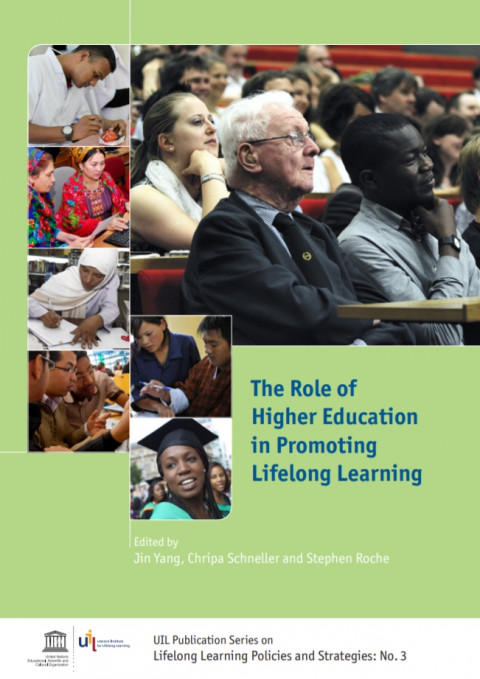 The Role of Higher Education in Promoting Lifelong Learning Año de publicación: 2015 Autor: Yang Jin, Schneller.Chripa, Roche.Stephen Autor corporativo: UNESCO Institute for Lifelong Learning (UIL) UNESCO’s vision of lifelong learning encompasses all contexts (formal, non-formal and informal) and ages (‘from cradle to grave’) of learning. The UNESCO Institute for Lifelong Learning and its predecessor, the UNESCO Institute for Education, have promoted policy and practice in this field for more than four decades. The decision to produce this volume was prompted by an observation that lifelong learning – both as a concept and in its many practical manifestations – is becoming a staple of education policy discourse around the globe. At the same time, we noted that understandings of lifelong learning differ widely, not only between countries, but also across the sub-sectors of education systems.This book, which emerged from a seminar held in 2012 to mark the 60th anniversary of the UNESCO Institute for Lifelong Learning, addresses various ways that higher education can promote lifelong learning, paying due consideration to regional disparities and specificities. These include responses to the learning needs of senior citizens in China, the challenge of implementing recurrent education in Japan, European efforts to develop a common approach to life-long learning at university, and how a lifelong learning approach is put into practice in higher education in Australia. It is hoped that this book will help the reader gain a better understanding of the theoretical frameworks and practical implementation of lifelong learning in higher education, both within their own region and globally.
  CONFINTEA VI Mid-Term Review 2017: The Status of Adult Learning and Education in Sub-Saharan Africa; Regional Report Año de publicación: 2017 Autor: John Aitchison Autor corporativo: UNESCO Institute for Lifelong Learning (UIL) The Sustainable Development Goals include educational targets which are entirely congruent with the existing focuses of ALE in African countries – to ‘ensure that all youth and a substantial proportion of adults, both men and women, achieve literacy and numeracy’ (4.6), to ‘substantially increase the number of youth and adults who have relevant skills, including technical and vocational skills, for employment, decent jobs and entrepreneurship’ (4.4) and to ‘ensure that all learners acquire the knowledge and skills needed to promote sustainable development, including, among others, through education for sustainable development and sustainable lifestyles, human rights, gender equality, promotion of a culture of peace and non-violence, global citizenship and appreciation of cultural diversity and of culture’s contribution to sustainable development’ (4.7). National targets and the criteria for success in reaching those targets will need to be developed. Undoubtedly, international cooperation and international support can help this gearing-up process.
  Suwon-Osan CONFINTEA VI Mid-Term Review Statement: The Power of Adult Learning and Education; A Vision Towards 2030 Año de publicación: 2018 Autor corporativo: UNESCO Institute for Lifelong Learning (UIL) The Sixth International Conference on Adult Education (CONFINTEA VI), held in Brazil in December 2009, closed with the adoption of the Belém Framework for Action, which recorded the commitments of Member States and presented a strategic guide for the global development of adult learning and education from a lifelong learning perspective. The third Global Report on Adult Learning and Education (GRALE III), published in 2016, drew on survey data to evaluate progress made by countries in fulfilling the commitments made in Brazil, while also highlighting some of the contributions adult learning and education can make to the 2030 Agenda for Sustainable Development. The CONFINTEA VI Mid-Term Review, held in Suwon, Republic of Korea, in October 2017, took stock of progress made by Member States in the past eight years, looking ahead to GRALE IV in 2019. This statement represents the overall perspective of delegates and their recommendations for the future. Bilan à mi-parcours de la CONFINTEA VI : Déclaration de Suwon-Osan - Le pouvoir de l'apprentissage et de l'éducation des adultes: Vision 2030 Año de publicación: 2018 Autor corporativo: UNESCO Institute for Lifelong Learning (UIL) La sixième Conférence internationale sur l'éducation des adultes (CONFINTEA VI) qui a eu lieu en décembre 2009 au Brésil, s’est achevée sur l’adoption du Cadre d'action de Belém qui a permis de rassembler les engagements des États membres et de présenter un guide stratégique pour le développement mondial de l’apprentissage et de l’éducation des adultes du point de vue de l’apprentissage tout au long de la vie. Le troisième Rapport mondial sur l'apprentissage et l'éducation des adultes (GRALE III), publié en 2016, s’est appuyé sur les données d'une enquête afin d’évaluer les progrès accomplis par les pays pour tenir leurs engagements pris au Brésil, tout en soulignant certaines des contributions que l’apprentissage et l’éducation des adultes peuvent apporter au Programme de développement durable à l'horizon 2030. Le Bilan à mi-parcours de la CONFINTEA VI qui s’est tenu en octobre 2017 à Suwon en République de Corée a fait l'inventaire des progrès réalisés par les États membres au cours des huit dernières années en vue du GRALE IV de 2019. La présente déclaration exprime les perspectives des délégués au niveau mondial et fait état de leurs recommandations pour l’avenir. Declaración de Suwon-Osan sobre la Revisión a Medio Término de la CONFINTEA VI: el poder del aprendizaje y la educación de adultos: una visión hacia el 2030 Año de publicación: 2018 Autor corporativo: UNESCO Institute for Lifelong Learning (UIL) La VI Conferencia Internacional de Educación de Adultos (CONFINTEA VI), celebrada en Belém (Brasil), en diciembre de 2009, se clausuró con la aprobación del Marco de acción de Belém que registró los compromisos de los Estados Miembros y presentó una guía estratégica para el desarrollo mundial del aprendizaje y la educación de adultos desde una perspectiva de aprendizaje a lo largo de toda la vida. El tercer Informe mundial sobre el aprendizaje y la educación de adultos (GRALE III), publicado en 2016, se basó en los datos de una encuesta destinada a evaluar el progreso realizado por los países en el cumplimiento de los compromisos formulados en Brasil, al mismo tiempo que hacía hincapié en algunas de las contribuciones que puede hacer el aprendizaje y la educación de adultos a la Agenda 2030 para el Desarrollo Sostenible. La Revisión a Medio Término de la CONFINTEA VI, realizada en Suwon (República de Corea) en octubre de 2017, hizo un balance del progreso realizado por los Estados Miembros en los últimos ocho años, mirando en la perspectiva del GRALE IV para 2019. Este pronunciamiento representa el punto de vista global de los delegados y sus recomendaciones para el futuro. 유네스코 제6차 세계성인교육회의 중간회의 수원-오산 선언문: 성인학습 교육(ALE)의 힘; 2030년을 향한 비전 Año de publicación: 2018 Autor corporativo: UNESCO Institute for Lifelong Learning (UIL) 2009년 12월 브라질 벨렘에서 개최된 제6차 세계성인교육회의(CONFINTEA VI)에서 벨렘 실행계획(Belém Framework for Action)이 채택되었다. 벨렘 실행계획은 회원국의 성인학습과 교육에 대한 공약을 기록하고, 평생학습 관점에서 성인학습과 교육의 세계적 발전을 위한 전략적 지침을 제시하였다. 2016년 발간된 유네스코의 제3차 성인학습과 교육(ALE)에 관한 글로벌 보고서(GRALE III)에서는 설문조사를 통해 수집된 데이터를 기반으로 2009년 제6차 회의 당시 회원국이 제시한 공약의 이행 현황을 평가하는 한편, 2030 지속가능발전의제(2030 Agenda for Sustainable Development) 이행에 있어 성인학습과 교육이 기여할 수 있는 부분을 강조하였다. 2017년 10월 대한민국 수원시에서 개최된 제6차 세계성인교육회의 중간회의(CONFINTEA VI Mid-Term Review)에서 회원국들은 지난 8년 동안 이행된 활동 현황을 검토하고, 2019년 발간 예정인 제4차 성인학습과 교육(ALE)에 관한 글로벌 보고서(GRALE IV)를 준비하였다. 이 선언문은 성인학습과 교육에 대한 각국 대표의 전반적 관점과 그들이 제시하는 미래에 대한 권고안이다.