
Recursos
Exploren una amplia gama de recursos valiosos en GCED para profundizar su comprensión y promover su búsqueda, incidencia, enseñanza y aprendizaje.
3,451 resultados encontrados
 Perception on Global Citizenship Education Competence between Pre-service Teachers and In-service Teachers in Kindergarten (Global Creative Leader: Education & Learning; Vol. 9, No. 4) Año de publicación: 2019 Autor: Hyojeong Lee | Kabsoon Kim Autor corporativo: Soongsil University. Research Institute for Gifted & Talented Education The purpose of this study was to establish the direction of teacher education based on global citizenship education competence studying the perception of pre-service teachers and in-service teachers on global citizenship education competence. The 2018 survey was conducted for a week beginning September 11. The respondents who were 200 pre-service teachers and 200 in-service teachers were selected from Seoul and Incheon. The researcher distributed and collected the questionnaire directly. The results of the study were as follows. First, pre-service teachers showed higher cognition than in-service teacher in both global citizenship competence and early childhood global citizenship competence. Second, among pre-service teachers, ones who had experienced global citizenship education showed higher cognition level in both categories than others. On the other hand, in-service teachers who had experienced global citizenship education did not show any difference of cognition in both global citizenship competence and early childhood global citizenship competence. This study was expected to reveal the perceptions of pre-service teachers and when training teachers, the data provided more specific details for early childhood educator curriculums about global citizenship education.
  Africa SDG Index and Dashboards Report 2020: Leave No One Behind to Achieve the SDGs in Africa Año de publicación: 2020 Autor: Ambrose Rwaheru Aheisibwe | Eve de la Mothe Karoubi | Olive Dushime | Grayson Fuller | Enock Nyorekwa Twinoburyo | Abigail Simkoko | Belay Begashaw | Guido Schmidt-Traub Autor corporativo: Sustainable Development Goals Center for Africa | Sustainable Development Solutions Network (SDSN) | Mo Ibrahim Foundation The 2020 Africa SDG Index and Dashboards Report provides an assessment of where African countries stand with respect to the SDGs and their progress toward the goals, with the additional lens of “leave no one behind.” The report also includes a preliminary analysis of the impact of COVID‑19 on the SDGs in Africa.
  미래의 위험에 대처하기 위한 인문사회적 상상력의 필요성: 코로나 판데믹과 미래 문해력을 중심으로 (Future Horizon Plus 제45권 제2호) Año de publicación: 2020 Autor: 최항섭 Autor corporativo: 과학기술정책연구원 미래문해력은 자신이 현재의 생존문제를 해결하는 것 때문에 전체 사회의 생존에 있어 미래의 변화에 대한 필요성을 잘 인식하지 못하는 개인 혹은 조직에게 필요한 역량이다.또한 미래문해력은 조직 구성원들로부터 얻는 현재의 인기와 명성보다는 전체 사회가 미래에 지속가능한 발전을 이룩할 수 있도록 하는 정책과 전략을 제시해야 하는 국가리더들에게도 가치가 있다. 국민들이 당장은 불편함을 호소해도 이러한 방법이 미래의 지속성을 위해서 필요하다고 믿게 하는 능력이 요구되기 때문이다.인문사회적 상상력은 미래에 대해서도 단순히 ‘밝은 미래-어두운 미래’라는 이분법으로 문제에 접근하는 것을 극복하게 한다. 인간과 자연의 공존, 개인과 공동체의 상생이라는 가치를 중심으로 하는 인문사회적 상상력은 나의 행위가 어떻게 타인의 행위로 이어지며, 이것이 전체 공동체의 미래에 어떠한 영향을 주어 결국 나의 삶에 어떠한 영향을 줄 것이라는 것을 그리게 해준다.
  Accelerating Education for the SDGs in Universities: A Guide for Universities, Colleges, and Tertiary and Higher Education Institutions Año de publicación: 2020 Autor corporativo: Sustainable Development Solutions Network (SDSN) The aim of this guide is to help accelerate the institutional process of mainstreaming ESDGs in universities, by helping stakeholders within and outside universities understand why they should pursue this goal, and how. It aims to expand, update and refine the information provided in the previous guide based on new resources, tools, thinking, and learnings from universities working to implement ESDGs, to consider what ESDGs mean for universities. The guide touches on the pedagogical aspects of ESDGs, in terms of how they affect institutional approaches to ESDGs, but does not attempt to provide a comprehensive review of them. The Guide outlines the case for mainstreaming education for the SDGs at universities, what this does and could look like in practice, and the processes and activities universities can take to support implementation. It also provides practical guidance, resources, and case studies to inspire universities to take action and deepen their practice.
  Education for Social Change: The Global Learning Programme in the North of Ireland (Policy and Practice: A Development Education Review; Vol. 23, Autumn) Año de publicación: 2016 Autor: Stephen McCloskey Autor corporativo: Centre for Global Education (CGE) The Global Learning Programme (GLP) is a four-year initiative funded by the UK government that aims ‘to support schools to teach about global poverty and international development, with a particular focus on upper primary and early secondary school’ (DfID, 2013). The overarching outcome for the project in Northern Ireland is ‘increased and improved delivery of development education in 50% of grant aided primary, secondary and special schools’. It seeks ‘to embed development education and global citizenship as regular practice across curriculum subjects and through whole school initiatives’. The GLP in the north of Ireland is managed by the Centre for Global Education and this article outlines the programme of support provided to schools including Continuing Professional Development (CPD), twilight training, senior leadership seminars and a designated website. The article will also describe the mixed methods approach used to evaluate the impact of the GLP on schools and, in particular, its effectiveness in implementing global learning in the classroom. The article will summarise research findings to date and what they reveal about how teachers have perceived the value of the support provided. The article will conclude by considering the positive impact of the GLP on the wider global education non-governmental sector in Northern Ireland.
  Opening Eyes and Minds: Inspiring, Educating and Engaging Third Level Students in Global Education (Policy and Practice: A Development Education Review; Vol. 19, Autumn) Año de publicación: 2014 Autor: Joanne Malone | Gráinne Carley | Meliosa Bracken Autor corporativo: Centre for Global Education (CGE) Suas has worked since its inception to engage Irish third level students in global citizenship education. This article focuses on the Suas Global Citizenship Programme, setting out the purpose and context of the programme, its innovative design and educational approach and its comprehensive monitoring and evaluation framework. The article presents an analysis of key findings from Suas’ evaluation process and a summary of our learning to date on the challenges of supporting third level students in reflecting, learning and acting on global justice issues.
 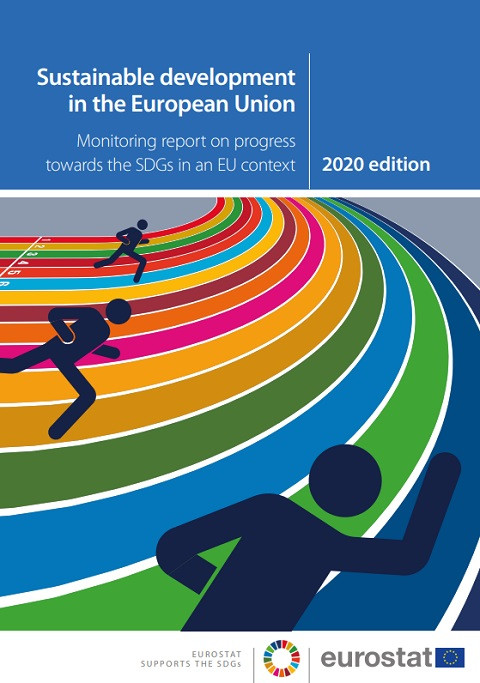 Sustainable Development in the European Union: Monitoring Report on Progress Towards the SDGs in an EU Context (2020) Año de publicación: 2020 Autor corporativo: European Union (EU) Sustainable development is firmly anchored in the European Treaties and has been at the heart of European policy for a long time. The 2030 Agenda for Sustainable Development and its 17 Sustainable Development Goals (SDGs), adopted by the UN General Assembly in September 2015, have given a new impetus to global efforts for achieving sustainable development. The EU is fully committed to playing an active role to maximise progress towards the Sustainable Development Goals. This publication is the fourth of Eurostat’s regular reports monitoring progress towards the SDGs in an EU context. The analysis in this publication builds on the EU SDG indicator set, developed in cooperation with a large number of stakeholders. The indicator set comprises around 100 indicators and is structured along the 17 SDGs. For each SDG, it focuses on aspects which are relevant from an EU perspective. The monitoring report provides a statistical presentation of trends relating to the SDGs in the EU over the past five years (‘short-term’) and, when sufficient data are available, over the past 15 years (‘long-term’). The indicator trends are described on the basis of a set of specific quantitative rules.
  Implementing Pedagogical Approaches for ESD in Initial Teacher Training at Spanish Universities (Sustainability 2019; Vol. 11, No. 18) Año de publicación: 2019 Autor: Sílvia Albareda-Tiana | Esther García-González | Rocío Jiménez-Fontana | Carmen Solís-Espallargas Autor corporativo: Multidisciplinary Digital Publishing Institute (MDPI) Within the framework of the United Nations 2030 Agenda for Sustainable Development, four case studies of the degree in Primary Education at three Spanish universities are analyzed. The aim is to study the suitability of three different active teaching-learning strategies: problem-based learning (PBL), project-oriented learning (POL), and a cross-disciplinary workshop. Another goal is to promote the integration of education for sustainable development (ESD) and measure the level of acquisition of several competencies of sustainability and the change in consumption habits of future teachers after implementing those pedagogical approaches. Initial and final ecological footprint (EF) as well as a rubric to measure the level of acquisition of competencies of sustainability were used as data collection instruments. The conclusions related to the research objectives show that when sustainability is implemented in the curriculum through active teaching-learning strategies, future teachers acquire competencies of sustainability. They also reveal that said strategies contribute to a change in consumption habits as a reduction in the EF is observed. There exists a relation between EF reduction and high levels of acquisition of competency in sustainability.
 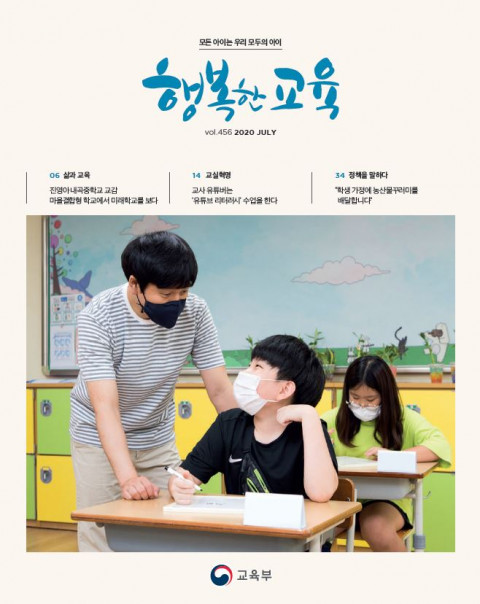 행복한 교육 2020년 7월호 (제456호) Año de publicación: 2020 Autor corporativo: 대한민국 교육부 특별기획 미래_지능정보사회를 이끌 인재 양성 청사진교육부는 최근 ‘과학·수학·정보·융합교육 종합계획(5개년)’을 발표하며 향후 5년간의 미래 인재 양성에 대한 청사진을 제시했다. 교과 간의 긴밀한 연결과 융합을 바탕으로 정책이 수립되어 시너지 효과가 기대된다. 이번 발표에 따르면, 인공지능(AI), 가상·증강현실(VR·AR) 등 최첨단 에듀테크 기술이 교육 현장에 적극적으로 도입되는데, 대표적으로 최첨단 기술을 적용한 지능형 과학실을 2024년까지 모든 학교에 구축하여 학생들이 첨단 과학을 직접 체험하고 학습할 수 있도록 한다는 계획이다. 교육부의 과학·수학·정보·융합교육 청사진을 살펴본다.정책을 말하다_“학생 가정에 농산물꾸러미를 배달합니다”학교급식의 중단으로 학부모와 농가, 급식업체의 부담이 증가함에 따라 교육부와 농림축산식품부는 시도교육청·지자체와 협력하여 ‘학생 가정 농산물꾸러미 지원사업’을 추진하고 있다. 꾸러미사업에 서울, 대구, 인천, 광주, 대전, 세종, 경기, 강원, 충북, 충남, 전북, 전남, 경북, 경남과 부산 기장군에서 참여하며 499만여 명의 학생 가정에 3만 7천 톤의 농산물을 공급하였다. 일부 지역(울산, 부산, 제주, 세종)에서는 학생 가정 내 경제적 부담을 줄여주고자 잔여 급식예산을 교육재난지원금 등의 형태로 지급하고 있다.
 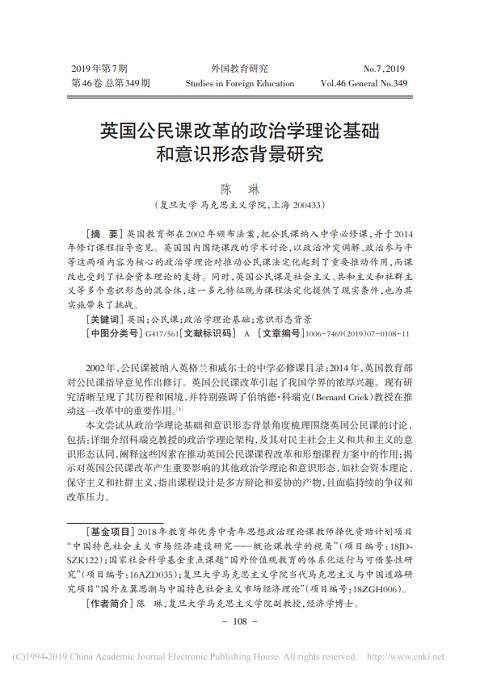 英国公民课改革的政治学理论基础 和意识形态背景研究 (外国教育研究; Vol. 46, No. 7) Año de publicación: 2019 Autor: Chen Lin Autor corporativo: Northeast Normal University 英国教育部在2002年颁布法案,把公民课纳入中学必修课,并于2014年修订课程指导意见。英国国内围绕课改的学术讨论,以政治冲突调解、政治参与平等这两项内容为核心的政治学理论对推动公民课法定化起到了重要推动作用,而课改也受到了社会资本理论的支持。同时,英国公民课是社会主义、共和主义和社群主义等多个意识形态的混合体,这一多元特征既为课程法定化提供了现实条件,也为其实施带来了挑战。