
Recursos
Exploren una amplia gama de recursos valiosos en GCED para profundizar su comprensión y promover su búsqueda, incidencia, enseñanza y aprendizaje.
3,441 resultados encontrados
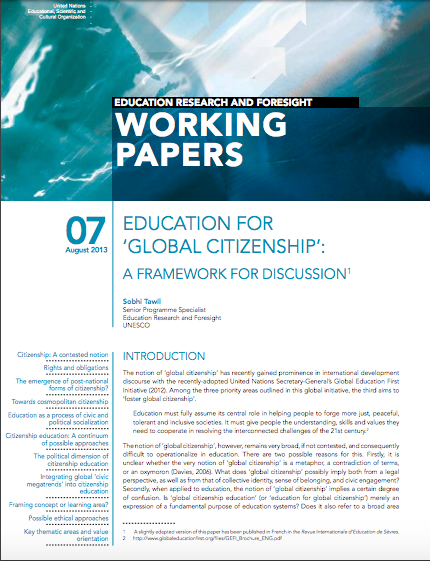 Education for 'Global Citizenship': A Framework for Discussion Año de publicación: 2013 Autor: Sobhi Tawil Autor corporativo: UNESCO The notion of ‘global citizenship’ has recently gained prominence in international development discourse with the recently-adopted United Nations Secretary-General’s Global Education First Initiative (2012). Among the three priority areas outlined in this global initiative, the third aims to ‘foster global citizenship’.The notion of ‘global citizenship’, however, remains very broad, if not contested, and consequently difficult to operationalize in education. There are two possible reasons for this. Firstly, it is unclear whether the very notion of ‘global citizenship’ is a metaphor, a contradiction of terms, or an oxymoron (Davies, 2006). Secondly, when applied to education, the notion of ‘global citizenship’ implies a certain degree of confusion. This paper discusses the following questions. What does ‘global citizenship’ possibly imply both from a legal perspective, as well as from that of collective identity, sense of belonging, and civic engagement? Is ‘global citizenship education’ (or ‘education for global citizenship’) merely an expression of a fundamental purpose of education systems? Does it also refer to a broad area of teaching and learning? If so, what are the contours of this domain? How does it relate to other often overlapping areas of learning associated with civic and political socialization?
 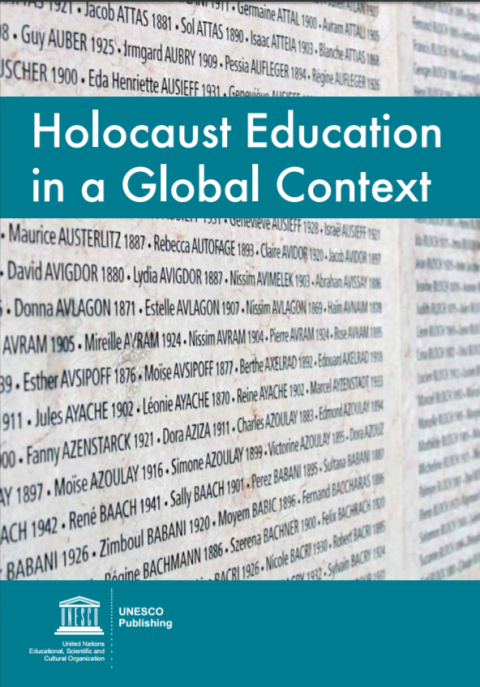 Holocaust Education in a Global Context Año de publicación: 2014 Autor: Karel Fracapane | Matthias Haß Autor corporativo: UNESCO | Topography of Terror Foundation (Germany) International interest in Holocaust education has reached new heights in recent years. This historic event has long been central to cultures of remembrance in those countries where the genocide of the Jewish people occurred. But other parts of the world have now begun to recognize the history of the Holocaust as an effective means to teach about mass violence and to promote human rights and civic duty, testifying to the emergence of this pivotal historical event as a universal frame of reference. In this new, globalized context, how is the Holocaust represented and taught? How do teachers handle this excessively complex and emotionally loaded subject in fast-changing multicultural European societies still haunted by the crimes perpetrated by the Nazis and their collaborators? Why and how is it taught in other areas of the world that have only little if any connection with the history of the Jewish people? Holocaust Education in a Global Context will explore these questions.
 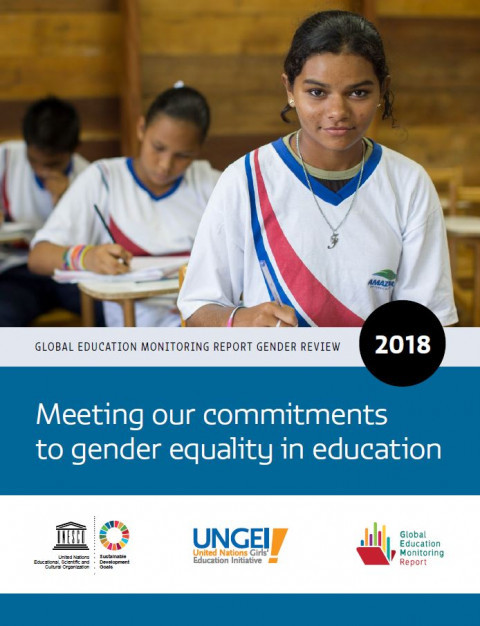 Meeting Our Commitments to Gender Equality in Education: Global Education Monitoring Report Gender Review 2018 Año de publicación: 2018 Autor corporativo: UNESCO The Education 2030 Framework for Action, a tool aimed at helping the international community achieve SDG 4 on education, explicitly recognizes gender equality as a guiding principle linked to the realization of the right to education. It states clearly that girls and boys, women and men, must be equally empowered ‘in and through education’.In this sixth Gender Review, in a series that began in 2011, the Global Education Monitoring Report team maintains the focus on a broad conception of gender equality that extends beyond counting boys and girls in classrooms. The review’s first part examines disparities in participation and skills, in education and political leadership positions, and in selected aspects of infrastructure and curricula. It also examines gender issues in professional development by exploring the role of education in three other SDGs: those concerning agriculture, health, and water and sanitation.The second part of the review analyses institutions, laws and policies to explore ways to determine and enforce accountability for gender equality in education. Tenir nos engagements en faveur de l'égalité des genres dans l'éducation: Rapport mondial de suivi sur l'éducation, résumé sur l'égalité des genres 2018 Año de publicación: 2018 Autor corporativo: Organisation des Nations Unies pour l'éducation, la science et la culture (UNESCO) Le Cadre d’action Éducation 2030, outil qui vise à aider la communauté internationale à atteindre l’ODD 4 sur l’éducation, reconnaît explicitement l’égalité des genres comme principe directeur lié à la réalisation du droit à l’éducation. Il stipule clairement que les filles et les garçons, les femmes et les hommes, doivent bénéficier des mêmes possibilités « dans et par l’éducation ».Dans ce sixième résumé sur l’égalité des genres, qui fait partie d’une série qui a commencé en 2011, l’équipe du Rapport mondial de suivi sur l’éducation reste concentrée sur une large conception de l’égalité des genres, qui va au-delà du simple comptage du nombre de filles et de garçons dans les classes. La première partie du résumé examine les disparités en matière de participation et de compétences, aux postes à responsabilité des secteurs éducatif et politique et dans certains aspects des infrastructures et des programmes scolaires. Elle examine également les questions liées au genre dans le cadre de la formation professionnelle, en explorant le rôle de l’éducation dans trois autres ODD concernant l’agriculture, la santé, et l’eau et l’assainissement.La deuxième partie du résumé analyse les institutions, les lois et les politiques afin d’explorer des manières de déterminer et de faire appliquer le principe de responsabilité pour l’égalité des genres dans l’éducation. Cumplir nuestros compromisos de igualdad de género en la educación: Resumen sobre género del informe de seguimiento de la educación en el mundo 2018 Año de publicación: 2018 Autor corporativo: Organización de las Naciones Unidas para la Educación, la Ciencia y la Cultura (UNESCO) El Marco de Acción para la Educación 2030, que es una herramienta encaminada a contribuir a que la comunidad internacional alcance el ODS 4 relativo a la educación, reconoce explícitamente la igualdad de género como un principio rector para la realización del derecho a la educación para todos. Dice claramente que las niñas y los niños, las mujeres y los hombres, deben adquirir las mismas competencias “en la educación y mediante ella”.En este sexto Resumen sobre Género de una serie que se inició en 2011, los autores del Informe de Seguimiento de la Educación en el Mundo siguen centrándose en un concepto amplio de la igualdad de género que va más allá del simple recuento del número de niños y niñas en las aulas.En la primera parte del documento se examinan las disparidades en materia de participación y de competencias, de puestos de dirección de alto nivel en el ámbito educativo y político, y en determinados aspectos de las infraestructuras y los programas de enseñanza. Se examinan asimismo las cuestiones de género en el desarrollo profesional, estudiando el papel de la educación en otros tres ODS, los relativos a la agricultura, la salud, y el agua y saneamiento.En la segunda parte se analizan las instituciones, leyes y políticas, con miras a explorar modalidades que permitan determinar y aplicar la rendición de cuentas en materia de igualdad de género en la educación.
 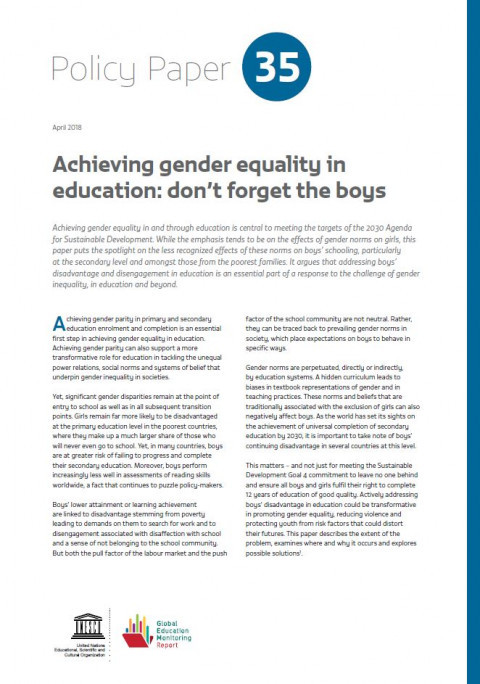 Achieving Gender Equality in Education: Don't Forget the Boys (Policy Paper 35) Año de publicación: 2018 Autor corporativo: UNESCO Achieving gender equality in and through education is central to meeting the targets of the 2030 Agenda for Sustainable Development. While the emphasis tends to be on the effects of gender norms on girls, this paper puts the spotlight on the less recognized effects of these norms on boys’ schooling, particularly at the secondary level and amongst those from the poorest families. It argues that addressing boys’ disadvantage and disengagement in education is an essential part of a response to the challenge of gender inequality, in education and beyond.
 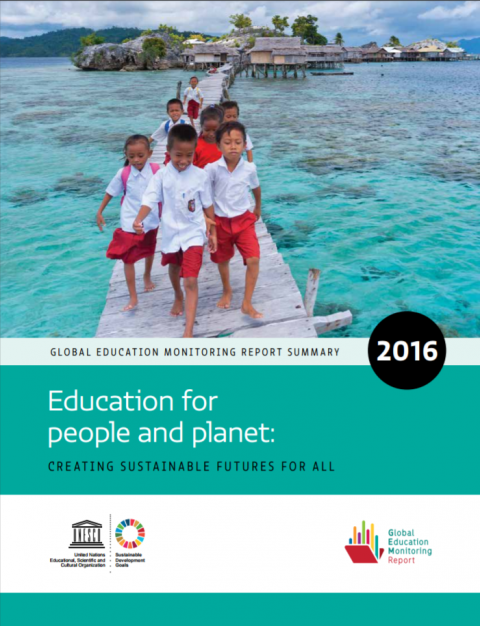 教育造福 人类与地球:为全民创造可持续的未来, 2016 全球教育监测报告; 摘要 Año de publicación: 2016 Autor corporativo: UNESCO The GEM Report provides an authoritative account of how education is the most vital input for every dimension of sustainable development. Better education leads to greater prosperity, improved agriculture, better health outcomes, less violence, more gender equality, higher social capital and an improved natural environment. Education is key to helping people around the world understand why sustainable development is such a vital concept for our common future. Education gives us the key tools – economic, social, technological, even ethical – to take on the SDGs and to achieve them. These facts are spelled out in exquisite and unusual detail throughout the report. Yet the report also emphasizes the remarkable gaps between where the world stands today on education and where it has promised to arrive as of 2030. التعليم من أجل الناس والكوكب: بناء مستقبل مستدام للجميع Año de publicación: 2016 Autor corporativo: UNESCO The GEM Report provides an authoritative account of how education is the most vital input for every dimension of sustainable development. Better education leads to greater prosperity, improved agriculture, better health outcomes, less violence, more gender equality, higher social capital and an improved natural environment. Education is key to helping people around the world understand why sustainable development is such a vital concept for our common future. Education gives us the key tools – economic, social, technological, even ethical – to take on the SDGs and to achieve them. These facts are spelled out in exquisite and unusual detail throughout the report. Yet the report also emphasizes the remarkable gaps between where the world stands today on education and where it has promised to arrive as of 2030.
 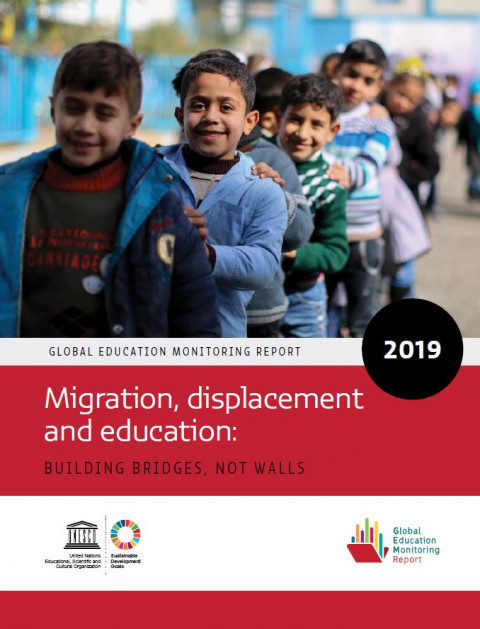 Rapport mondial de suivi sur l'éducation 2019: Migration, déplacement et éducation: bâtir des ponts, pas des murs Año de publicación: 2018 Autor corporativo: UNESCO | Global Education Monitoring Report Team Le Rapport mondial de suivi sur l’éducation 2019 examine l’incidence des migrations et des déplacements sur l’éducation à travers tous les mouvements de population : à l’intérieur et à l’extérieur des frontières, volontaires ou forcés, motivés par l’emploi ou par les études. Le Rapport fait également le point sur les progrès accomplis dans le domaine de l’éducation dans le cadre du Programme de développement durable à l’horizon 2030.Deux nouveaux pactes mondiaux sur les migrants et les réfugiés reconnaissent le rôle de l’éducation et fixent des objectifs conformes à l’engagement pris par la communauté internationale pour que personne ne soit laissé pour compte. Ce Rapport, guide pratique indispensable au service de ces deux pactes, aborde des questions d’ordre politique concernant les migrants saisonniers, le regroupement des écoles rurales, les programmes interculturels, l’intégration des réfugiés aux systèmes éducatifs nationaux, la lutte contre la ségrégation, la reconnaissance des qualifications, le financement ciblé des écoles, le renforcement de l’efficacité de l’aide humanitaire allouée à l’éducation et une formation qui prépare les enseignants à la diversité dans les classes.Ce Rapport invite les pays à considérer l’éducation comme un outil de gestion des migrations et des déplacements et comme une chance pour ceux qui en ont besoin. Informe de seguimiento de la educación en el mundo, 2019: Migración, desplazamientos y educación: construyendo puentes, no muros Año de publicación: 2018 Autor corporativo: UNESCO | Global Education Monitoring Report Team La edición 2019 del Informe de Seguimiento de la Educación en el Mundo examina la incidencia de la migración y los desplazamientos en la educación considerando todos los movimientos de población: dentro y fuera de las fronteras, voluntarios y forzados, con fifines de empleo y de educación. Examina asimismo los progresos realizados con miras a la consecución del objetivo de educación de la Agenda 2030 para el Desarrollo Sostenible.Dos nuevos pactos mundiales sobre los migrantes y refugiados reconocen el papel de la educación y establecen objetivos acordes con el compromiso mundial de no dejar a nadie atrás. Este informe es un conjunto de herramientas vital para la aplicación de estos pactos. Aborda temas de política que abarcan los migrantes estacionales, la concentración de las escuelas rurales, los planes de estudio interculturales, la inclusión de los refugiados en los sistemas educativos nacionales y la lucha contra la segregación, el reconocimiento de las cualifificaciones, la orientación de la fifinanciación escolar a destinos específificos, una ayuda humanitaria más efificaz dedicada a la educación, y la preparación de los docentes para hacer frente a un alumnado de gran diversidad.Este informe exhorta a los países a considerar la educación como una herramienta para gestionar la migración y los desplazamientos y una oportunidad para quienes la necesitan.