
Recursos
Exploren una amplia gama de recursos valiosos en GCED para profundizar su comprensión y promover su búsqueda, incidencia, enseñanza y aprendizaje.
684 resultados encontrados
 포스트 코로나 시대, 성인문해교육과 디지털 리터러시 Año de publicación: 2020 Autor: 길혜지 Autor corporativo: 국가평생교육진흥원 본 연구에서는 코로나 19로 가속화된 디지털 전환기 및 디지털 격차 문제를 인식하면서 문해의 새로운 영역인 디지털 리터러시의 개념 및 프레임워크를 살펴본다. 또한 디지털 정보격차의 실태와 성인문해교육의 맥락에서 디지털 리터러시 관련 교육에 대한 정부지원 현황을 알아본다. 본 연구의 결론에서는 학습자의 디지털 리터러시 교육 요구에 대한 실증 자료에 기반하여 국가수준에서 디지털 리터러시 교육 표준을 마련하고, 커리큘럼 및 교재를 개발하여 보급함으로써, 다양한 교육기관에서 유사 교육과정을 운영하거나 교사 및 강사 중심으로 교육 프로그램을 운영해 온 한계를 개선하는 데 도움이 될 수 있다고 기대한다.
  The Role of Media Literacy in the Promotion Of Common Values and Social Inclusion: Position Paper Año de publicación: 2017 Autor corporativo: All Digital While we live in an increasingly digital society, a significant number of European citizens continue to lack basic digital skills. Media practices have changed, and now we are not only receiving information passively. Anyone can be active in content creation and (re-)produce (dis)information. For example, mobile technology and ubiquitous Internet access allow citizens to produce real time information, including content for mass media (newspapers, TV channels).The production of information and news thus no longer remains in the capacity of journalists, but something within everyone’s capacity. Without the necessary skills, however, the creation of information and news is not always done in a responsible or professional manner. This is only one example of many, highlighting why media literacy is more important than ever.This position paper talks about:the role for media literacy in promoting common values and social inclusion in several ways: resilience, content creation, dissemination, social inclusionthe role of non-formal education in teaching media literacy andgives examples of media literacy programmes and projects across Europeprovides policy recommendations in terms of funding, recognition and promotion.
  C'est quoi une information? Año de publicación: 2015 Autor: Olivier Marquézi | Mathieu Decarli Autor corporativo: Radio France | Réseau Canopé | France Télévisions | La Generale de Production Un film d’animation qui aborde des questions telles que « Qu’est-ce qu’un média », « Qu’est-ce qu’une information », « Qu’est-ce qu’une source ?... ». Autant de sujets pour amener les élèves à une pratique raisonnée autour des écrans, de l’information, du métier de journaliste.
  Explained: What is False Information? Año de publicación: 2020 Autor corporativo: Dublin West Education Centre (DWEC) With so much information at our fingertips it can be easy to come across something online that isn’t quite as accurate or reliable as it should be. This kind of information is often called Fake News but a better description might be false information because it affects more than news stories. This animation, explaining false information, supports the education resource Connected - an introduction to digital media literacy.
 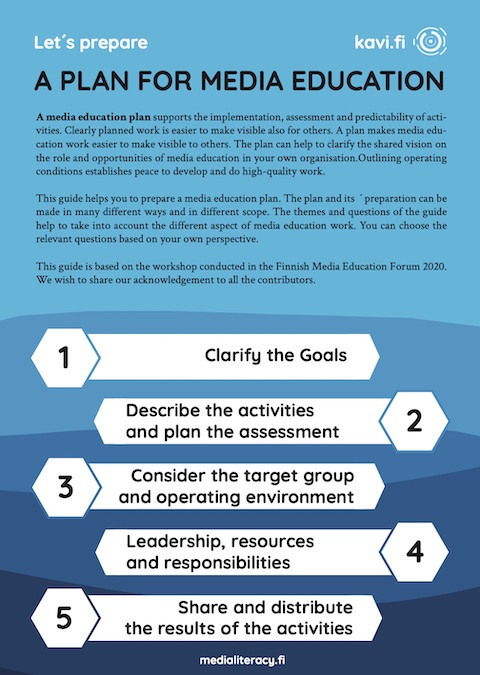 Let's Prepare: A Plan For Media Education Año de publicación: 2020 Autor corporativo: KAVI National Audiovisual Institute (Finland) This guide helps you to prepare a media education plan. The plan and its preparation can be made in many different ways and in different scope. The themes and questions of the guide help to take into account the different aspect of media education work. You can choose the relevant questions based on your own perspective. This guide is based on the workshop conducted in the Finnish Media Education Forum 2020.
  Adult Media Literacy in Australia: Attitudes, Experiences and Needs Año de publicación: 2021 Autor: Tanya Notley | Simon Chambers | Sora Park | Michael Dezuanni Autor corporativo: Western Sydney University | Queensland University of Technology | University of Canberra This report is based on a survey of 3,510 adult Australians to understand the different types of media they use, the value they place on different media activities, their confidence in their own media abilities and their access to media literacy support. The survey was designed with input from diverse voices in the media literacy field including researchers, media producers, policymakers, government agencies, educators and public cultural institutions. The findings show that most Australians use several different types of media each day, they believe a diverse range of media activities are important in their lives, but their confidence in their own media abilities is unexpectedly low. The findings demonstrate that if we accept that media is integral to all aspects of our lives, far more needs to be done to address the needs of groups who are the least confident about their media abilities and who have access to the least support. The findings also show that increasing media literacy can yield direct benefits for increasing people’s civic engagement.
 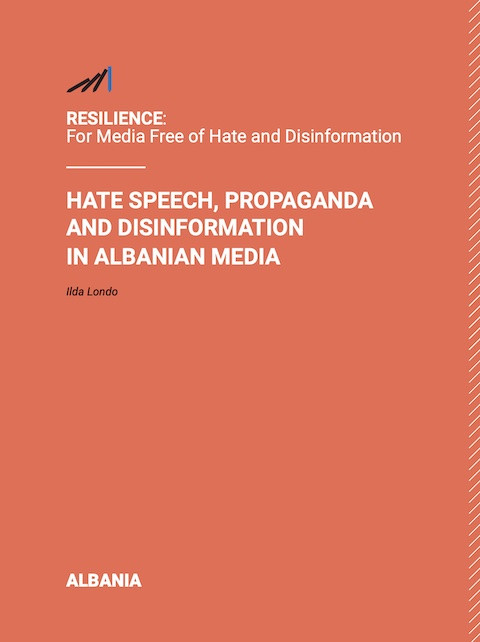 Hate Speech, Propaganda and Disinformation in Albanian Media Año de publicación: 2020 Autor: Ilda Londo Autor corporativo: South East European Network for Professionalization of Media (SEENPM) | Peace Institute | Albanian Media Institute This publication aims to highlight the main models and elements that media in Albania manifest regarding hate speech, propaganda and disinformation and also to identify ways of countering these narratives. According to this research, even though the media is rarely active in fighting hate speech in the country, it cannot be said that it is a source of hate speech or that it is actively promoting it. Politicians often push hate speech narratives, which the media publishes or reflects, provoking protest from some human rights organizations. On the other hand, there is a visible problem with ethics and lack of moderation in User Generated Content, more specifically in users’ comments sections of online media.In addition, contrary to hate speech narratives, which are rarely present, attempts to misinform and spread propaganda are a constant trend in the Albanian media. While the furthering of foreign propaganda is confined to a limited number of media, the use of conspiracy theories and sensationalism to further media popularity, unfortunately, is not. Few online media outlets have escaped the trend of publishing conspiracy theories, which turned into a frenzy especially with the emergence of the coronavirus. Even television stations, which are supposed to have more filters and be more responsible about their content, have intensified this kind of coverage. Proponents of conspiracy theories are readily present in a few television stations in their main current affairs programmes, amplifying these theories and information, which leads to an increasingly greater influence on the public, especially given the lack of programmes or education on media literacy.
 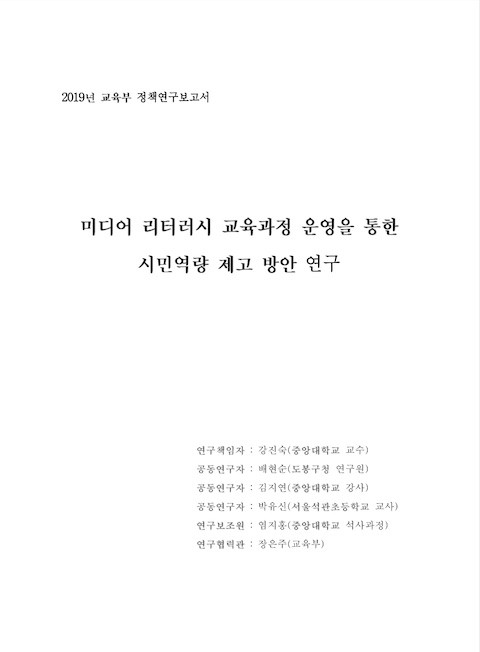 미디어 리터러시 교육과정 운영을 통한 시민역량 제고 방안 연구 (2019년 교육부 정책연구보고서) Año de publicación: 2019 Autor: 강진숙 | 배현순 | 김지연 | 박유신 | 엄지홍 본 연구는 시민역량을 제고할 수 있는 국내 초중등 미디어 리터러시 교육과정의 구성과 실행방안 및 정책방안을 도출하는 데 목적이 있다.
 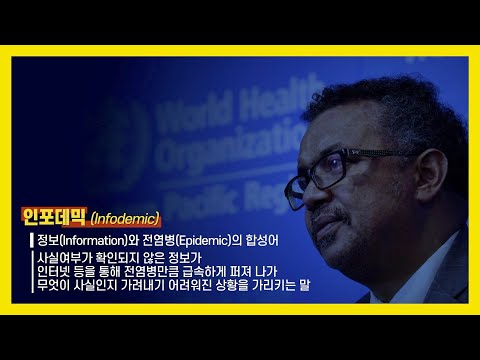 인포데믹을 이기는 미디어 리터러시 Año de publicación: 2020 Autor corporativo: 서울특별시교육청 교육연구정보원 본 영상은 코로나19시대에 우리가 고민해야 할 중요한 이슈인 미디어리터러시를 강조하면서, 팩트체크 사이트 및 가짜뉴스 판별법 10가지 적용하기 등을 통해 비판적 사고력을 길러 인포데믹을 이기는 방법을 소개한다.
 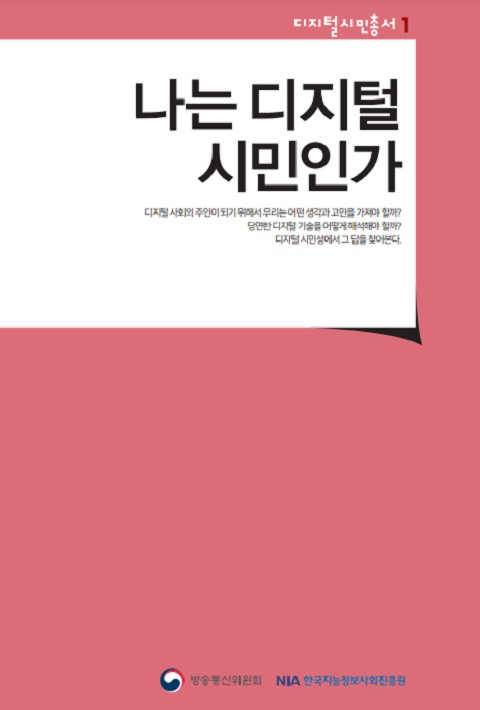 나는 디지털 시민인가 (디지털 시민총서; 1) Año de publicación: 2020 Autor: 김양은 Autor corporativo: 방송통신위원회 | 한국지능정보사회진흥원 본 자료는 디지털 시대가 요구하는 디지털 시민성, 그리고 디지털 시민이 알아야 할 디지털 사회의 다양한 모습을 살펴보도록 구성하였다.