
Recursos
Exploren una amplia gama de recursos valiosos en GCED para profundizar su comprensión y promover su búsqueda, incidencia, enseñanza y aprendizaje.
883 resultados encontrados
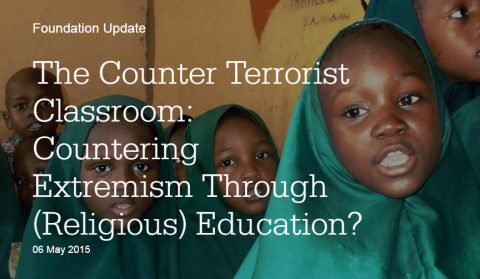 The Counter Terrorist Classroom: Countering Extremism Through (Religious) Education? Año de publicación: 2015 Autor: Liam Gearon The article identifies international cases– from the United States, Europe, and the United Nations– of an emergent interface of religion, education and security. This is manifest in the uses of religion in education to counter religious extremism, the notional “counter terrorist classroom”. To avoid an over-association of extremism with religion, the article provides some historical reminders that the post-Enlightenment centuries were marked by political extremism, particularly in the phenomenon that came to be known as totalitarianism. The Counter Terrorist Classroom: Countering Extremism Through (Religious) Education? Año de publicación: 2015 Autor: Liam Gearon Cet article identifie des cas d’interaction croissante entre les sphères du religieux, de l’éducation et le domaine sécuritaire - aux États-Unis, en Europe, et au sein des Nations Unies. Par exemple, l’intégration du religieux dans l’éducation afin de lutter contre l’extrémisme religieux, la théorique « lutte contre le terrorisme au sein des salles de classe ». Pour éviter une trop forte association entre extrémisme et religion, l’auteur procède à quelques rappels historiques et souligne le fait qu’à la fin du siècle des Lumières et jusqu’à aujourd’hui, les sociétés ont été marquées par diverses formes d’extrémisme politique, comme le montre notamment l’exemple les totalitarismes du XXe siècle.
  Countering Terrorism through Education of Populations: The Case of African Countries Año de publicación: 2011 Autor: Simon M. Lelo Terrorism has become a major concern of current governments. African countries are also involved in counter- terrorism but, due to several internal security and development problems, their effective participation in the combat against terrorism is very limited. They need capacity and skills in order to participate actively in countering terrorism. Education is one of the most appropriate ways for preparing African countries to prevent terrorism. Education provides not only knowledge but also capacity to make informed decisions, strategies and policies. The international community should help African countries to strengthen their education through specialized and general training programmes. Countering Terrorism through Education of Populations: The Case of African Countries Año de publicación: 2011 Autor: Simon M. Lelo Le terrorisme est devenu un enjeu de premier ordre pour les gouvernements actuels. Les pays africains prennent également part à la lutte contre le terrorisme ; cependant, à cause de problèmes de sécurité nationale et de développement, leur participation effective dans le combat contre le terrorisme reste très limitée. Ces pays manquent de moyen pour pouvoir y participer de manière plus active. Ainsi, l'éducation doit être privilégiée afin de soutenir les efforts de prévention dans les pays africains. L’éducation n'apporte pas seulement des connaissances aux apprenants, elle permet également de prendre des décisions, et de mettre en place des stratégies et des mesures de manière informée. La communauté internationale doit aider les pays africains à renforcer leurs systèmes éducatifs à travers divers programmes de formation.
  2016 UN Global Citizenship Education Seminar Año de publicación: 2016 Autor corporativo: United Nations (UN) 2016 UN Global Citizenship Education SeminarSeminar on “Global Citizenship Education: An emerging agenda for peace and preventing violent extremism and promoting sustainable development and human dignity”. This seminar was co-organized by the Permanent Missions of Andorra, Croatia, Jordan and the Republic of Korea; and the Asia-Pacific Centre of Education for International Understanding (APCEIU), the United Nations Educational, Scientific and Cultural Organization/Global Education First Initiative (UNESCO/GEFI), the United Nations Academic Impact (UNAI), the UN-Women, InterPress Service, and the Coalition for Global Citizenship 2030.
  Interrupting Extremism by Creating Educative Turbulence Año de publicación: 2014 Autor: Lynn Davies Autor corporativo: Curriculum Inquiry This article begins from the premise that it is important to explore how people unlearn, as well as learn, specifically in terms of extremist or violent attitudes. Three different country examples are given of intergroup encounters that interrupt rigidities in attitudes: working across ethnic groups in Sri Lanka, tackling religious divides in Northern Ireland through shared classes, and initiatives to prevent violent extremism in the United Kingdom. Pedagogical implications of unlearning involve working with the four Ds of deradicalization, debiasing, disengagement and desistence. Interrupting Extremism by Creating Educative Turbulence Año de publicación: 2014 Autor: Lynn Davies Autor corporativo: Curriculum Inquiry Cet article développe l'idée qu'il est important d'analyser les processus de désapprentissage, autant que d'apprentissage, qui conduisent un individu à adopter des attitudes extrémistes ou violentes. Des exemples tirés de trois pays sont mobilisés pour montrer comment des rencontres intergroupes conduisent à infléchir des comportements rigides : le travail entre groupes ethniques au Sri Lanka, la lutte contre les divisions religieuses en Irlande du Nord à l'aide de classes mixtes, et des initiatives visant à prévenir l'extrémisme violent au Royaume-Uni. Les implications pédagogiques d'une approche par le "désapprentissage" nécessitent de mobiliser les quatre "D": déradicalisation, désubjectivation, désengagement et désistance.
  Beyond Bali Education Package Año de publicación: 2012 Autor: Lily Taylor | Saul Karnovsky The Beyond Bali Project funded by Building Community Resilience (BCR) aims to develop and produce an education resource for secondary school students (years 8/9) on the Bali bombings and the Bali Peace Park. The resource is designed to build social resilience to violent extremism by: - providing students with the skills and tools to critically analyze and challenge violent extremism, its causes and consequences - raising awareness and education on the social impacts of violent extremism - encouraging students to think about how societies can resist the influence of violent extremism - engaging students through activities and discussion about the Bali Peace Park as social resistance to terrorism. Beyond Bali Education Package Año de publicación: 2012 Autor: Lily Taylor | Saul Karnovsky Le projet Beyond Bali financé par Building Community Resilience (BCR) a pour objectif l’élaboration d’une ressource pédagogique pour les collégiens (de 5ème et 4ème) qui porte sur les attentats survenus à Bali et le Bali Peace Park. Cette ressource est conçue afin de renforcer la résilience sociale à l’extrémisme violent. Pour ce faire, elle :- Fournit aux étudiants les compétences et les outils nécessaires pour analyser de façon critique et remettre en question l’extrémisme violent, ses causes et ses conséquences,- Sensibilise aux impacts sociaux de l’extrémisme violent- Encourage les étudiants à réfléchir sur les façons dont les sociétés peuvent résister à l’influence de l’extrémisme violent- Propose aux étudiants de participer à des activités et à engager des discussions autour du Bali Peace Park.
  Educating Against Extremism Año de publicación: 2012 Autor: Dianne Gereluk Extremism is a huge concern across the world right now, fueled by its links to terrorism and religious fundamentalism. This book explores the relationship of education to extremism and examines how education could counter its more dangerous forms. Lynn Davies proposes a very different educational strategy to the conventional tolerant multiculturalism that pertains in the west. The task – a challenging one – is to politicize young people without cementing uncritical acceptance of single truths.