
Recursos
Exploren una amplia gama de recursos valiosos en GCED para profundizar su comprensión y promover su búsqueda, incidencia, enseñanza y aprendizaje.
1,471 resultados encontrados
 Programme Interinstitution d'éducation pour la paix: compétences pour la vie constructive; aperçu du programme Año de publicación: 2005 Autor: Antonella Verdiani Autor corporativo: UN. Office of the United Nations High Commissioner for Refugees (UNHCR) | Inter-agency Network for Education in Emergencies (INEE) Ce manuel est l'une des composantes du «Programme Interinstitution d'éducation pour la paix». Le programme est conçu pour les gestionnaires de l'éducation des ministères chargés de l'éducation formelle et non-formelle et pour les organismes qui mettent en œuvre des activités d'éducation au nom du gouvernement. La structure de mise en œuvre est basée sur l'expérience acquise au cours des huit années, le programme a été utilisé, de 1998 à 2005. Le programme a été évalué par des experts externes et les nouveaux matériaux révisés (2005) intègrent à la fois les suggestions formulées dans l'évaluation et les réactions des spécialistes qui œuvre dans le domaine.
 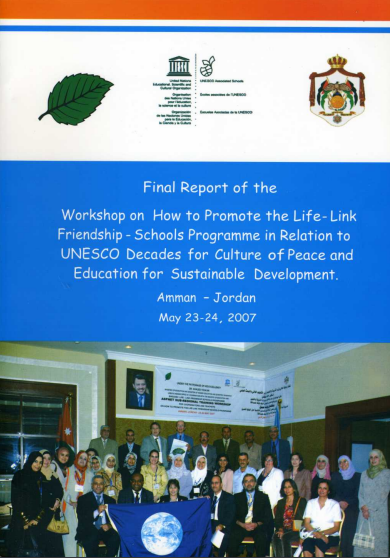 Final report of the workshop on how to promote the life-link friendship-schools programme in relation to UNESCO decades for culture of peace and education for sustainable development, Amman, Jordan, May 23-24, 2007 Año de publicación: 2007 Autor corporativo: UNESCO Amman This chapter provides a brief summary of the speeches presented at the official opening and closing ceremonies as well as presentations delivered by the experts of Life-Link and UNESCO staff at the two day workshop The sub-regional workshop for ASPnet National Coordinators and Life-Link Friendship Schools Programme, organized in close collaboration with the Ministry of Education, was constructed according to the following format: (i). An organizing Committee was formed comprising of staff from the Ministry of Education and UNESCO Amman Office and Chairperson of Life-Link Programme. The committee oversaw the organization, preparation of documentation, venue, draft agenda, logistic and procedural aspects of the workshop. (ii). The selection of participants for the workshop was done by the National Commissions for UNESCO to Lebanon, Palestine, Iraq, Egypt, Oman and Jordan. The participating Arab Countries were selected by UNESCO Office-Amman and Life-Link. (iii).The selected participants comprised the National Coordinators and teachers for ASPnet in their countries. A member from Life-Link in Jordan was invited as an observer for the workshop. (iv).The resource persons (trainers) for the workshop were carefully selected on the basis of their expertise, experience and relevance to the main subjects of the workshop. The experts came from the Ministry of Education, Life-Link, UNESCO and UNRWA. (v). The format of the workshop was basically structured to firstly provide an overview and background of the Life-Link Friendship Schools Programme and ASPnet, followed by experts' presentations relevant to the main subjects of Life-Link Programme. The workshop also had three sessions of discussion on the different aspects of Life Link Programme. Participants were circulated to these sessions one after another. The workshop also had a session on how to plan for implementing peace actions as Extra Curricula Activities in schools. (vi). The ASPnet national workshop was organized under the patronage of his Excellency Dr. Khaled Toukan, the Minister of Education and the Minister of Higher Education & Scientific Research and Chairman of the Jordan National Commission for UNESCO. Rapport final de l'atelier sur la façon de promouvoir le programme de liaison de vie amitié écoles par rapport aux décennies UNESCO pour la culture de la paix et de l'éducation pour le développement durable, Amman, Jordanie, 23 au 24 mai 2007 Año de publicación: 2007 Autor corporativo: UNESCO Amman Ce chapitre présente un bref résumé des discours présentés lors de l'ouverture officielle et de clôture ainsi que les présentations faites par les experts de Life-Link et personnel de l'UNESCO à l'atelier de deux jours. L'atelier sous-régional pour réseau des coordonnateurs nationaux et de Life-Link Programme des Écoles Amitié, organisée en étroite collaboration avec le Ministère de l'éducation, a été construit selon le format suivant: (i). Un comité d'organisation a été formé, comprenant des membres du personnel du ministère de l'Education et le Bureau UNESCO à Amman et présidente programme Life-Link. Le comité a supervisé l'organisation, la préparation de la documentation, le lieu, le projet de l'ordre du jour, la logistique et les aspects procéduraux de l'atelier. (Ii). La sélection des participants de l'atelier a été fait par les Commissions nationales pour l'UNESCO au Liban, en Palestine, en Irak, en Egypte, à Oman et en Jordanie. Les pays arabes participants ont été sélectionnés par l'UNESCO Bureau-Amman et Life-Link. (Iii). Les participants sélectionnés comprennent les coordonnateurs nationaux et les enseignants pour Réseau dans leur pays. Un membre de la Life-Link en Jordanie a été invité à titre d'observateur à l'atelier. (Iv). Les personnes ressources (formateurs) pour l'atelier ont été soigneusement sélectionnés sur la base de leur expertise, de l'expérience et de la pertinence des principaux sujets de l'atelier. Les experts provenaient du ministère de l'Education, Life-Link, l'UNESCO et l'UNRWA. (V). Le format de l'atelier a été essentiellement structuré pour fournir d'abord une vue d'ensemble et contexte de Life-Link Programme Amitié Ecoles et Reseau, suivie par les présentations des experts compétents pour les sujets principaux programme Life-Link de. L'atelier a également eu trois séances de discussion sur les différents aspects du Programme Life Link. Les participants ont été distribués à ces sessions un après l'autre. L'atelier a également eu une séance sur la façon de planifier la mise en œuvre des actions de paix en tant Activités extra curricula dans les écoles. (Vi). L'atelier national a été organisé reseau sous le patronage de son excellence Dr. Khaled Toukan, Ministre de l'Éducation et le Ministre de l'Enseignement Supérieur et de la Recherche et Président de la Commission Nationale Jordanienne pour l'UNESCO Scientifique. Discours de M. Koïchiro Matsuura, Directeur général de l'UNESCO, à l'occasion de la Cérémonie de Remise du Prix UNESCO de l'Éducation pour la Paix 2008, UNESCO, 18 Septembre 2008 Año de publicación: 2008 Autor corporativo: UNESCO. Director-General, 1999-2009 (Matsuura, K.) This is an address by Address by Mr Koïchiro Matsuura, Director-General of UNESCO, on the occasion of the Award Ceremony for the UNESCO Prize for Peace Education 2008.
  Address by Mr Koïchiro Matsuura, Director-General of UNESCO, on the occasion of the Award Ceremony for the UNESCO Prize for Peace Education 2008; UNESCO, 18 September 2008 Año de publicación: 2008 Autor corporativo: UNESCO. Director-General, 1999-2009 (Matsuura, K.) This is an address by Address by Mr Koïchiro Matsuura, Director-General of UNESCO, on the occasion of the Award Ceremony for the UNESCO Prize for Peace Education 2008. Discours de M. Koïchiro Matsuura, Directeur Général de l'UNESCO, à l'occasion de la Cérémonie de remise du Prix UNESCO de l'éducation pour la paix 2008; UNESCO, 18 Septembre 2008 Año de publicación: 2008 Autor corporativo: UNESCO. Director-General, 1999-2009 (Matsuura, K.) Ceci est une adresse par adresse de M. Koïchiro Matsuura, Directeur général de l'UNESCO, à l'occasion de la Cérémonie de remise du Prix UNESCO de l'Éducation pour la Paix 2008.
  EDUCATION A LA CULTURE DE LA PAIX, AUX DROITS HUMAINS, A LA CITOYENNETE, A LA DEMOCRATIE ET A L’INTEGRATION REGIONALE MANUEL DE REFERENCE DE LA CEDEAO A L’USAGE DE LA FORMATRICE / DU FORMATEUR DE FORMATEURS/FORMATRICES Año de publicación: 2013 Autor corporativo: UNESCO Dakar | Economic Community of West African States (ECOWAS) The manual comprises seven modules dealing with the Culture of Peace and Conflict Management; Human Rights; Civism and Citizenship; Democracy and Good Governance; Gender and Development; Public Health, Environment and Sustainable Development; and Regional Integration. Each module has sub-themes with introductions, reference materials, general objectives to guide the trainer and generic pedagogical tables that are flexible enough to be adapted to available teaching resources in the different ECOWAS countries. It is also suitable and adaptable to the training of teachers involved in both formal and non-formal education delivery at different levels of teaching and learning. The ultimate goal of the Manual is to build a critical mass of ECOWAS citizens equipped with competent skills, not only for cognitive and psycho-motor domains of education, but also affective skills for positive values, attitudes and behaviors that promote peace, tolerance and peaceful co-existence of community citizens.
  Guide on Human Rights Education Curriculum Development Año de publicación: 2021 Autor: Cecilia Decara | Carol Rask | Felisa Tibbitts Autor corporativo: Danish Institute for Human Rights This document aims to bring conceptual clarity on human rights education and curriculum development and provide concrete suggestions on how to build human rights curricula ft for 21st century human rights challenges, while contributing to the realisation of the SDG goals and targets set by the international community.
  2023 Asia-Pacific Regional Global Citizenship Education (GCED): Network Activities Summary Report Año de publicación: 2023 Autor: Seek Ling Tan Autor corporativo: UNESCO Bangkok This is a summary report from the Global Citizenship Education (GCED) network activities in Asia-Pacific in 2023. The Asia-Pacific Regional Global Citizenship Education Network, spearheaded by UNESCO Bangkok and the Asia-Pacific Centre of Education for International Understanding (APCEIU), has illuminated the path to empower learners to become global citizens since its inception in 2018. In 2023, their journey was punctuated by significant milestones and a revitalized commitment to propel GCED across the region. This commitment is particularly evident in the key priority areas of advocacy, capacity building, learning/teaching materials, policy and research and the synergizing of regional collaboration towards Education 2030.
  School Convivencia : Reviewing the Concept (Psicoperspectivas; No. 18, Vol. 1) Año de publicación: 2019 Autor: Cecilia Fierro-Evans | Patricia Carbajal-Padilla Autor corporativo: Catholic University of Valparaíso. School of Psychology This article reports an effort to review the concept of school convivencia (peaceful coexistence, living together) in the Spanish context with the purpose of advancing into its clarification, and thus contributing to developing a common language in the Latin American region. The authors conduct a basic literature review oriented to identify the main theoretical approaches in the convivencia field. Subsequently, they analyze four studies focused in systematizing the prevailing approaches in the study of school convivencia. As a result, they propose a concept of convivencia from a social justice perspective adapted to education, and they operationalize it in three areas of school life: pedagogical-curricular, organizationaladministrative, and the socio-communitarian. This comprehensive notion of school convivencia may guide future research, educational initiatives, and school assessments in the convivencia field that may respond to the violence and pervasive social exclusion that exist in the Latin American region.