
Recursos
Exploren una amplia gama de recursos valiosos en GCED para profundizar su comprensión y promover su búsqueda, incidencia, enseñanza y aprendizaje.
1,187 resultados encontrados
 Education for sustainable development country guidelines for changing the climate of teacher education to address sustainability: putting transformative education into practice Año de publicación: 2011 Autor corporativo: UNESCO Jakarta This document on ESD Country Guidelines for TEIs is the result of the Regional Training Workshop Programme, titled “Developing Capacities of Teacher Education Institutions (TEIs) of Brunei Darussalam, Indonesia, Malaysia, Philippines and Timor-Leste in Reorienting Teacher Education to Address Sustainability” and has been developed by the five cluster countries of the UNESCO Office, Jakarta. The developed guidelines ultimately aim to reorient each country's curriculum, policies, standard practices and programmes to address sustainability and implement it in a tangible way. Although many idealistic descriptions of sustainability and sustainability education exist, faculties of education must decide which themes should receive particular focus and create their own guidelines and design criteria on this specific area. Therefore, these ESD Country Guidelines are significant initial steps to ensuring teacher education programmes fit the environmental, social, cultural and economic conditions and goals of each country's communities, regions and nations. Lignes directrices pour l'éducation au service du développement durable pour changer le climat de la formation des enseignants pour aborder la durabilité: mettre en pratique l'éducation transformatrice Año de publicación: 2011 Autor corporativo: UNESCO Jakarta Le présent document sur EDD pour les Institutions de Formations des Enseignants (IFE) est le résultat du Programme régional d'ateliers de formation intitulé «Développer les capacités des établissements d'enseignement de Brunei Darussalam, de l'Indonésie, de la Malaisie, des Philippines et du Timor-Leste pour réorienter la formation des enseignants pour la durabilité» et a été développé par les cinq pays du Bureau de l'UNESCO à Jakarta. Les lignes directrices élaborées visent en fin de compte à réorienter les programmes, les politiques, les pratiques et les programmes standard de chaque pays en vue d'aborder la durabilité et de la mettre en œuvre de façon tangible. Bien que de nombreuses descriptions idéalistes de la durabilité et de l'éducation en matière de durabilité existent, les facultés d'éducation doivent décider quels thèmes devraient recevoir une attention particulière et créer leurs propres lignes directrices et critères de conception dans ce domaine spécifique. Par conséquent, ces EDD directrices sont des étapes importantes pour assurer que les programmes de formation des enseignants correspondent aux conditions et aux objectifs environnementaux, sociaux, culturels et économiques des communautés, des régions et des nations de chaque pays. Globalising the school curriculum: gender, EFA and global citizenship education (RECOUP working paper 17) Año de publicación: 2008 Autor: Harriet Marshall | Madeleine Arnot Autor corporativo: Research Consortium on Educational Outcomes and Poverty (RECOUP) This paper aims to bring the school curriculum into the analysis of gender, education and development. There is a marked absence of discussion both in the academic field of development studies and in the political domain of educational policy making around Education for All about what is required of the school curriculum so that it could help promote gender equality. All too often national school curricula reproduce gender inequalities in the public and private sphere and sustain hegemonic male regimes on a national and global scale (Arnot, 2002). Curriculum research, however, can challenge these social messages embedded in curricular formations as well as raise deeper questions about whose forms of knowledge should be transmitted through official forms of schooling. Critical sociological research, for example, recognises the importance of the rules governing the access and redistribution of knowledge, and also the politics behind the selection, organisation and evaluation of legitimate knowledge through formal national educational institutions within developing economies and the impact these have on indigenous social stratifications. It can also critically assess new global interventions into the school curriculum whether in the name of economic progress, human rights or social justice. These global developments are controversial not least because of the challenge they represent to what has been considered the prerogative of national governments – to transmit its own selection of educational knowledge to its citizens, using its own contextualised pedagogic style. The study of national curricula therefore offers the possibility of exploring the equity dimensions of global–national and local educational interfaces and policy agendas. The paper has limited but hopefully valuable ambitions. It aims to initiate discussion of the curriculum in relation to gender, education and development by exploring the global significance of recent interventions on gender, and in particular girls’ education. The first section briefly considers the implications of globalisation as a transformative process on the development of educational knowledge and queries whether the school curricula could address persistent worldwide gender disparities, inequalities and female subjugation. In the second section, we focus specifically on whether new global declarations around gender equality such as those analysed in the UNESCO Education for All Global Monitoring Reports imply certain roles for the school curriculum. The final section addresses the possibilities for gender equality implied by recent interest global citizenship education – a new curriculum subject and approach that promises much. We consider in a preliminary way whether these new developments represent a move towards forms of educational knowledge that are critical rather than legitimating and ‘normalising’ in relation to gender inequalities. Mondialiser le programme scolaire: le sexe, l'EPT et L'éducation à la Citoyenneté Mondiale (ECM) (papier de travail 17) Año de publicación: 2008 Autor: Harriet Marshall | Madeleine Arnot Autor corporativo: Research Consortium on Educational Outcomes and Poverty (RECOUP) Ce document vise à amener le programme scolaire dans l'analyse de genre, l'éducation et le développement. Il y a une absence marquée de la discussion à la fois dans le domaine académique des études de développement et dans le domaine politique de la politique en matière d'éducation autour de l'éducation pour tous à propos de ce qui est requis du programme scolaire afin qu'il puisse aider à promouvoir l'égalité des sexes. Tous les programmes scolaires nationaux trop souvent reproduisent les inégalités entre les sexes dans le domaine public et privé et de soutenir les régimes de sexe masculin hégémonique à l'échelle nationale et mondiale (Arnot, 2002). la recherche des programmes, cependant, ne peut contester ces messages sociaux intégrés dans les formations scolaires ainsi que soulever des questions plus profondes sur dont les formes de connaissances doivent être transmises par le biais des formulaires officiels de scolarité. recherche sociologique critique, par exemple, reconnaît l'importance des règles régissant l'accès et la redistribution des connaissances, ainsi que la politique derrière la sélection, l'organisation et l'évaluation des connaissances légitimes par les institutions éducatives nationales officielles dans les économies en développement et de l'impact qu'elles ont sur autochtones stratifications sociales. Il peut également évaluer de façon critique les nouvelles interventions mondiales dans le programme scolaire que ce soit au nom du progrès économique, les droits de l'homme ou de la justice sociale. Ces développements mondiaux sont controversés pas moins à cause du défi qu'ils représentent pour ce qui a été considéré comme la prérogative des gouvernements nationaux - de transmettre sa propre sélection de connaissances sur l'éducation de ses citoyens, en utilisant son propre style pédagogique contextualisée. L'étude des programmes nationaux offre donc la possibilité d'explorer les dimensions d'équité des interfaces éducatives globales nationales et locales et les agendas politiques. Le papier a des ambitions limitées mais nous espérons précieux. Il vise à engager un débat sur le programme d'études en fonction du sexe, de l'éducation et le développement en explorant l'importance mondiale des récentes interventions sur le sexe, et en particulier l'éducation des filles. La première section examine brièvement les implications de la mondialisation comme un processus de transformation sur le développement des connaissances et des requêtes si les programmes scolaires pourraient remédier aux disparités persistantes entre les sexes dans le monde, les inégalités et la subordination des femmes de l'éducation. Dans la deuxième section, nous nous concentrons particulièrement sur le fait de nouvelles déclarations globales autour de l'égalité des sexes, tels que ceux analysés dans UNESCO sur l'Education pour tous rapports globaux Suivi impliquent certains rôles pour le programme scolaire. La dernière section porte sur les possibilités d'égalité entre les sexes impliqués par l'intérêt récent L'éducation à la citoyenneté Mondiale (ECM) - un nouveau sujet de curriculum et de l'approche qui promet beaucoup. Nous considérons de façon préliminaire si ces nouveaux développements représentent une évolution vers des formes de connaissances pédagogiques qui sont essentielles plutôt que légitimant et «normalisation» par rapport aux inégalités entre les sexes. Repositioning and reconceptualizing the curriculum for the effective realization of Sustainable Development Goal Four, for holistic development and sustainable ways of living Año de publicación: 2015 Autor corporativo: UNESCO International Bureau of Education (IBE) The purpose of this discussion paper is two-fold, it is to reposition curriculum at the center of the national and the global development dialogue and to highlight its power to give effect to national and to global aspirational statements on the role of education in holistic development. When well designed and effectively enacted, curriculum determines the quality, inclusiveness and development-relevance of education.Second, is to reconceptualize curriculum as a fundamental force of integration of education systems and as an operational tool for giving effect to policies on lifelong learning. Curriculum leads all core aspects of education that are known to determine quality, inclusion, and relevance such as content, learning, teaching, assessment and the teaching and learning environments among others. Its horizontal and vertical articulation, as well as its articulation across learning settings is what gives effect to lifelong learning policies.This paper therefore seeks to reposition curriculum as an indispensable tool for giving effect to SDG Goal 4. Repositionnement et reconceptualiser le programme d'études pour l'utilisation Efficace du Développement Durable Objectif Quatre, pour le développement holistique et modes de vie durables Año de publicación: 2015 Autor corporativo: UNESCO International Bureau of Education (IBE) Le but de ce document de travail est double, il est de repositionner curriculum au centre national et le dialogue mondial du développement et de mettre en évidence son pouvoir pour donner effet aux nationaux et aux états ambitieux mondiaux sur le rôle de l'éducation dans le développement holistique . Quand bien conçu et efficacement adopté, le curriculum détermine la qualité, l'inclusion et le développement-pertinence de l'éducation. Deuxièmement, il faut reconceptualiser programme comme une force fondamentale de l'intégration des systèmes d'éducation et comme un outil opérationnel pour donner effet aux politiques sur l'apprentissage continu. Curriculum conduit tous les aspects essentiels de l'éducation qui sont connus pour déterminer la qualité, l'inclusion et la pertinence tels que le contenu, l'apprentissage, l'enseignement, l'évaluation et l'enseignement et des environnements d'apprentissage entre autres. Son articulation horizontale et verticale, ainsi que son articulation dans tous les milieux d'apprentissage est ce qui donne effet aux politiques d'apprentissage continu. Ce document vise donc à repositionner programme comme un outil indispensable pour donner effet à ODD Objectif 4.
  Sharing Malaysian experience in participation of girls in STEM education Año de publicación: 2016 Autor corporativo: UNESCO International Bureau of Education (IBE) The Malaysia government has placed STEM as a focus in developing the country towards achieving the status of a developed nation. The government acknowledges the role of women as equal partners in nation building. Thus, various policies ranging from economy, education, women’s welfare and human resources have been formulated through the years. These policies have resulted in among others, the increase in women researchers from 35.8% in 2004 to 49.9% in 2012 as well as more women’s participation in selected STEM courses at the tertiary level. A total of 84 girls’ day schools with 6 of them as residential STEM Girls’ schools have been built since 1939. There are many female role models in STEM for the girls to emulate. This has been made possible by the successful implementation of the various policies related to women in STEM as well as innovative measures in facing the continuing challenges in STEM education.
  Ten Clues for Rethinking Curriculum (In-Progress Reflection; No. 42, 2021) Año de publicación: 2021 Autor: Renato Opertti Autor corporativo: UNESCO International Bureau of Education (IBE) This discussion document highlights the urgency of rethinking curriculum in light of reinforcing the commitments of the Education 2030 Agenda on learning, disruptive systemic worldwide societal changes, and crucially, the profound transformation of education and education systems post Covid-19. Curriculum is always at the core of giving effect to social aspirations and ideals on the why, what, how, when, and where of teaching, learning, and assessing. We propose a series of 10 interconnected clues to deepen on the systemic and holistic understanding of curriculum as contributing to lay foundations for a better, sustainable and fair future. These clues are: understanding the new generations; combatting factors related to vulnerability; reinforcing understanding between school and families; deepening glo-local education; enhancing the focus on the person; promoting synergies among values; valuing diversity; focusing on education that enhances freedom; moving toward hybrid modes of education; and inspiring affection for educators.
 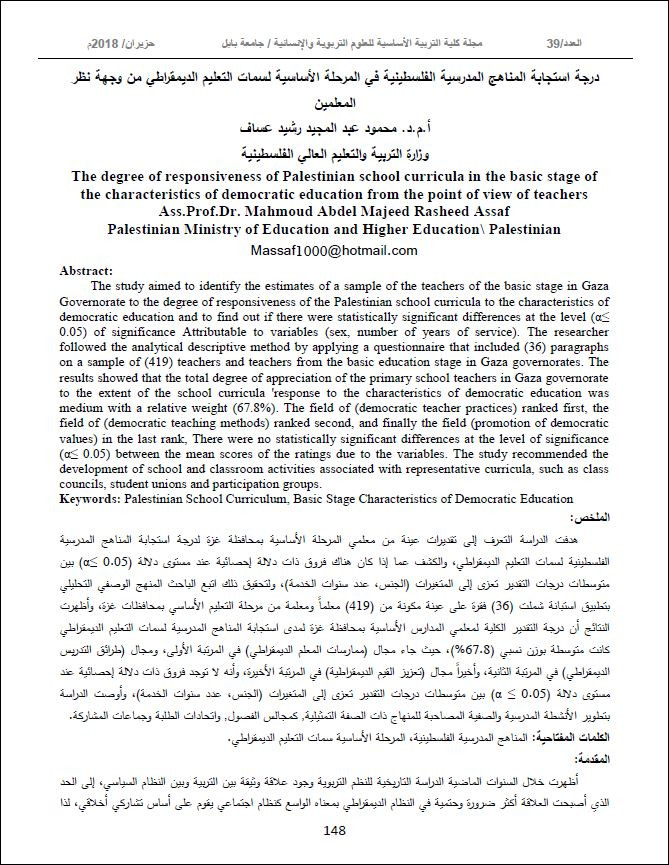 The Degree of Responsiveness of Palestinian School Curricula in the Basic stage of the Characteristics of Democratic Education from the Point of View of Teachers Año de publicación: 2018 Autor: Mahmoud Abdel Majeed Rasheed Assaf Autor corporativo: University of Babylon The study aimed to identify the estimates of a sample of the teachers of the basic stage in Gaza Governorate to the degree of responsiveness of the Palestinian school curricula to the characteristics of democratic education and to find out if there were statistically significant differences at the level (α≤ 0.05) of significance Attributable to variables (sex, number of years of service). The researcher followed the analytical descriptive method by applying a questionnaire that included (36) paragraphs on a sample of (419) teachers and teachers from the basic education stage in Gaza governorates. The results showed that the total degree of appreciation of the primary school teachers in Gaza governorate to the extent of the school curricula 'response to the characteristics of democratic education was medium with a relative weight (67.8%). The field of (democratic teacher practices) ranked first, the field of (democratic teaching methods) ranked second, and finally the field (promotion of democratic values) in the last rank, There were no statistically significant differences at the level of significance (α≤ 0.05) between the mean scores of the ratings due to the variables. The study recommended the development of school and classroom activities associated with representative curricula, such as class councils, student unions and participation groups. درجة استجابة المناهج المدرسية الفلسطينية في المرحلة الأساسية لسمات التعليم الديمقراطي من وجهة نظرالمعلمين Año de publicación: 2018 Autor: Mahmoud Abdel Majeed Rasheed Assaf Autor corporativo: University of Babylon هدفت الدراسة التعرف إلى تقديرات عينة من معلمي المرحلة الأساسية بمحافظة غزة لدرجة استجابة المناها المدرسية الفلسطينية لسمات التعليم الديمقراطي، والكشف عما إذا كان هنالك فروق ذات دالة إحصائية عند مستوى دالة (05.0≤ α (بين متوسطات درجات التقدير تعزى إلى المتغيرات )الجنس، عدد سنوات الخدمة(، ولتحقيق ذلل اتبع الباحث المنها الوصفي التحليلي بتطبيق استبانة شملت )36 )فقرة على عينة مكونة من )419 )معلما ومعلمة من مرحلة التعليم الأساسي بمحافظات غزة، وأظهرت النتائج أن درجة التقدير الكلية لمعلمي المدارس الأساسية بمحافظة غزة لمدى استجابة المناها المدرسية لسمات التعليم الديمقراطي كانت متوسطة بوزن نسبي )8.67 ،)%حيث جاء مجال )ممارسات المعلم الديمقراطي( في المرتبة الأولى، ومجال )طرائق التدريس وأخي ار مجال )تعزيز القيم الديمقراطية( في المرتبة الأخيرة، وأنث ال توجد فروق ذات دالة إحصائية عند الديمقراطي( في المرتبة الثانية، مستوى دالة (05.0 ≤ α (بين متوسطات درجات التقدير تعزى إلى المتغيرات )الجنس، عدد سنوات الخدمة(، وأوصت الدراسة بتطوير الأنشطة المدرسية والصفية المصاحبة للمنهاج ذات الصفة التمثيلية, كمجالس الفصول, واتحادات الطلبة وجماعات المشاركة.