
Recursos
Exploren una amplia gama de recursos valiosos en GCED para profundizar su comprensión y promover su búsqueda, incidencia, enseñanza y aprendizaje.
2 resultados encontrados
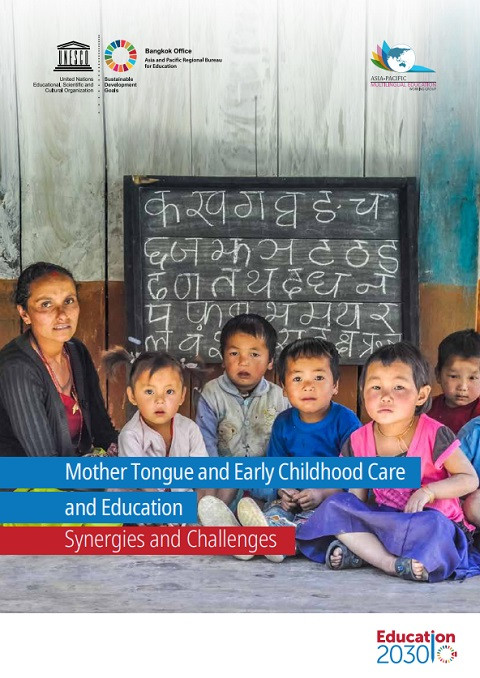 Mother Tongue and Early Childhood Care and Education: Synergies and Challenges Año de publicación: 2020 Autor: Sheldon F. Shaeffer Autor corporativo: UNESCO Bangkok Evidence tells us that learning first in one’s MT leads to better outcomes in the future – for individuals, cultures, and nations. But MT is used rarely in ECCE programmes and the early grades of primary school so that many children are forced to learn in a language they poorly understand, and in an environment which neglects and even represses their cultural identity and the language which “carries” it. Evidence also tells us that good quality ECCE programmes enhance the well-being of young children. But many governments spend few resources on ECCE and put very little effort into creating a developmentally and linguistically appropriate curriculum and pedagogy for young pre-school children. The challenge is that while the most disadvantaged children benefit the most from ECCE programmes, these children participate in them the least. Thus, for both cultural and educational reasons, and as a child’s right, ECCE and initial literacy should be provided in a child’s MT, and actions can be taken at both macro- and micro-levels to ensure that this is achieved. In other words, the long and often difficult process of revitalising, maintaining, and further developing endangered languages of indigenous peoples must begin first in families and communities – but then must continue into ECCE programmes and into the wider education system. Without this, indigenous, minority languages and cultures will never thrive – and many will not survive.
  Media and Information Literacy Education in Asia: Exploration of Policies and Practices in Japan,Thailand, Indonesia, Malaysia, and the Philippines Año de publicación: 2020 Autor: Masato Kajimoto | Phansasiri Kularb | Bobi Guntarto | Sabariah Mohamed Salleh | Therese Patricia S. Torres | Guillian Mae C. Palcon | Ramon Tuazon Autor corporativo: UNESCO This book looked at the current media and information literacy education policies and teaching practices in formal and informal settings. It explores how MIL could address emerging and pressing problems such as political extremism, false news, online harassment and discrimination in Indonesia, Japan, Malaysia, the Philippines, and Thailand.