
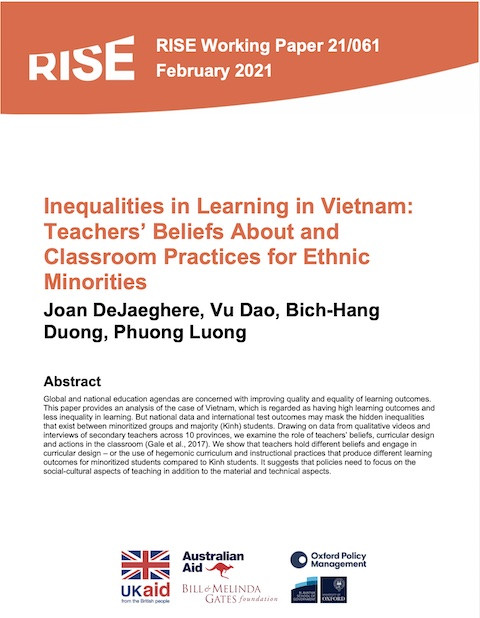
Inequalities in Learning in Vietnam: Teachers’ Beliefs About and Classroom Practices for Ethnic Minorities (RISE Working Paper Series; 21/061)
- Auteur institutionnel
- Research on Improving Systems of Education (RISE)
- Collation
- 32 p.
- Langue de la ressource
- Anglais
- Année de publication
- 2021
- Thème
- Mondialisation et justice sociale / Compréhension internationaleDiversité / Compétence culturelle / Inclusion
- Type de ressource
- Research papers / journal articles
- Niveau d’éducation
- Enseignement secondaire
- Région
- Asie et Pacifique
- Lieu de publication
- Oxford
Global and national education agendas are concerned with improving quality and equality of learning outcomes. This paper provides an analysis of the case of Vietnam, which is regarded as having high learning outcomes and less inequality in learning. But national data and international test outcomes may mask the hidden inequalities that exist between minoritized groups and majority (Kinh) students. Drawing on data from qualitative videos and interviews of secondary teachers across 10 provinces, we examine the role of teachers’ beliefs, curricular design and actions in the classroom (Gale et al., 2017). We show that teachers hold different beliefs and engage in curricular design – or the use of hegemonic curriculum and instructional practices that produce different learning outcomes for minoritized students compared to Kinh students. It suggests that policies need to focus on the social-cultural aspects of teaching in addition to the material and technical aspects.
Ressources associées
-
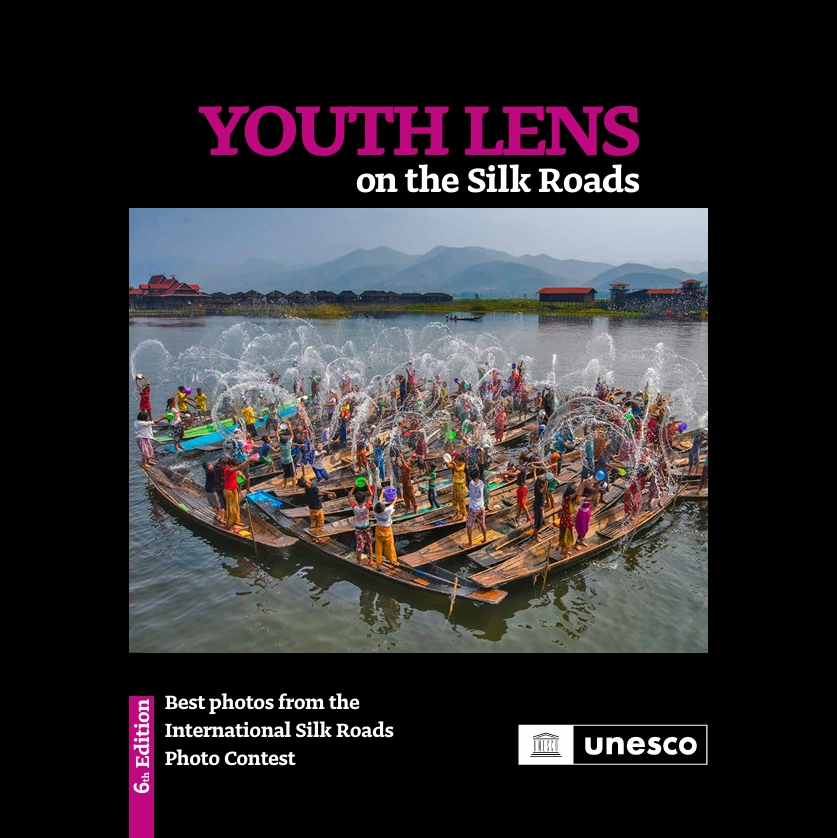 Youth Lens on the Silk Roads: Best Photos from the International Silk Roads Photo Contest; 6th Edition
 -
 Addressing Violent Pasts through Education: A Policy Guide
 -
 UNESCO Framework for Culture and Arts Education: Implementation Guidance
 -
 The Representation of Jews, Judaism and Antisemitism in School Textbooks and Curricula in Europe