
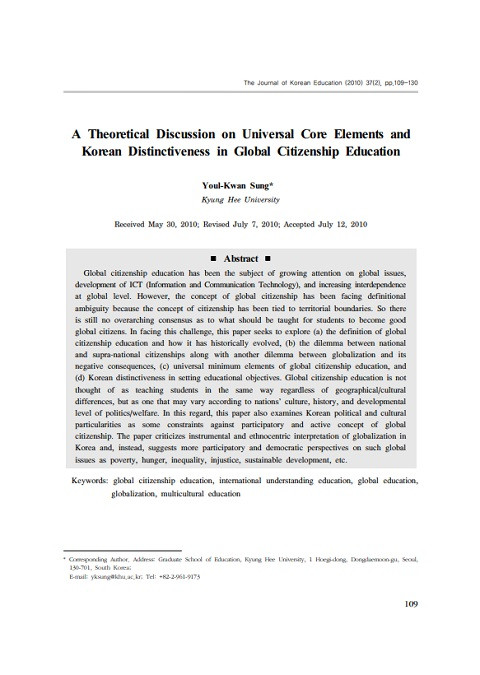
A Theoretical Discussion on Universal Core Elements and Korean Distinctiveness in Global Citizenship Education (The Journal of Korean Education; Vol. 37, No. 2)
- Auteur
- Youlkwan Sung
- Auteur institutionnel
- Korean Educational Development Institute (KEDI)
- ISBN
- ISSN 1599-2659
- Collation
- p.109-130
- Langue de la ressource
- Coréen
- Année de publication
- 2010
- Thème
- Civisme / Citoyenneté / DémocratieDiversité / Compétence culturelle / InclusionMondialisation et justice sociale / Compréhension internationale
- Type de ressource
- Research papers / journal articles
- Niveau d’éducation
- Enseignement primaireEnseignement secondaire
- Région
- Asie et Pacifique
- Lieu de publication
- Jincheon
Global citizenship education has been the subject of growing attention on global issues, development of ICT (Information and Communication Technology), and increasing interdependence at global level. However, the concept of global citizenship has been facing definitional ambiguity because the concept of citizenship has been tied to territorial boundaries. So there is still no overarching consensus as to what should be taught for students to become good global citizens. In facing this challenge, this paper seeks to explore (a) the definition of global citizenship education and how it has historically evolved, (b) the dilemma between national and supra-national citizenships along with another dilemma between globalization and its negative consequences, (c) universal minimum elements of global citizenship education, and (d) Korean distinctiveness in setting educational objectives. Global citizenship education is not thought of as teaching students in the same way regardless of geographical/cultural differences, but as one that may vary according to nations' culture, history, and developmental level of politics/welfare. In this regard, this paper also examines Korean political and cultural particularities as some constraints against participatory and active concept of global citizenship. The paper criticizes instrumental and ethnocentric interpretation of globalization in Korea and, instead, suggests more participatory and democratic perspectives on such global issues as poverty, hunger, inequality, injustice, sustainable development, etc.
Ressources associées
-
 IIEP-UNESCO 12th Medium-Term Strategy: 2026–2029
 -
 Youth Lens on the Silk Roads: Best Photos from the International Silk Roads Photo Contest; 6th Edition
 -
 Advancing Intergenerational Learning: Identifying Challenges and Opportunities for Older Adults; Integrated Case Study Report
 -
 Digital Empowerment for Lifelong Learning and Transformative Andragogy (DELTA) for Adult Educators: Introduction to the DELTA Framework and Resources